


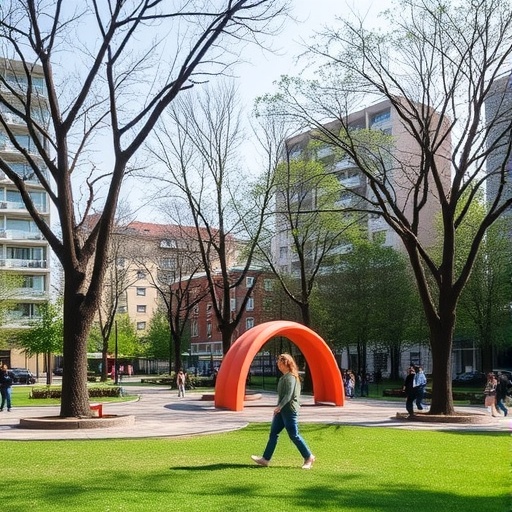
Urban green spaces are often celebrated as havens of tranquility and safety amidst bustling cityscapes. Conventional wisdom holds that lush greenery, particularly ample tree cover, contributes to a sense of security for urban dwellers. However, a groundbreaking study published in npj Urban Sustainability challenges this assumption, demonstrating that physical and social disorder within these spaces, rather than tree density, critically undermines perceived safety. This revelation has profound implications for urban planning and public health, urging cities worldwide to pivot their focus towards managing disorder to foster safer communal spaces.
The research, authored by Berdejo-Espinola, Fuller, and Zahnow, confronts the deeply entrenched narrative that greenery alone enhances the safety of urban environments. Using sophisticated analytical methods, the study disentangles the complex factors that influence how people perceive the risk of harm while in green spaces. Contrary to expectations, it finds that the presence of well-maintained tree cover does not statistically enhance feelings of security. Instead, the presence of physical decay—such as litter, graffiti, vandalism—and social disorder—manifested by loitering or disruptive behaviors—significantly diminishes perceived safety.
This paradigm shift builds on theories rooted in environmental psychology and urban sociology. The “broken windows theory,” which posits that visible signs of disorder and neglect invite crime and anti-social behavior, underpins the investigation. The study operationalizes disorder through a composite framework examining indicators like damaged infrastructure, presence of garbage, and signs of public intoxication or groups engaging in threatening activities. By correlating these disorder markers with safety perception surveys, the authors illuminate the psychological mechanisms engendered by dereliction and chaos.
Methodologically, the research harnesses a multi-city, large-scale dataset combining observational audits with self-reported feelings of safety. Participants traversed diverse urban green spaces—ranging from small pocket parks to expansive forested reserves—across multiple demographic and socioeconomic contexts. Geospatial analysis techniques and multivariate regression models isolate the unique contributions of disorder and tree cover on safety perceptions, controlling for confounders such as time of day, lighting, and neighborhood crime rates.
One fascinating finding is how social disorder, particularly the presence of groups exhibiting aggressive or disruptive behaviors, profoundly escalates fear levels among visitors. This finding challenges planners to refine surveillance and community engagement strategies rather than merely planting more trees. Moreover, physical disorder’s detrimental effects highlight the necessity of routine maintenance and rapid repair protocols to sustain environmental cues that signal care and vigilance.
The implications extend into public health domains, as perceived safety directly affects the willingness to utilize green spaces for recreation, exercise, and social interaction. When individuals feel unsafe, they retreat indoors, exacerbating sedentary lifestyles and diminishing the mental health benefits typically afforded by access to nature. Therefore, managing disorder translates into not only safer but healthier and more inclusive urban ecosystems.
Importantly, the study also explores demographic variations, revealing that women, older adults, and minority groups often experience heightened sensitivity to disorder, reinforcing existing inequalities in access to safe outdoor environments. These findings necessitate equity-focused interventions that prioritize inclusive design and community-led stewardship to cultivate trust and shared responsibility.
Furthermore, the research critiques reliance on increasing tree canopy goals as isolated policy measures. While urban forestry is vital for ecosystem services—such as air quality improvement and temperature regulation—the findings advocate for integrated strategies combining ecological enhancement with social and institutional mechanisms to manage disorder effectively.
The authors suggest several practical pathways. These include deploying well-trained park wardens, fostering neighborhood watch programs, enhancing lighting and sight lines, and promoting public art and beautification projects to counteract signs of neglect. Community involvement emerges as a cornerstone, empowering residents to co-create green spaces that feel safe, maintained, and welcoming.
While the study acknowledges limitations related to the subjective nature of perceived safety and the contextual variability of disorder manifestations, its robust analytical approach provides compelling evidence to shift urban sustainability dialogues. It serves as a clarion call to reimagine green space design and governance through a lens that prioritizes social cohesion and upkeep as much as environmental aesthetics.
In conclusion, this research marks a pivotal advancement in understanding what makes urban green spaces truly safe from the perspective of their users. Physical and social disorder represent formidable barriers to safety perceptions, overshadowing the benign influence of tree cover alone. Urban policymakers, planners, and communities must embrace holistic frameworks that integrate environmental stewardship with vigilant management of disorder to unlock the full potential of urban nature for all citizens.
The insights contained in this study have the potential to reshape urban sustainability policies worldwide, inspiring new initiatives that balance ecological goals with nuanced social realities. As cities continue to grow and densify, ensuring equitable access to safe, thriving green spaces will be paramount to fostering resilient, healthy, and vibrant urban populations. This work underscores the power of interdisciplinary research to unravel complexities and inform actionable solutions in the quest for urban well-being.
Cite Scienmag News
Courtney Benton. (March 19, 2026). Disorder, Not Trees, Lowers Safety in Urban Parks. Scienmag. https://scienmag.com/disorder-not-trees-lowers-safety-in-urban-parks/
Courtney Benton. "Disorder, Not Trees, Lowers Safety in Urban Parks." Scienmag, 19 March 2026, https://scienmag.com/disorder-not-trees-lowers-safety-in-urban-parks/. Accessed 4 September 2026.
Courtney Benton. "Disorder, Not Trees, Lowers Safety in Urban Parks." Scienmag. March 19, 2026. https://scienmag.com/disorder-not-trees-lowers-safety-in-urban-parks/


