


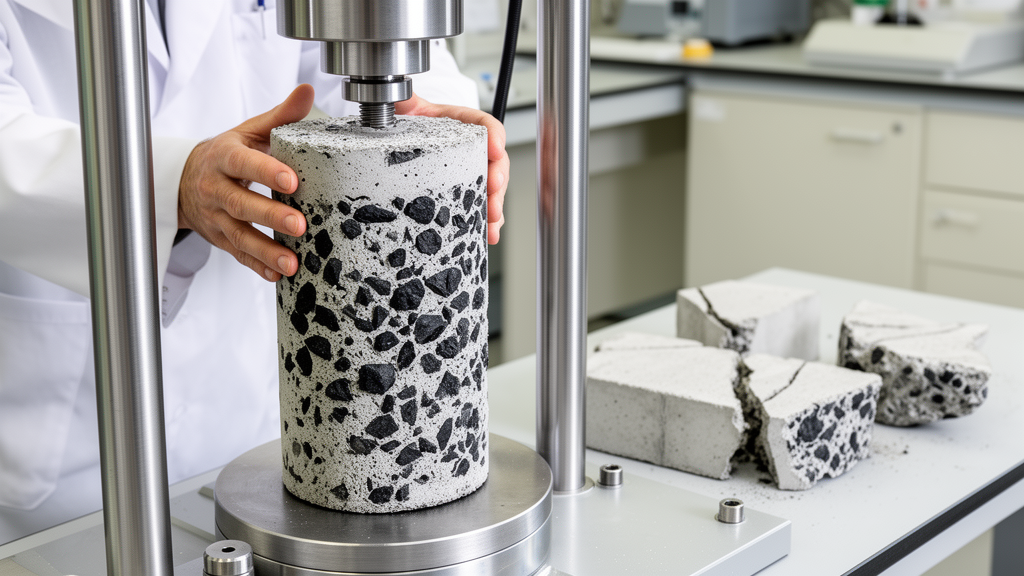
Laboratory tests and numerical simulations found that weathered coal gangue treated with cement paste and a lithium-based curing agent could replace part of the aggregate in mining-area pavement concrete while meeting the study’s secondary-road strength criteria. The largest tested replacement range extended from 2.36 to 19.0 mm and produced 28-day compressive, splitting tensile and flexural strengths of 27.81, 2.13 and 4.67 MPa, respectively. This was a materials study involving concrete specimens and calibrated models, not a field trial, so the results apply to the tested mixtures and curing conditions rather than establishing long-term pavement performance.
The researchers used weathered coal gangue that had been stored in the open air for two years at the Jilin Coal Energy Reserve Base in China. The particles were light gray, rough, loosely structured and unevenly graded, with most concentrated in the 9.5–19.0 mm range. Untreated material had a crushing index of 23.96%, above the 20% limit for Class II crushed stone specified in GB/T 14685-2022, and was therefore considered unsuitable for direct use as a pavement-concrete aggregate. Its other measured properties were a 28.61% Los Angeles wear rate, 24.86% firmness index, 84.32 kgf/mm² Vickers hardness and 7.32% aggregate impact value.
The treatment combined a physical cement coating with chemical hardening. Cement paste was prepared at a water-to-cement ratio of 0.75, and 1.5% magnesium aluminum silicate was added to stabilize the paste and suppress bleeding. Weathered gangue was mixed into the paste for two minutes, soaked for 30 minutes, removed and air-dried for two days. A water-based lithium-based curing agent, diluted at a curing-agent-to-water ratio of 1:2, was then sprayed evenly over the particle surfaces. After another 30 minutes of room-temperature drying, the material was cured for 28 days. The agent’s lithium silicate can react with calcium hydroxide in the cement coating to form calcium silicate hydrate, while cement reactions can produce calcium silicate hydrate and calcium aluminate hydrate on and beneath the aggregate surfaces.
After consolidation and 28 days of curing, the gangue’s crushing index declined from 23.96% to 16.05%, placing it below the cited Class II threshold. Vickers hardness rose from 84.32 to 141.43 kgf/mm², Los Angeles wear loss fell from 28.61% to 19.88%, and the aggregate impact value declined from 7.32% to 5.66%. These laboratory measurements showed greater hardness and resistance to wear and impact-induced fragmentation. Density increased from 2.4751 to 2.619 g/cm³, while water absorption rose slightly from 4.32% to 4.82%, meaning that the treatment strengthened the particles without removing their porous character.
To examine how particle size affected concrete behavior, the team prepared one natural-stone control and four mixtures in which consolidated weathered gangue progressively replaced conventional aggregate over wider size intervals. The Fuller target gradation contained 0–2.36, 2.36–4.75, 4.75–9.50, 9.50–19.0 and 19.0–31.5 mm fractions. The gangue mixtures cumulatively replaced conventional aggregate through 2.36–4.75, 2.36–9.50, 2.36–19.0 and 2.36–31.5 mm, representing 11.46%, 27.55%, 50.29% and 72.63% of the total aggregate. The 0–2.36 mm fraction was not replaced, and the study did not separately test different replacement ratios within an individual size fraction.
Each mixture and specimen type included four replicates, with reported values and force–displacement data calculated as arithmetic means. According to GB/T 50081-2019, 100 mm cubes were used for compressive and shear testing, 150 mm cubes for splitting tensile testing and 100 by 100 by 400 mm prisms for flexural testing. The pavement mix contained 315 kg/m³ of cement, 120 kg/m³ of water, 1% water-reducing admixture, 632 kg/m³ of fine aggregate and 1,283 kg/m³ of coarse aggregate. Specimens were tested after 28 days, using a loading rate of 0.5 MPa/s for compression and shear and 0.05 MPa/s for splitting tension and flexure.
Under the study’s secondary-road criteria, the maximum admissible replacement extended from 2.36 to 19.0 mm. At that setting, the concrete achieved 27.81 MPa compressive strength, 2.13 MPa splitting tensile strength, 4.67 MPa flexural strength, 2.93 MPa cohesion and an internal friction angle of 66.20°. Replacing only the 2.36–4.75 mm fraction yielded flexural and splitting tensile strengths of 5.24 and 3.13 MPa, compared with 5.22 and 3.08 MPa in the control. Because the splitting-strength difference was only about 1.6% and the error bars overlapped, the researchers interpreted it as essentially unchanged. The 2.36–9.50 mm mixture also retained 5.18 MPa flexural strength, above the study’s heavy- and higher-traffic criterion of more than 5.0 MPa.
Mechanical performance generally weakened as larger gangue fractions entered the concrete. Splitting tensile strength was 2.78 MPa for the 2.36–9.50 mm replacement, 2.13 MPa for 2.36–19.0 mm and 1.52 MPa for replacement through 31.5 mm. The latter two values represented reductions of 30.8% and 50.6% relative to the unreplaced control. Flexural strength fell to 3.44 MPa in the fully replaced mixture, 34.1% below the control. The researchers associated the reductions with the lower strength and higher porosity of coarse gangue, which promoted aggregate fracture and stress concentration. They also observed that gangue absorbed water during curing, potentially lowering the local water-to-cement ratio and strengthening the aggregate–mortar bond.
Failure morphology changed alongside the strength measurements. Natural-aggregate concrete developed an X-shaped fracture that began near the corners and propagated through interfacial transition zones, or ITZs, toward the center. In gangue mixtures, cracks increasingly traveled through the gangue as well as the ITZ and mortar, and the overall response became more plastic. Under full replacement, the outermost large gangue particles failed first, after which damage progressed inward. Splitting-tensile failure displacement decreased from 10.43 mm in the control to 4.19 mm in the fully replaced group, indicating reduced deformation capacity. Cohesion declined from 4.23 MPa in the control to 1.75 MPa at full replacement, while the internal friction angle increased to 71.43°; the authors noted that this occurred alongside deterioration in other mechanical properties.
A two-dimensional finite-element model represented the 100 mm compression specimens with 40,000 CPS4R elements and four material phases: gravel, mortar, consolidated gangue and a weakened ITZ. Simulated compressive strengths exceeded the corresponding laboratory means by 5.61–10.68%. For example, the model estimated 44.62 MPa for the control, compared with a measured mean of 41.32 MPa, and 23.68 MPa at full replacement, compared with 21.41 MPa. The study attributes the difference partly to the idealized model, which does not reproduce specimen unevenness and machine error and cannot fully capture thickness-direction behavior, lateral diffusion or all cracking effects. Despite these limitations, the simulations reproduced the observed shift in failure location and crack path.
At the maximum replacement range of 2.36–19.0 mm, the model indicated that natural aggregate in the 19.0–31.5 mm fraction carried 58.31% of the stress contribution. The corresponding shares were 22.88% for 9.50–19.0 mm, 13.43% for 4.75–9.50 mm and 5.38% for 2.36–4.75 mm. Mean stress was 22.54 MPa in the largest natural-stone fraction, compared with 9.30, 9.77 and 9.68 MPa in the progressively smaller fractions. The analysis supports a gradual replacement strategy under the tested conditions: consolidated weathered gangue can occupy smaller aggregate fractions while the largest conventional stones provide much of the modeled load-bearing capacity. Durability under traffic, repeated loading, environmental exposure and field-scale construction was not evaluated, leaving those questions beyond the evidence presented by this laboratory study.
Subject of Research: Mechanical performance of mining-area pavement concrete containing consolidated weathered coal gangue
Article Title: Mechanical behaviors of weathered coal gangue filled concrete pavement based on surface solidification
Article References: Li, Y., Guo, W., Miao, X., Tao, X., Wang, Q., Zhang, J., Chen, W., & Wei, Z. (2026). Mechanical behaviors of weathered coal gangue filled concrete pavement based on surface solidification. Frontiers in Materials, 13, Article 1954367. https://doi.org/10.3389/fmats.2026.1954367
Image Credits: AI Generated
DOI: 10.3389/fmats.2026.1954367
Keywords: weathered coal gangue, concrete pavement, surface consolidation, lithium silicate, recycled aggregate, compressive strength, flexural strength, failure modes, finite-element simulation, mining infrastructure, Mechanical, behaviors
Cite Scienmag News
Denise Maddox. (October 21, 2026). Laboratory tests assess consolidated coal gangue in mining-area pavement concrete. Scienmag. https://scienmag.com/laboratory-tests-assess-consolidated-coal-gangue-in-mining-area-pavement-concrete/
Denise Maddox. "Laboratory tests assess consolidated coal gangue in mining-area pavement concrete." Scienmag, 21 October 2026, https://scienmag.com/laboratory-tests-assess-consolidated-coal-gangue-in-mining-area-pavement-concrete/. Accessed 21 October 2026.
Denise Maddox. "Laboratory tests assess consolidated coal gangue in mining-area pavement concrete." Scienmag. October 21, 2026. https://scienmag.com/laboratory-tests-assess-consolidated-coal-gangue-in-mining-area-pavement-concrete/


