


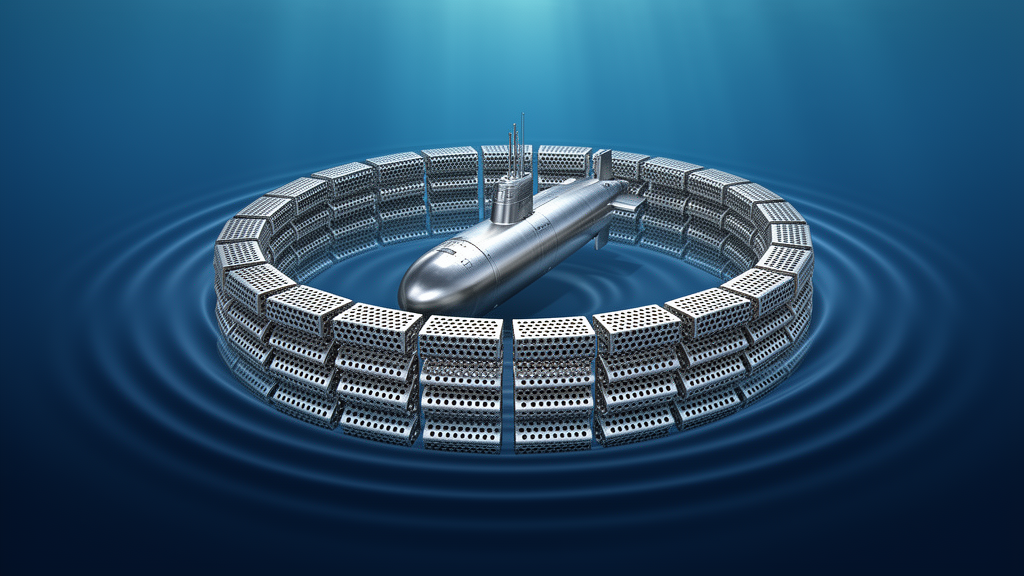
A square-lattice pentamode metamaterial was designed, simulated and fabricated as an underwater acoustic cloak for suppressing scattering around a concealed object. The study combined finite-element modelling with laboratory measurements; numerical results covered a broad frequency range, while the physical experiment tested a narrower band around the transducer response.
The researchers developed four aluminium unit-cell geometries with a 10 mm lattice constant. The selected Type 4 design combined rounded mass elements with curved connecting arms. Finite-element analysis showed that this geometry expanded the range in which transverse modes were suppressed and longitudinal modes propagated, approximately doubling the relevant band compared with the original configuration.
At a selected arm width of 0.5 mm, the structure had an effective mass density of 1,072 kg/m³ and bulk modulus of 2.44 GPa. These values were close to the water properties used in the modelling, while its effective shear modulus was 38.4 MPa. Simulations indicated that the structure behaved as a water-like medium at lower frequencies, with deviations appearing as the wavelength became comparable to the unit-cell dimensions.
The cloak comprised 11 unit cells along each axis and had dimensions of 110 by 110 by 20 mm. Four cell types supplied gradually varying effective properties, with mass widths decreasing linearly from 4.0 mm in the water-matched outer layer to 2.8 mm farther inward. This gradient was designed to redirect waves around a central square object with a side length of 21.2 mm.
In numerical tests, the cloak guided waves around the concealed region and produced less distortion than a comparable aluminium block. At 40 kHz, the total scattering cross section was 0.45 for the cloak, compared with 0.65 for the block. Across the reported angular analysis, the cloak’s average total scattering cross section was 0.3, versus 0.8 for the aluminium block. Simulations at 28 kHz also showed that the cloak could conceal circular and elliptical targets of comparable cross-sectional area.
A prototype was machined from 6061-T6 aluminium alloy using wire electrical discharge machining and sealed with polyurethane sheets. The 369 g sample was tested in a 100-litre water tank lined with acoustic absorbers. Ultrasonic transducers operated at 28 kHz, with the transmitter and receiver each positioned 22 cm from the target. Measurements were conducted from 20 to 30 kHz because excitation efficiency declined outside the transducer’s resonance range.
The researchers used transmittive target strength, rather than directly measuring total scattering cross section, to compare the cloak with an aluminium block and a reference condition without an object. Results were averaged from at least ten repetitions. The cloak’s transmittive target strength was close to zero across most tested frequencies, indicating that transmitted energy was restored relative to the blocked condition. Between 25 and 29 kHz, its average transmittive target strength was 8.5 dB higher than that of the aluminium block.
Additional simulations examined environmental effects. The calculated response remained broadly stable across salinities from 0 to 20 parts per thousand, although resonance peaks near 6–7 kHz appeared at higher salinity levels. Small changes in total scattering cross section were calculated over temperatures of 0–25°C. Under simulated hydrostatic pressure of 0.4 MPa, maximum von Mises stress was approximately 35 MPa, about half the stated 70 MPa yield strength of the aluminium.
The evidence supports effective scattering reduction in numerical models and improved transmission in a tank experiment over 25–29 kHz. It does not establish experimental performance across the full modelled 1–40 kHz range. The experiment also used a single prototype and a limited frequency interval, while the broader environmental and pressure findings were numerical or structural analyses rather than field demonstrations.
Subject of Research: Design, simulation and laboratory validation of a square-lattice pentamode acoustic cloak for underwater use
Article Title: Square-lattice pentamode metamaterial for acoustic cloaking: design and validation
Article References: Ahmadzadeh, F., & Bahrami, A. (2026). Square-lattice pentamode metamaterial for acoustic cloaking: design and validation. Results in Engineering, 32, Article 113611. https://doi.org/10.1016/j.rineng.2026.113611
Image Credits: AI Generated
DOI: 10.1016/j.rineng.2026.113611
Keywords: acoustic cloaking, pentamode metamaterial, square lattice, underwater acoustics, wave scattering, finite-element modelling, aluminium structure, acoustic transmission, environmental stability, Square-lattice, pentamode, metamaterial
Cite Scienmag News
Neil Sanderson. (October 21, 2026). Square-lattice pentamode metamaterial for acoustic cloaking: design and validation. Scienmag. https://scienmag.com/square-lattice-pentamode-metamaterial-for-acoustic-cloaking-design-and-validation/
Neil Sanderson. "Square-lattice pentamode metamaterial for acoustic cloaking: design and validation." Scienmag, 21 October 2026, https://scienmag.com/square-lattice-pentamode-metamaterial-for-acoustic-cloaking-design-and-validation/. Accessed 21 October 2026.
Neil Sanderson. "Square-lattice pentamode metamaterial for acoustic cloaking: design and validation." Scienmag. October 21, 2026. https://scienmag.com/square-lattice-pentamode-metamaterial-for-acoustic-cloaking-design-and-validation/


