


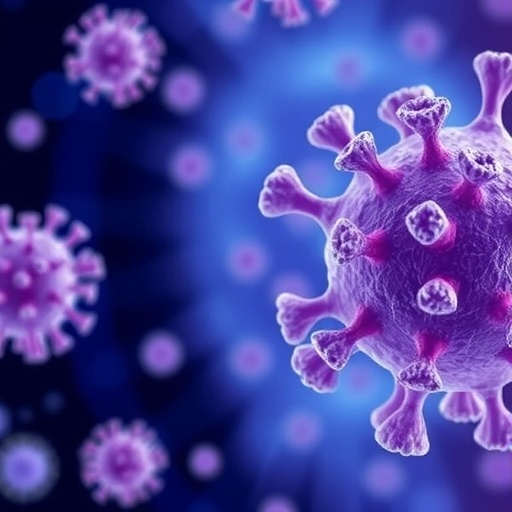
Groundbreaking research emerging from Swansea University reveals a revolutionary synthetic glycosystem capable of blocking SARS-CoV-2—the virus responsible for Covid-19—from infecting human cells with nearly 99% efficiency. This innovative development centers around a sugar-coated polymer nanoparticle meticulously engineered to imitate the natural sugar structures found on the surfaces of human cells. By mimicking these biological signatures, the glycosystem acts as a decoy, intercepting and neutralizing the virus before it can initiate infection.
The core of this discovery lies in the rational design of the synthetic molecule, which replicates polysialosides—polymers composed of repeating units of sialic acid, a sugar that many viruses exploit to attach to host cells. Through molecular mimicry, the nanoparticle binds selectively to the spike protein of SARS-CoV-2, outcompeting native sugars on cell membranes and effectively blocking viral entry. This mechanism operates independently of the immune system’s typical response, marking a departure from vaccines and traditional antiviral therapies.
Employing cutting-edge experimental methodologies, the research team quantified the interaction strength between the glycosystem and the viral spike protein. Remarkably, this synthetic polysialoside binds with an affinity approximately 500 times greater than chemically similar compounds lacking the precise sugar architecture, such as sulphated analogs. This heightened binding affinity underscores the critical importance of the sugar moieties’ spatial arrangement and conformation in achieving potent antiviral activity.
The efficacy of this glycosystem is not limited to a single strain of the virus. Laboratory studies demonstrated robust inhibition against both the original SARS-CoV-2 isolate and the D614G variant, widely recognized for its increased transmissibility. Consequentially, the synthetic molecule exhibits broad-spectrum potential, positioning it as a versatile tool for combating existing and emergent viral strains.
In vitro experiments utilizing human lung cell cultures revealed a dramatic 98.6% reduction in viral infection when the glycosystem was applied. Such near-complete suppression at remarkably low dosages suggests a highly efficient mode of action with minimal cytotoxicity. This discovery could profoundly transform strategies for prophylaxis and treatment, particularly for vulnerable populations with diminished vaccine responsiveness.
Unlike conventional vaccines that stimulate adaptive immunity through antigen presentation, this synthetic glycosystem functions as a physical barrier, sequestering the virus extracellularly. By precluding the virus’s initial attachment phase, the nanoparticle prevents subsequent cellular entry and replication, fundamentally blocking the infectious cycle at its earliest stage.
The research consortium behind this breakthrough represents an international collaboration involving Swansea University, Freie Universität Berlin, and Charité – Universitätsmedizin Berlin. The interdisciplinary nature of the project—integrating chemistry, virology, and materials science—was pivotal in advancing the design, synthesis, and functional validation of the glycosystem, culminating in this unprecedented antiviral agent.
Future work aims to extend biological validation, including more comprehensive testing in biosafety level 3 laboratories to evaluate efficacy across diverse SARS-CoV-2 variants and related coronaviruses. Scaling from the molecular to the clinical realm will necessitate rigorous assessment of pharmacodynamics, bioavailability, and safety profiles to propel the glycosystem towards therapeutic application.
Potential real-world implementations envisioned include antiviral nasal sprays, topical surface disinfectants, and adjunctive treatment modalities designed to shield those at heightened risk, such as immunocompromised individuals or the elderly. These applications could provide rapid, non-immunogenic protection, complementing vaccination programs and enhancing public health defenses against future viral outbreaks.
This discovery not only expands the arsenal against Covid-19 but also exemplifies the transformative potential of nanotechnology and glycobiology in infectious disease control. By exploiting virus-host interaction pathways at a molecular level, researchers have carved a new paradigm for antiviral therapeutics centered on biomimicry and molecular precision.
The published study, titled “Polysialosides Outperform Sulfated Analogs for Binding with SARS-CoV-2,” appeared in the journal Small and outlines the comprehensive biochemical and virological data supporting the glycosystem’s efficacy. The authors confirm no conflicts of interest, underscoring the scientific integrity and collaborative transparency of the initiative.
As global efforts continue to confront evolving viral threats, this synthetic glycosystem heralds a promising frontier—a molecular shield that may soon fortify humanity’s defense strategies, transforming the landscape of viral infection prevention and paving the way for next-generation antiviral materials.
News Publication Date: 16-Jul-2025
Web References:
https://onlinelibrary.wiley.com/doi/10.1002/smll.202500719
https://www.swansea.ac.uk/staff/sumati.bhatia/
https://www.fu-berlin.de/
https://virologie-ccm.charite.de/en/
Keywords
COVID 19, Long Covid, Viral infections, COVID 19 vaccines, Disease outbreaks, Chemistry, Nanomaterials, Viruses, Coronavirus, SARS CoV 2, SARS CoV
Cite Scienmag News
Kristina Jarvis. (August 11, 2025). Lab-Created Sugar-Coated Particles Block COVID-19 Infection—A Promising New Treatment Ahead. Scienmag. https://scienmag.com/lab-created-sugar-coated-particles-block-covid-19-infection-a-promising-new-treatment-ahead/
Kristina Jarvis. "Lab-Created Sugar-Coated Particles Block COVID-19 Infection—A Promising New Treatment Ahead." Scienmag, 11 August 2025, https://scienmag.com/lab-created-sugar-coated-particles-block-covid-19-infection-a-promising-new-treatment-ahead/. Accessed 3 September 2026.
Kristina Jarvis. "Lab-Created Sugar-Coated Particles Block COVID-19 Infection—A Promising New Treatment Ahead." Scienmag. August 11, 2025. https://scienmag.com/lab-created-sugar-coated-particles-block-covid-19-infection-a-promising-new-treatment-ahead/


