


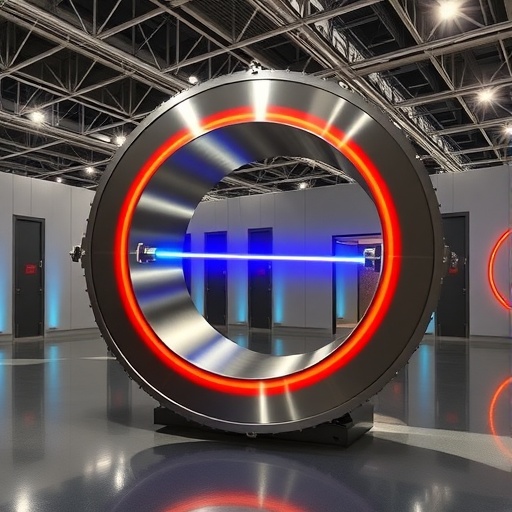
The hunt for the axion, one of particle physics’ most elusive hypothetical particles, has entered a decisive new phase. The German Research Foundation, or DFG, has approved funding for the construction of a €6 million superconducting magnet system that will form the core of the BabyIAXO experiment. The project is being developed through the Color meets Flavor Cluster of Excellence, a collaboration involving the University of Bonn, the University of Siegen and TU Dortmund University. Researchers hope the experiment will provide new clues about the nature of dark matter and resolve one of the deepest theoretical inconsistencies in the Standard Model.
At the center of BabyIAXO will be a magnet approximately ten meters long, designed to operate at temperatures close to absolute zero—around minus 270 degrees Celsius. At such temperatures, superconducting materials can carry electrical current with virtually no resistance, allowing the magnet to generate a powerful magnetic field continuously and efficiently. The enormous instrument will also be mounted on a movable platform, enabling it to follow the Sun across the sky for up to 12 hours each day. This combination of extreme cooling, high magnetic-field strength and precision movement makes the system one of the most technically ambitious magnets ever built for a particle-physics experiment.
The magnet is essential because axions are expected to interact with electromagnetic fields, although only extraordinarily weakly. In the BabyIAXO design, axions produced inside the Sun could enter the magnet and, under the right conditions, convert into detectable X-ray photons. This process is known as the axion–photon conversion. The probability of conversion is extremely small, which means that the experiment must combine a large magnetic volume with highly sensitive X-ray detectors and long observation periods. Tracking the Sun increases the opportunity to search for these rare conversion events while reducing the background signals that could obscure them.
Construction of the magnet system is planned at DESY, the German Electron Synchrotron research center in Hamburg. The project presents unusual engineering challenges because a conventional fixed magnet would not be sufficient. BabyIAXO must be tilted through a wide range of angles while maintaining the stability of its cryogenic systems, superconducting components and detector alignment. Engineers must also ensure that the magnet can withstand the mechanical stresses produced during movement and operation. According to Professor Matthias Schott of the University of Bonn, who coordinates the research proposal, the magnet is the “beating heart” of the experiment and makes the entire BabyIAXO search strategy possible.
BabyIAXO is intended as a technology demonstrator and an intermediate step toward the much larger International Axion Observatory, known as IAXO. The proposed full-scale observatory would use a magnet approximately 20 meters long, making it the largest helioscope ever planned for axion research. A helioscope is a telescope designed to observe axions generated in the Sun rather than visible light or conventional electromagnetic radiation. By increasing the magnet’s size, field strength and detector coverage, IAXO could improve the sensitivity of solar-axion searches by roughly 10,000 times compared with the most powerful helioscope currently in operation.
The larger observatory is expected to include eight observation stations. Each station could be equipped with different combinations of X-ray telescopes and detectors, allowing researchers to search for axions across a broad range of possible masses and interaction strengths. This flexibility is important because the axion has not yet been observed, and theoretical models do not specify a single value for all of its properties. Professor Klaus Desch of the University of Bonn, Chair of the IAXO Collaboration Board, says the range of instruments would allow scientists to investigate multiple axion scenarios simultaneously rather than relying on one narrow experimental design.
The scientific motivation reaches far beyond the discovery of a new particle. The axion was proposed in 1977 by physicists Roberto Peccei and Helen Quinn to address the strong CP problem, a fundamental puzzle in the Standard Model. The strong nuclear force, which binds quarks together inside protons and neutrons, appears to permit violations of charge-parity symmetry. In principle, such violations could produce a measurable electric dipole moment for the neutron. Yet despite decades of increasingly precise experiments, no such effect has been observed. The axion mechanism provides a possible explanation: a new field would dynamically suppress the strong interaction’s CP-violating contribution, restoring agreement between theory and observation.
The particle could also help explain another major mystery. Because axions would be extremely light and interact very weakly with ordinary matter, vast numbers of them could have survived from the early universe. Their collective gravitational influence could account for some or all of the dark matter that shapes galaxies and large-scale cosmic structure. Unlike ordinary matter, dark matter does not emit, absorb or reflect light in a readily detectable way. An axion discovery would therefore have implications for both particle physics and cosmology, connecting the behavior of subatomic fields with the evolution of the universe.
Researchers involved in the project stress that BabyIAXO is not simply a smaller version of IAXO, but a critical test of the technologies required for the future observatory. The experiment will allow scientists to validate the superconducting magnet, its cryogenic operation, tracking platform, X-ray optics and detector systems under real experimental conditions. Professor Julia K. Vogel of TU Dortmund University, Deputy Spokesperson for IAXO, describes this development and testing phase as essential preparation for the larger instrument. Twenty universities and research institutions from around the world are participating in the broader IAXO collaboration, while the BabyIAXO magnet is supported by €3 million from the DFG, €2.4 million from the state of North Rhine-Westphalia and €600,000 contributed jointly by the participating universities. If the experiment performs as planned, the first stage of the search for the axion could transform one of particle physics’ most persistent hypotheses into a testable reality.
Keywords
Axion, BabyIAXO, IAXO, dark matter, particle physics, superconducting magnet, helioscope, strong CP problem, solar axions, University of Bonn, DESY, DFG, quantum physics
Cite Scienmag News
Katie Riggs. (August 12, 2026). Scientists search for elusive axions using a powerful giant magnet. Scienmag. https://scienmag.com/scientists-search-for-elusive-axions-using-a-powerful-giant-magnet/
Katie Riggs. "Scientists search for elusive axions using a powerful giant magnet." Scienmag, 12 August 2026, https://scienmag.com/scientists-search-for-elusive-axions-using-a-powerful-giant-magnet/. Accessed 3 September 2026.
Katie Riggs. "Scientists search for elusive axions using a powerful giant magnet." Scienmag. August 12, 2026. https://scienmag.com/scientists-search-for-elusive-axions-using-a-powerful-giant-magnet/


