

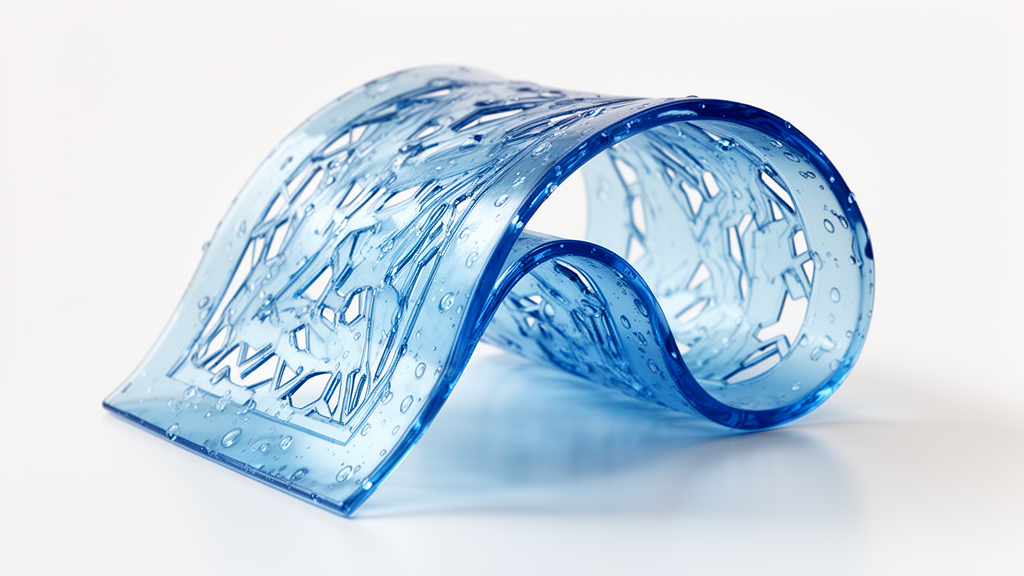
Every snowflake cut from folded paper carries a lesson in transformation. Unfold it, and a flat sheet becomes something intricate and three-dimensional, its pattern determined entirely by where the cuts were made and how the paper was folded. That ancient craft, known as kirigami, has now been borrowed by bioengineers at the University of Illinois Chicago, who report that the same principles of cutting, folding, and programmed unfolding can coax flat, cell-laden gels into the curved, complex shapes of living human tissue. The work, published in Cell Biomaterials, describes what the researchers call a 4D bio-kirigami strategy, where time is the fourth dimension: the constructs do not simply hold a shape, they change shape on their own as they mature in culture.
The research team, led by members of professor Eben Alsberg’s laboratory in UIC’s College of Engineering, set out to solve one of the most stubborn problems in tissue engineering. Human tissues are not flat. Cartilage curves around joints, blood vessels branch and bend, the trachea spirals in a series of horseshoe-shaped rings, and bone sweeps through the skeleton in arcs that no simple mold can reproduce. Conventional biofabrication approaches, which typically build tissues layer by layer or cast them in static scaffolds, have struggled to reproduce these intricate curvatures and fine surface features. The new strategy instead lets the material do the work, programming a flat construct to bend, fold, and curl itself into a target geometry as its internal structure swells at different rates.
Kirigami, the Japanese art of paper cutting, has already inspired engineers far beyond the classroom. Its techniques have informed deployable structures for spacecraft, flexible semiconductors, wearable technology, and optical devices. The appeal is straightforward: by introducing carefully placed cuts into a flat, stiff sheet, the material gains stretchability and flexibility it never had before, and it can be reshaped without any change to its chemical composition. What had been largely unexplored, according to Kaelyn L. Gasvoda, the paper’s lead author and a 2024 UIC PhD graduate now at the Mayo Clinic, was whether kirigami could be adapted to tissue engineering and, crucially, to soft, gel-like materials that can host living cells.
The challenge is that living hydrogels are nothing like paper. They are fragile, they swell in aqueous culture media, and any structural trick must remain cytocompatible, meaning it cannot harm the cells embedded within it. The UIC team’s solution was a hydrogel platform built from derivatives of gelatin and alginate, a natural polymer derived from seaweed. Both materials are well established in the biomaterials field: gelatin offers cell-friendly biochemical cues, while alginate provides a tunable structural backbone. By combining them, the researchers created a material system in which mechanical behavior and biological support could be engineered separately and then brought together.
The key to programming shape change lies in a technique called photolithography. Using patterned light, the team created regions of different crosslinking densities within the same hydrogel construct. Crosslinks are the molecular bridges that tie polymer chains together, and their density dictates how much a given region can swell when immersed in culture medium. Densely crosslinked areas resist expansion and hold their form, while lightly crosslinked areas absorb the medium and grow. By patterning these regions with kirigami-inspired precision, the researchers could dictate exactly which parts of a construct would stay rigid and which would expand, and by how much, producing controlled bending, folding, and self-patterning over time.
The design philosophy behind the platform reflects a deliberate division of labor within the material. Ding, a research associate professor on the team, explained that the researchers aimed to create structures with a rigid outer framework that would maintain its shape without expanding in the culture medium. In contrast, the inner regions needed to absorb the medium and expand while remaining compatible with long-term cell survival, growth, and differentiation. That combination, a stable skeleton paired with a growing, living interior, is what allows the constructs to transform autonomously while the cells inside them continue to develop into tissue-like structures with precisely defined geometries, all without additional manipulation by the researchers.
Gasvoda described the progression as an effort to push beyond the team’s earlier demonstrations. The initial achievement of constructs that changed shape over time was exciting, she said, but the goal was to create more complex shapes with controlled self-patterning and bending, designing structures where the researchers could precisely guide how they form and transform. That precision matters because, as Ding emphasized, complex geometries are central to tissue engineering: human tissues have intricate three-dimensional shapes that are closely linked to their functions. The Alsberg laboratory focuses on engineering tissues with complex architectures, including cartilage, bone, tracheal, and vascular tissues, with the aim of recreating their native structures and functions rather than approximations of them.
The implications extend to wound healing as well as tissue replacement. Repairing defects in curved anatomical surfaces, whether in cartilage, skin-adjacent structures, or tubular organs, requires implants or engineered constructs that match the geometry of the site they are meant to restore. A flat patch forced onto a curved wound bed fits poorly, integrates poorly, and functions poorly. A construct that can be fabricated flat, shipped and handled easily, and then programmed to assume the correct curvature as it matures offers a fundamentally different approach. The platform also enables the spatial organization of multiple cell types within a single construct, supporting their distinct functions in ways that uniform scaffolds cannot.
What makes the work particularly striking is its conceptual economy. No new chemistry was required, no exotic materials, and no external actuators. The shape change emerges from the interplay between patterned crosslinking, differential swelling, and time, the same interplay that turns a folded sheet of paper into a snowflake. Gasvoda summarized the demonstration succinctly: kirigami-patterned, cytocompatible hydrogels can be engineered to autonomously bend, fold, and transform into complex three-dimensional shapes. In doing so, the approach addresses a longstanding challenge in the field, opening the possibility of engineering tissues that more closely replicate the intricate architectures of the native tissues they are meant to replace or repair.
The team is candid about the road ahead. Having shown that the platform can generate complex geometries in concert with new tissue formation in the laboratory, the next step is to evaluate its performance in animal models, with the long-term goal of translating the technology toward clinical applications. That path will test whether the programmed transformations remain reliable in the messier environment of a living body, where mechanical loading, biochemical signaling, and immune responses all compete with the engineered design. But the underlying idea, that a flat sheet of living material can be taught to fold itself into the shape of the tissue it will become, offers a compelling glimpse of where biofabrication may be headed, and it began, fittingly, with a pair of scissors and a sheet of paper.
Subject of Research: A 4D bio-kirigami hydrogel platform for engineering complex tissue curvatures
Article Title: New 4D biofabrication technology holds promise for tissue engineering, wound healing
Article References: New 4D biofabrication technology holds promise for tissue engineering, wound healing. Original publication (Bibliographic details unavailable.)
Image Credits: AI Generated
DOI: Not provided
Keywords: 4D biofabrication, kirigami, hydrogels, tissue engineering, wound healing, photolithography, alginate, gelatin, cell Biomaterials, University of Illinois Chicago, cartilage, regenerative medicine
Cite Scienmag News
Gregory Coleman. (October 19, 2026). Kirigami-Inspired 4D Hydrogels Reshape Themselves Into Complex Human Tissue Forms. Scienmag. https://scienmag.com/kirigami-inspired-4d-hydrogels-reshape-themselves-into-complex-human-tissue-forms/
Gregory Coleman. "Kirigami-Inspired 4D Hydrogels Reshape Themselves Into Complex Human Tissue Forms." Scienmag, 19 October 2026, https://scienmag.com/kirigami-inspired-4d-hydrogels-reshape-themselves-into-complex-human-tissue-forms/. Accessed 19 October 2026.
Gregory Coleman. "Kirigami-Inspired 4D Hydrogels Reshape Themselves Into Complex Human Tissue Forms." Scienmag. October 19, 2026. https://scienmag.com/kirigami-inspired-4d-hydrogels-reshape-themselves-into-complex-human-tissue-forms/


