


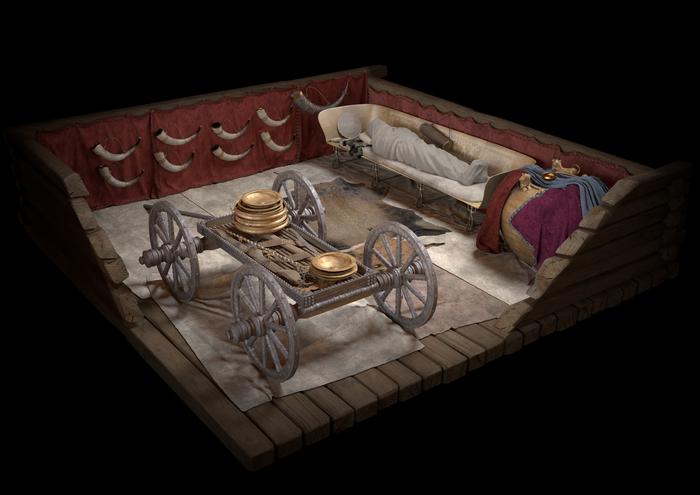
The burial mounds of Eberdingen-Hochdorf and Asperg-Grafenbühl, known as Fürstengräber, are among the richest burials of German prehistory, with gold finds and elaborate bronze vessels. A new genetic analysis has now revealed that the two princes, buried about 10 kilometers apart, were biologically closely related. “It has long been suspected that the two princes from the burial mounds in Eberdingen-Hochdorf and Asperg ‘Grafenbühl‘ were related,” says Dirk Krausse of the State Office for the Preservation of Historical Monuments, “but only now has this assumption been confirmed by the new analyses“.

Credit: © Landesmuseum Württemberg, FaberCourtial; Thomas Hoppe (scientific reconstruction)
The burial mounds of Eberdingen-Hochdorf and Asperg-Grafenbühl, known as Fürstengräber, are among the richest burials of German prehistory, with gold finds and elaborate bronze vessels. A new genetic analysis has now revealed that the two princes, buried about 10 kilometers apart, were biologically closely related. “It has long been suspected that the two princes from the burial mounds in Eberdingen-Hochdorf and Asperg ‘Grafenbühl‘ were related,” says Dirk Krausse of the State Office for the Preservation of Historical Monuments, “but only now has this assumption been confirmed by the new analyses“.
For the current analyses, teeth and skull bones of the inner ear were sampled at the MPI-EVA using the latest methods, and the remaining DNA was sequenced to reconstruct the genomes of a total of 31 individuals. The two central burials stand out from the rest of the group due to their close relationship.
Two princes closely related
After establishing a genetic relationship between the two individuals, the team looked at all possible connections, such as brothers, half-siblings, grandfather and grandson, as well as uncle and nephew. “Based on the fairly precise death dates, estimates of age at death and the genetic similarity of the two princes, only one scenario comes into question as uncle and nephew, more precisely: the sister of the Hochdorf prince was the mother of the Asperg prince,” explains Stephan Schiffels from MPI-EVA.
“This result shows that political power in this society was most likely inherited through biological succession, comparable to a dynasty,” says Joscha Gretzinger from MPI-EVA. This is also supported by evidence of relationships between other individuals from the two mounds, as well as from the much more distant Magdalenenberg mound, which was built about 100 years earlier. Gretzinger adds: “Overall, we seem to be dealing with a broad network among the Celts in Baden-Württemberg, in which political power was underpinned by biological kinship”.
But how were the Celts related to other inhabitants of Iron Age Europe beyond Baden-Württemberg? A detailed analysis of the genetic origins of this group reveals a genetic origin most likely to be found in present-day France, but which was widespread throughout southern Germany at the time. In addition, several individuals show a genetic origin from Italy, which also fits well with the objects found in the graves, many of which show Mediterranean styles.
The study is therefore an important piece of the puzzle in our understanding of European history in the Middle and Late Iron Age, which, unlike the Roman and other Early Medieval periods, can hardly be researched from written sources.
Journal
Nature Human Behaviour
Article Title
Evidence for dynastic succession among early Celtic elites in Central Europe
Article Publication Date
3-Jun-2024
Cite Scienmag News
Courtney Benton. (June 3, 2024). Kinship and ancestry of the Celts in Baden-Württemberg, Germany. Scienmag. https://scienmag.com/kinship-and-ancestry-of-the-celts-in-baden-wurttemberg-germany/
Courtney Benton. "Kinship and ancestry of the Celts in Baden-Württemberg, Germany." Scienmag, 3 June 2024, https://scienmag.com/kinship-and-ancestry-of-the-celts-in-baden-wurttemberg-germany/. Accessed 3 September 2026.
Courtney Benton. "Kinship and ancestry of the Celts in Baden-Württemberg, Germany." Scienmag. June 3, 2024. https://scienmag.com/kinship-and-ancestry-of-the-celts-in-baden-wurttemberg-germany/

