


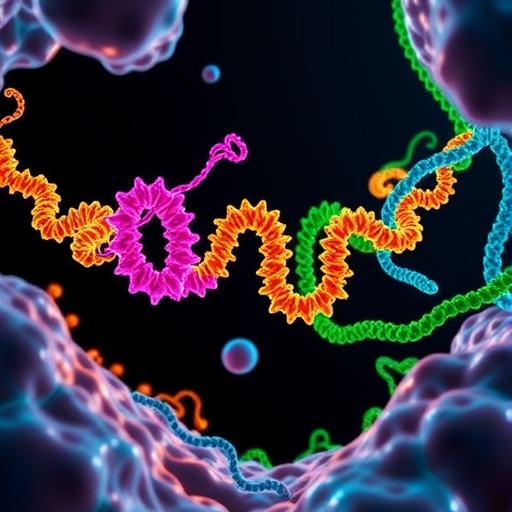
In the ever-evolving landscape of cellular biology and molecular engineering, the challenge of guiding therapeutic agents into the cytosol or nucleus of target cells has persisted as a significant barrier to effective drug delivery. Recently, a groundbreaking study has illuminated the pathways and biophysical mechanisms that underpin the efficient endosomal escape of designed mini-proteins, with a particular focus on the zinc-finger motif-containing mini-protein known as ZF5.3. This research, published in Nature Chemistry, not only advances our molecular understanding of intracellular trafficking but opens new doors for the targeted delivery of biologics with unprecedented precision.
Endosomal entrapment has long stymied the use of macromolecular therapeutics. Once internalized by endocytosis, many bioactive molecules become sequestered in membrane-bound compartments and are eventually targeted for degradation or recycling, rather than reaching their functional destinations. The design and optimization of molecular tools that can avoid this fate and efficiently escape these confines have represented a holy grail for drug developers. The ZF5.3 mini-protein emerges as a compelling model, owing to its distinctive capability to not only traverse the endosomal membrane but also maintain functional integrity post-escape.
Central to the study is the revelation that ZF5.3 maintains structural resilience under a range of conditions typical of early endosomal environments. This mini-protein remains tightly folded even when subjected to elevated temperatures and pH levels from 5.5 to 7.5, a property indicating remarkable stability relative to many biological molecules. Such robustness suggests a built-in resistance against premature degradation or misfolding during the initial stages of cellular uptake, thereby preserving the functional state required for delivery.
However, the twist in the tale lies in the behavior of ZF5.3 under the acidic conditions characteristic of late endolysosomal compartments, where the pH falls below 5.5. Here, a cooperative unfolding occurs, driven by the protonation of histidine residues coordinating Zn(II) ions, whose pKa aligns intricately with the endolysosomal pH milieu. This protonation triggers a conformational shift, effectively dismantling the stable fold that ZF5.3 sustains moments before. The linkage between pH-dependent unfolding and cellular location reveals a finely tuned molecular switch that the protein exploits to activate membrane-interacting capabilities precisely where escape is essential.
Intriguingly, the study also demonstrates that this pH-induced transition is not merely an incidental feature but a prerequisite for effective endosomal exit. To validate this principle, researchers engineered a ZF5.3 analogue specifically designed to retain its folded conformation even under acidic conditions. The outcome was stark: the analogue’s impaired capacity to detach from the endosome confirmed that the unfolding step is causally linked to escape efficiency. This finding refines our understanding of not only the structural dynamics of such mini-proteins but also their functional interplay with the intracellular trafficking machinery.
The biophysical mechanism underlying escape extends to an interaction with bis(monoacylglycero)phosphate (BMP), a lipid component uniquely enriched in the inner leaflets of late endolysosomal membranes. ZF5.3 exhibits a pH-dependent affinity for BMP, whereby the unfolded conformation facilitates membrane association. This lipid-protein interaction likely promotes destabilization or perturbation of the endosomal membrane, enabling the protein—and its conjugated cargo—to brea͏k free into the cytosolic compartment. This coupling between conformational state and lipid binding uncovers a precise molecular handshake that orchestrates the delicate process of membrane traversal.
Moreover, the study reinforces the essential role of the homotypic fusion and protein sorting (HOPS) complex, a multisubunit tethering complex responsible for late endosomal and lysosomal membrane fusion events. The HOPS complex seems to provide a cellular scaffold or functional environment that supports ZF5.3-mediated escape, although its exact mechanistic contributions await further elucidation. The dependency on an intact HOPS complex underlines that the process is not purely driven by the protein’s intrinsic properties but also critically reliant on host cell machinery.
These insights collectively establish a refined biophysical model for endosomal escape that reconciles structural stability, environment-responsive unfolding, specific lipid interaction, and host factor involvement. From a therapeutic perspective, the implications are profound. The ability to engineer mini-proteins like ZF5.3 with programmable endosomal escape mechanisms can revolutionize the intracellular delivery of large biomolecules such as antibodies, enzymes, or nucleic acids, which traditionally face delivery bottlenecks.
Beyond immediate biomedical applications, this research also enriches our understanding of natural protein trafficking and membrane interaction phenomena. It raises questions about whether similar pH-sensitive unfolding motifs exist in endogenous proteins that harness the endocytic pathway, potentially influencing signaling, immunity, or metabolic regulation. The apparent evolutionary tuning of protonation-sensitive histidines to exploit the late endolysosomal environment is a testament to the sophisticated molecular choreography within cells.
Furthermore, the study’s methodology, which integrates biophysical characterization with cellular assays and molecular engineering, represents a methodological blueprint for interrogating other protein-based delivery systems. The demonstration that subtle pKa shifts and structural transitions can dictate profound biological outcomes may drive a wave of targeted design strategies aimed at enhancing intracellular targeting specificity and efficiency.
It is also notable that the cooperative unfolding of ZF5.3 is tightly coupled with its cargo properties. The mini-protein’s ability to successfully deliver is dependent on the cargo being relatively small or capable of unfolding, indicating a nuanced interplay between the transporter and its molecular passengers. This highlights potential future avenues to customize cargo characteristics alongside mini-protein design to further maximize delivery success.
Finally, the research underscores the growing synergy between structural biology and cellular biophysics in tackling longstanding challenges in drug delivery. By deciphering how a designed protein negotiates cellular landscapes with precision, the findings mark a step towards programmable bio-delivery tools that could transform treatments across neurological diseases, cancer, and genetic disorders.
As the promise of molecular medicine matures, studies like this provide not just mechanistic insights but practical blueprints that merge fundamental science with therapeutic innovation. Designed mini-proteins that can reliably escape endosomes portend a new generation of smart delivery systems—engineered to navigate the cellular terrain with unprecedented finesse—and pave the way for interventions that act at the precise intracellular coordinates where diseases unfold.
Cite Scienmag News
Bethany Barker. (August 10, 2025). Key Biophysical Rules for Mini-Protein Endosomal Escape. Scienmag. https://scienmag.com/key-biophysical-rules-for-mini-protein-endosomal-escape/
Bethany Barker. "Key Biophysical Rules for Mini-Protein Endosomal Escape." Scienmag, 10 August 2025, https://scienmag.com/key-biophysical-rules-for-mini-protein-endosomal-escape/. Accessed 3 September 2026.
Bethany Barker. "Key Biophysical Rules for Mini-Protein Endosomal Escape." Scienmag. August 10, 2025. https://scienmag.com/key-biophysical-rules-for-mini-protein-endosomal-escape/


