


By Maddie Johnson

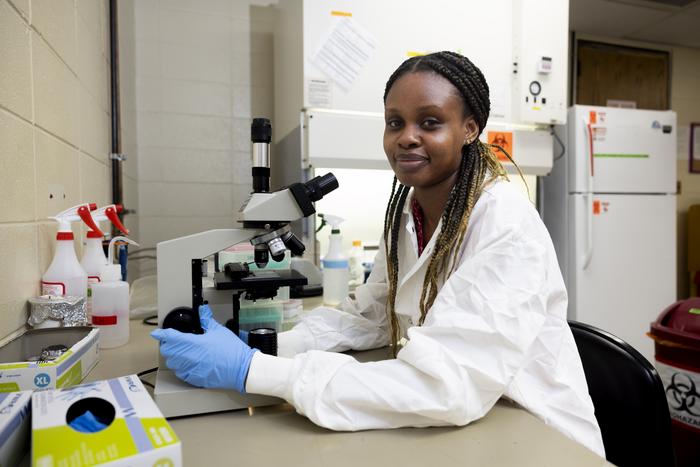
Credit: U of A System Division of Agriculture photo by Paden Johnson
By Maddie Johnson
University of Arkansas System Division of Agriculture
Arkansas Agricultural Experiment Station
FAYETTEVILLE, Ark. — While half the global population relies on rice as a staple, about 15 percent of rice produced each year is contaminated by potentially fatal aflatoxins. Seeing this threaten lives in her home country of Kenya prompted a graduate research assistant to focus on eradicating the risk through safer storage methods.
Faith Ouma, a Ph.D. student in the food science department at the University of Arkansas, was the lead author of “Investigating safe storage conditions to mitigate aflatoxin contamination in rice.” It was published in Food Control, an international food safety journal.
Ouma completed her undergraduate studies in biochemistry in Kenya before earning a master’s and pursuing a doctoral degree at the University of Arkansas. Her study was conducted through the Arkansas Agricultural Experiment Station, the research arm of the University of Arkansas System Division of Agriculture. The food science department is part of the Dale Bumpers College of Agricultural, Food and Life Sciences.
When exposed to poor storage conditions such as high temperatures and humidity, rice can become contaminated with fungi. Fungi can then produce naturally occurring toxic compounds called mycotoxins though researchers have yet to discover why they create the toxins. Aflatoxins, a family of mycotoxins, are poisonous compounds that have been designated by the International Agency for Research on Cancer as Group 1 carcinogens, meaning there is sufficient evidence they can cause cancer in humans. Aflatoxins also pose a greater risk to children by threatening their immune systems and growth.
“Aflatoxins in the U.S. are not much of a big problem because of development,” Ouma said. “But where I come from in Kenya, it is one of the hotspots. There was a time people died because they consumed corn contaminated with aflatoxins.”
According to research published in 2020 by the Journal of Young Investigators, in 2004, Kenya saw the most extreme aflatoxin outbreak in the world, which included 317 cases and 125 deaths.
Griffiths Atungulu, food science associate professor and director of the Arkansas Rice Processing Program, serves as Ouma’s adviser and co-author. Other co-authors included Kaushik Luthra, a food science postdoctoral fellow, and Abass Oduola, a former food science doctoral student.
The project is part of Ouma’s larger research objective on the safety of ready-to-eat rice products, such as instant rice, that she will maintain as she pursues her doctorate. For her rice safety research, she earned the first-place award from the Arkansas Association for Food Protection for her poster in the Interventions, Pre- and Post-Harvest division in 2022. She was also recognized as outstanding presenter at the American Society of Agricultural and Biological Engineers Annual International Meeting for her oral presentation the same year.
Aflatoxin contamination poses an even greater risk with products such as instant rice and rice cakes. Atungulu noted that a producer’s window for mitigating this risk is in the early stages of rice processing. In later processing to create products such as instant rice and rice cakes, even high temperatures reaching 200 degrees Celsius, or 392 degrees Fahrenheit, won’t eliminate aflatoxins once they are produced. Even if high temperatures were effective in destroying the aflatoxin, they would likely degrade nutritional quality.
“Once the toxin’s been formed, the grain becomes almost useless,” Atungulu said.
Investigating growth conditions
Researchers set out to understand how to prevent aflatoxin formation by measuring how temperature, humidity, storage time and moisture impacted the toxin’s growth.
Rice from a farm in Hazen was collected and divided into rough, brown and milled rice fractions. Rough rice is unprocessed and still has its hull, or hard protective covering, while brown rice does not. Milled rice has its hull and bran layers removed. Samples of each type of rice were then divided into autoclaved, or steam-sterilized, and non-autoclaved. All samples were inoculated with Aspergillus flavus, a type of fungus that produces aflatoxins, and the team then tracked aflatoxin levels.
“We were looking at what the environments are that would make these fungi feel so confident to start producing the toxin,” Atungulu said.
The researchers measured ergosterol, a substance in the fungus cell walls, and the quantity of Aflatoxin B1, a potent toxin linked to liver cancer and immune system suppression. Researchers found that temperature and relative humidity levels had the most significant impacts on fungal growth, and they had an even greater impact when present together. They also found that brown rice had notably high Aflatoxin B1 levels due to the fats in its bran, which can provide carbon for increased fungal growth and aflatoxin production.
Ouma’s study showed that proper rice storage conditions to reduce aflatoxin risk after harvest include a temperature below 20 degrees Celsius, or 68 degrees Fahrenheit, and relative humidity below 75 percent. While the research involved careful measurements of fungal and aflatoxin levels at various temperatures, humidity levels, and other parameters, Ouma said she hopes the impact of her work is twofold.
“As much as I want to publish data, I also want to come up with something that can help solve a real-world problem when I go back home,” Ouma said.
To learn more about Division of Agriculture research, visit the Arkansas Agricultural Experiment Station website: https://aaes.uada.edu. Follow on Twitter at @ArkAgResearch. To learn more about the Division of Agriculture, visit https://uada.edu/. Follow us on Twitter at @AgInArk. To learn about extension programs in Arkansas, contact your local Cooperative Extension Service agent or visit www.uaex.uada.edu.
About the Division of Agriculture
The University of Arkansas System Division of Agriculture’s mission is to strengthen agriculture, communities, and families by connecting trusted research to the adoption of best practices. Through the Agricultural Experiment Station and the Cooperative Extension Service, the Division of Agriculture conducts research and extension work within the nation’s historic land grant education system.
The Division of Agriculture is one of 20 entities within the University of Arkansas System. It has offices in all 75 counties in Arkansas and faculty on five system campuses.
The University of Arkansas System Division of Agriculture offers all its Extension and Research programs and services without regard to race, color, sex, gender identity, sexual orientation, national origin, religion, age, disability, marital or veteran status, genetic information, or any other legally protected status, and is an Affirmative Action/Equal Opportunity Employer.
# # #
Media Contact: John Lovett
U of A System Division of Agriculture
Arkansas Agricultural Experiment Station
(479) 763-5929
jlovett@uada.edu
Journal
Food Control
Method of Research
Observational study
Subject of Research
Not applicable
Article Title
Investigating safe storage conditions to mitigate aflatoxin contamination in rice
Article Publication Date
4-May-2024
Cite Scienmag News
Alan Morgan. (July 15, 2024). Kenyan crop contamination outbreak inspires grad student to improve rice storage. Scienmag. https://scienmag.com/kenyan-crop-contamination-outbreak-inspires-grad-student-to-improve-rice-storage/
Alan Morgan. "Kenyan crop contamination outbreak inspires grad student to improve rice storage." Scienmag, 15 July 2024, https://scienmag.com/kenyan-crop-contamination-outbreak-inspires-grad-student-to-improve-rice-storage/. Accessed 4 September 2026.
Alan Morgan. "Kenyan crop contamination outbreak inspires grad student to improve rice storage." Scienmag. July 15, 2024. https://scienmag.com/kenyan-crop-contamination-outbreak-inspires-grad-student-to-improve-rice-storage/

