


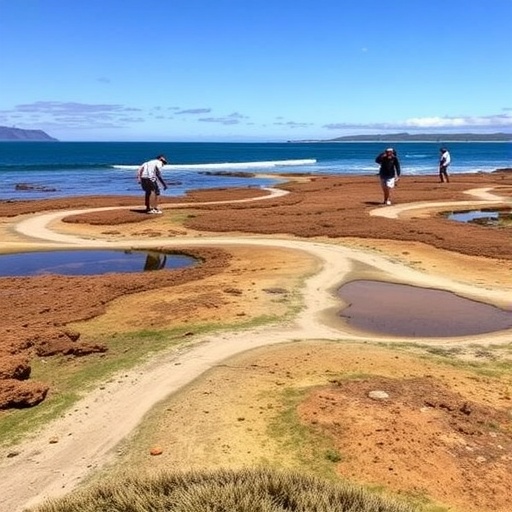
For millennia, Kangaroo Island off South Australia’s coast has harbored unique ecosystems shaped by the interplay of climate, fire, and human intervention—or lack thereof. A groundbreaking study delving into seven-meter-long sediment cores extracted from Lashmars Lagoon, located on the Dudley Peninsula, unveils a detailed chronology of environmental change over the past 7,000 years. This research, led by Associate Professor Jonathan Tyler from the University of Adelaide, provides critical insights into how climate fluctuation and human absence intensified bushfire activity, offering essential implications for current and future ecological management of this biodiversity hotspot.
The sediment core analyses, utilizing multi-proxy techniques including charcoal particle quantification and pollen assemblage assessments, reveal a complex narrative. Approximately 5,000 years ago, archaeological scrutiny confirms a notable human departure from Kangaroo Island, corroborating Indigenous oral histories that attribute this exodus to the island’s geographical isolation from the mainland. This cessation of anthropogenic influence marked a pivotal transition in vegetation dynamics and fire regimes.
Vegetation succession following human abandonment saw the proliferation of denser, shrubbier plant communities. Carbon isotope data and fossil pollen signatures indicate that despite the increased availability of fuel, fire occurrences remained infrequent and subdued for roughly three millennia—a phenomenon likely sustained by prevailing wetter climatic conditions during the mid-Holocene. This prolonged quiescence underscores the nuanced relationship between moisture availability and fire susceptibility in isolated ecosystems.
However, the paradigm shifted dramatically around 2,000 years ago as regional paleoclimate proxies denote a trend towards increased aridity. This drying phase directly correlated with heightened fire frequency and intensity evidenced by elevated charcoal concentrations within sediment layers. The period spanning 1150 to 1350 CE exhibits an anomalously pronounced fire episode, reflecting the synergistic effect of climatic drying and fuel accumulation on fire regime intensification.
Interestingly, the study juxtaposes these findings with mainland Australia’s fire record, illustrating a divergent trajectory. While Kangaroo Island experienced amplified fire events, the mainland contemporaneously manifested reduced fire activity despite undergoing similar climatic drying. This differential pattern highlights the critical role of Indigenous land management practices on the mainland, where intentional fire stewardship likely attenuated wildfire proliferation, thus maintaining ecological balance.
Integrating these paleoenvironmental reconstructions with ethnographic data prompts a compelling argument for incorporating Indigenous knowledge and cultural burning techniques into contemporary conservation frameworks. With anthropogenic climate change exacerbating fire risks globally, the resilience demonstrated by Kangaroo Island’s flora offers optimism yet also raises cautionary questions regarding ecosystem thresholds under intensified stressors such as prolonged drought and hotter temperatures.
The research team emphasizes that while flora has historically rebounded from major fire disturbances, the intervening centuries of reduced fire activity were vital for ecological regeneration and stability. Modern ecosystems may thus depend on analogous recovery periods to sustain biodiversity. Understanding these legacy effects is paramount for formulating adaptive management strategies that balance fire suppression with ecological processes.
Methodologically, the study deployed rigorous sediment core sampling, followed by radiocarbon dating to establish a robust temporal framework. Charcoal particle analysis served as a proxy for fire occurrence, while palynological examination elucidated vegetation changes concomitant with fire regimes and climate. These multi-disciplinary approaches converged to produce a high-resolution record illuminating the intricate feedback loops between climate, fire, and human activity—or its absence.
Notably, the sedimentary archive from Lashmars Lagoon functions as a natural laboratory, enabling scientists to disentangle long-term environmental drivers with precision. It underscores the value of paleoecological records in contextualizing contemporary environmental challenges within long-term natural variability and anthropogenic impact narratives.
The study’s implications extend beyond Kangaroo Island, providing a case study for fire-prone landscapes worldwide experiencing climate-induced fire regime shifts. It calls for synergistic collaboration among ecologists, climatologists, archaeologists, and Indigenous communities to devise holistic responses that respect cultural heritage and foster ecological resilience.
In conclusion, this extensive investigation into Kangaroo Island’s fire history reveals a landscape intricately molded by climatic oscillations and human absence over millennia. It reinforces the urgency for integrated fire management approaches that incorporate Indigenous stewardship alongside scientific evidence as climate change accelerates. The resilience of Kangaroo Island’s unique ecosystems offers both hope and a blueprint for navigating the increasingly fire-prone future faced globally.
Cite Scienmag News
Russell Cooper. (May 6, 2026). Kangaroo Island’s Ancient Sediments Reveal Climate-Driven Fire Activity Before Human Presence. Scienmag. https://scienmag.com/kangaroo-islands-ancient-sediments-reveal-climate-driven-fire-activity-before-human-presence/
Russell Cooper. "Kangaroo Island’s Ancient Sediments Reveal Climate-Driven Fire Activity Before Human Presence." Scienmag, 6 May 2026, https://scienmag.com/kangaroo-islands-ancient-sediments-reveal-climate-driven-fire-activity-before-human-presence/. Accessed 3 September 2026.
Russell Cooper. "Kangaroo Island’s Ancient Sediments Reveal Climate-Driven Fire Activity Before Human Presence." Scienmag. May 6, 2026. https://scienmag.com/kangaroo-islands-ancient-sediments-reveal-climate-driven-fire-activity-before-human-presence/


