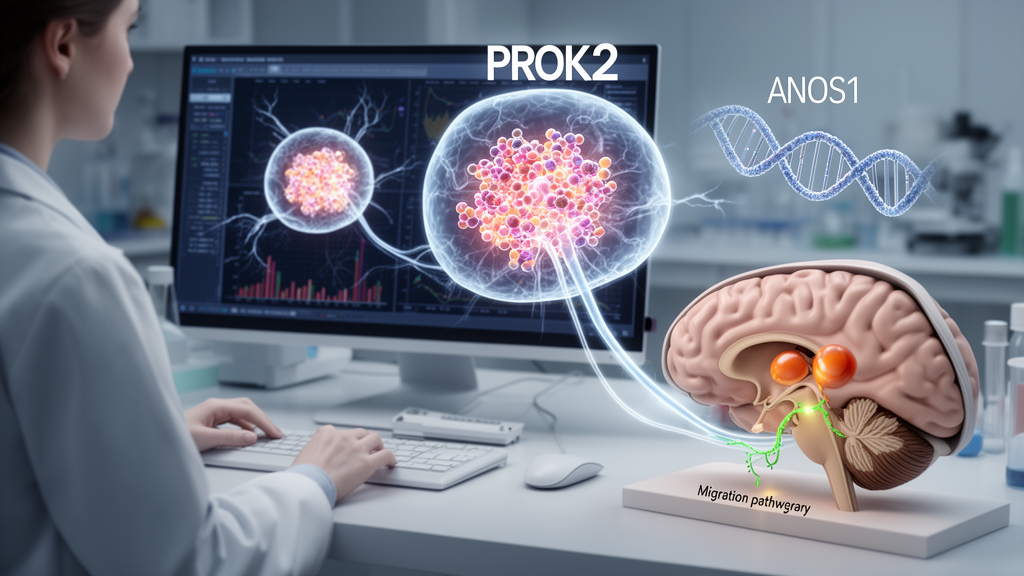
A family-based study of two Polish brothers with Kallmann syndrome found the same hemizygous missense variant in ANOS1 and increased expression of the neurodevelopmental gene PROK2 in peripheral blood. The brothers, aged 9 and 15 when examined, had hypogonadotropic hypogonadism, markedly impaired odor identification and a history of self-reported anosmia. Their mother, maternal grandmother and maternal aunt were heterozygous carriers of the ANOS1 c.452G>C variant, also known as p.Cys151Ser, while a male cousin also carried the variant.
The pattern of disease in the family was consistent with X-linked recessive inheritance. Researchers classified the newly identified variant as a variant of uncertain significance, meaning that the available evidence does not establish that it is pathogenic. The investigators combined clinical phenotyping, standardized olfactory testing, chromosome and copy-number analysis, targeted sequencing, a cell-based splicing assay, whole-blood RNA sequencing and quantitative reverse-transcription PCR.
Constitutional karyotypes were normal in both affected brothers, as were array comparative genomic hybridization results, and no clinically relevant copy-number changes were detected. The team also sequenced the coding regions and flanking sequences of all 14 ANOS1 exons and all four PROK2 exons. The ANOS1 variant had not previously been reported in ClinVar, dbSNP or gnomAD.
Computational tools including SIFT and PolyPhen-2 predicted that the substitution could be deleterious, but integrated interpretation under American College of Medical Genetics and Genomics and Association for Molecular Pathology criteria left the variant in the uncertain-significance category. Both affected brothers had micropenis, cryptorchidism and delayed puberty. Endocrine testing showed reduced testosterone, luteinizing hormone and follicle-stimulating hormone, together with blunted luteinizing hormone and follicle-stimulating hormone responses to gonadotropin-releasing hormone stimulation.
They also shared a narrow bitemporal diameter, epicanthal folds, facial asymmetry and antimongoloid palpebral fissures. The younger brother additionally had right renal agenesis, a supernumerary nipple and agenesis of the left maxillary second tooth. The mother had normal odor-identification performance.
Because this was a small family cohort, the clinical findings describe the phenotype observed in the two affected brothers but do not establish how much of the syndrome is attributable to the ANOS1 variant. Smell function was evaluated with the 12-item Odorized Markers Test, a standardized forced-choice procedure in which participants identify odors presented through pen-like devices. The older brother correctly identified four odors with each nostril and four when both nostrils were tested.
The younger brother identified four odors with the left nostril, six with the right and four during bilateral testing. These results were interpreted against age- and sex-adjusted Polish reference data derived from 9,139 subjects. Because the assessment measured odor identification rather than directly demonstrating complete absence of smell, the investigators described the brothers as having markedly impaired odor identification in the context of their reported anosmia, rather than definitively categorizing the results as normosmia, hyposmia or anosmia.
Magnetic resonance imaging of the olfactory bulbs was unavailable, leaving the study without direct anatomical evidence of olfactory-bulb abnormalities. The p.Cys151Ser substitution lies in exon 4 of ANOS1, within the whey acidic protein-like, or WAP, domain of anosmin-1. This extracellular glycoprotein contains a WAP domain with eight conserved cysteine residues forming a four-disulfide core, a structural feature considered important for proper folding and extracellular interactions.
The altered cysteine is one of those residues, and previous ANOS1 substitutions affecting other cysteines in the domain have been associated with impaired disulfide bonding and reduced protein stability. Those findings make the location of p.Cys151Ser biologically relevant, but the researchers did not directly measure disulfide formation, protein folding, secretion or interactions of the mutant protein with potential molecular partners. In silico predictions and the conserved position of the residue therefore supported further investigation rather than proving a functional mechanism.
Because ANOS1 expression was negligible in peripheral blood, the team could not directly assess splicing in patient-derived RNA. Instead, the investigators built minigene constructs containing intron 3, exon 4 and intron 4 of ANOS1 from either the patient or a control. These constructs were introduced into HEK293T and SH-SY5Y cells.
Reverse-transcription PCR produced a single product of the expected 1,130-base-pair size for both wild-type and mutant constructs, indicating that c.452G>C did not cause a detectable alteration in ANOS1 pre-mRNA splicing under the experimental conditions tested. The assay does not exclude effects on other expression mechanisms, including protein stability or secretion, and the two cell lines do not reproduce every feature of the developing olfactory and hypothalamic systems. Whole-blood RNA sequencing generated approximately 100 million paired-end reads per sample and compared the two affected brothers, one heterozygous female carrier and two unaffected controls.
No widespread gene-level differences met the adjusted significance threshold across the analyzed comparisons. ANOS1 abundance remained below 0.02 transcripts per million in every sample and was undetectable by quantitative reverse-transcription PCR, precluding reliable gene- and exon-level assessment of that gene in blood. Most of the selected candidate genes, including ANOS1, CCDC141, DUSP6, SMCHD1 and TCF25, did not show significant gene-level differences between affected individuals and controls.
By contrast, the combined affected-group comparison showed significantly higher PROK2 expression than the male control: 66.4 versus 34.28 fragments per kilobase per million, corresponding to approximately 1.94-fold upregulation and an FDR-adjusted P value of 0.00853. No significant differences in PROK2 exon usage were detected. Sanger sequencing of the PROK2 coding region and splice sites also found no sequence variants in either affected brother, indicating that the increased expression was not accompanied by a detectable coding or splice-site defect.
Reference-gene normalization used HPRT1 and TBP, and each reaction was performed in technical duplicates. Because the number of independent biological samples was small, the researchers did not perform inferential statistical testing on the reverse-transcription PCR data; they used the measurements to assess concordance with RNA sequencing. Semi-quantitative reverse-transcription PCR also found no major change in transcript size or pattern for PROK2.
Exon-level analysis identified reduced use of exon 3 in DUSP6 by approximately 2.3-fold, with an adjusted P value of 8.82 × 10⁻¹⁰, and moderate changes in several exonic regions of TCF25. These differences were not accompanied by consistent changes in overall expression and were not supported by quantitative reverse-transcription PCR for DUSP6 or by semi-quantitative reverse-transcription PCR for either gene. They may therefore represent subtle regulatory differences or technical artifacts rather than reproducible transcriptional changes.
The clearer transcriptomic observation was increased PROK2 abundance, which was detected by both RNA sequencing and quantitative reverse-transcription PCR but was not explained by detectable changes in PROK2 coding sequence, splice sites or exon usage. The interpretation remains constrained by the two patients being siblings, the small number of controls and the use of peripheral blood rather than disease-relevant neural tissue. Sampling time was not standardized, and inflammatory markers and leukocyte profiles were not systematically assessed.
Circadian phase, inflammation, blood-cell composition, pubertal state and treatment could therefore have influenced expression measurements. The related-network analysis found no direct ANOS1–PROK2 interaction. Instead, the two genes appeared within a broader network containing regulators of olfactory development and gonadotropin-releasing hormone neuron migration, including CHD7, FGFR1, FGF8 and PROKR2.
This network arrangement is consistent with possible pathway convergence, but it does not establish that ANOS1 dysfunction causes PROK2 upregulation or that the blood signal reflects events in the olfactory bulb and hypothalamus. Overall, the study provides a framework for testing how a primary ANOS1 variant might be accompanied by secondary changes in a functionally related pathway. The affected brothers carried a family-segregated variant affecting a structurally important part of anosmin-1, yet its clinical interpretation and biochemical effects remain uncertain.
Their shared increase in PROK2 was reproduced by two expression methods and was not explained by detectable PROK2 coding variants or altered exon usage. Whether the signal reflects a compensatory response, an indirect consequence of disrupted anosmin-1 signaling, or a feature of blood composition in this family cannot be settled by the present data. Replication in unrelated patients, together with neuronal, induced pluripotent stem-cell-derived or olfactory-cell models, will be needed to determine whether the proposed ANOS1–PROK2 relationship is reproducible and biologically relevant.
Subject of Research: Genetic and transcriptomic analysis of ANOS1-associated familial Kallmann syndrome
Article Title: ANOS1 variant and PROK2 upregulation in familial Kallmann syndrome: integrative genetic, transcriptomic, and phenotypic study
Article References: Bilińska, K., Gajewska, A., Hołub, K., Wojciechowski, P., de Castro, F., & Pasińska, M. (2026). ANOS1 variant and PROK2 upregulation in familial Kallmann syndrome: integrative genetic, transcriptomic, and phenotypic study. Frontiers in Molecular Neuroscience, 19, 1960672. https://doi.org/10.3389/fnmol.2026.1960672
Image Credits: AI Generated
DOI: 10.3389/fnmol.2026.1960672
Keywords: Kallmann syndrome, ANOS1, PROK2, anosmia, hypogonadotropic hypogonadism, variant interpretation, RNA sequencing, gene regulation, neurodevelopment, variant, upregulation, familial
Cite Scienmag News
Juliet Wilcox. (October 22, 2026). Kallmann family study finds PROK2 upregulation with uncertain ANOS1 variant. Scienmag. https://scienmag.com/kallmann-family-study-finds-prok2-upregulation-with-uncertain-anos1-variant/
Juliet Wilcox. "Kallmann family study finds PROK2 upregulation with uncertain ANOS1 variant." Scienmag, 22 October 2026, https://scienmag.com/kallmann-family-study-finds-prok2-upregulation-with-uncertain-anos1-variant/. Accessed 22 October 2026.
Juliet Wilcox. "Kallmann family study finds PROK2 upregulation with uncertain ANOS1 variant." Scienmag. October 22, 2026. https://scienmag.com/kallmann-family-study-finds-prok2-upregulation-with-uncertain-anos1-variant/