


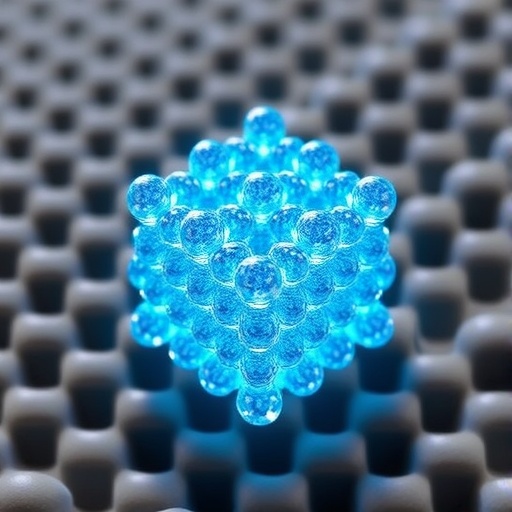
Gas molecules inside porous materials have long been treated as disordered guests, filling microscopic cavities according to averaged properties such as adsorption capacity and selectivity. A new study from the Korea Advanced Institute of Science and Technology (KAIST), however, suggests that confined gases can do something far more organized: assemble into crystal-like lattices. By using the architecture of a porous material as a template, researchers have designed a framework in which gas atoms adopt a regular, predictable arrangement inside the pores.
The work, led by Professor Jihan Kim of KAIST’s Department of Chemical and Biomolecular Engineering, introduces a computational strategy that combines large-scale screening of metal–organic frameworks, or MOFs, with machine-learning-assisted inverse design. MOFs are porous crystalline materials made by connecting metal ions or clusters with organic molecules. Their structures can be tuned to create networks of nanoscale cavities, making them valuable for gas storage, separation, catalysis and carbon-management technologies. Until now, most efforts to improve MOF performance have focused on modifying the host material to strengthen its interaction with individual gas molecules.
The KAIST team proposes a different design philosophy. Instead of treating the adsorbed gas as a disordered population, the researchers consider the arrangement of the guest molecules itself as a controllable material property. Their concept, called a “gas lattice,” describes a confined gas phase in which molecules or atoms exhibit structural correlations and pack into a regular pattern. In this approach, the pore is not merely a container. It acts as a nanoscale template that can stabilize an ordered arrangement under conditions where the same gas would require extreme pressure to crystallize in bulk.
To test the concept, the researchers selected xenon, a chemically inert and relatively large noble-gas atom, as a model system. Computer simulations based on grand canonical Monte Carlo, or GCMC, methods were used to examine how xenon molecules enter, distribute themselves within and leave the pores of different MOF structures. The calculations identified a cobalt-based framework known as Co-CAU-36 as a particularly effective host. Within this material, the xenon atoms were predicted to form a body-centered cubic, or BCC, lattice rather than spreading randomly throughout the pore space.
A BCC lattice is a highly organized three-dimensional structure in which particles occupy the corners of a cube and one additional particle sits at its center. The simulated xenon arrangement therefore resembles a miniature crystal embedded within the porous framework. The result is significant because it demonstrates that gas ordering can arise from geometric confinement and framework design, rather than from the enormous pressures typically required to form a dense crystalline gas phase under bulk conditions. The pore environment effectively supplies the structural constraints needed to guide the atoms into an ordered configuration.
The simulations also revealed an unexpected effect in mixtures of xenon and krypton, two noble gases with industrial relevance. When both gases were introduced into the framework, xenon preferentially occupied an ordered shell-like region near the pore walls, while krypton was displaced toward the central part of the cavity. This spatial separation differs from conventional adsorption, in which gases are generally described through overall loading, equilibrium composition or average affinity for the framework. The findings indicate that selective adsorption may involve not only which molecule is favored, but also where each component is positioned within a pore.
That behavior could open a new route for separating gases whose chemical properties are very similar. Xenon and krypton are both chemically inert and difficult to distinguish using conventional interactions, yet their size, polarizability and packing characteristics differ. A framework capable of arranging the two gases into separate regions could potentially provide new principles for purification, isotope processing or the recovery of valuable noble gases. The study remains computational, but it offers a molecular-level explanation for how pore geometry may create separation effects that are not obvious from bulk adsorption data alone.
To show that the ordered structures were not simply an accidental feature of Co-CAU-36, the researchers combined machine learning with a genetic algorithm. Inverse design begins with a desired outcome—in this case, a BCC- or face-centered cubic, or FCC-like, gas lattice—and works backward to identify host structures that might produce it. Rather than testing every possible MOF experimentally or through costly simulations, the computational framework learns relationships between pore geometry, adsorption behavior and guest–guest correlations. It can then search for candidate materials capable of stabilizing a specified molecular arrangement.
This shift could expand the role of MOFs from passive storage media into active structural platforms for controlling matter at the nanoscale. Ordered gas phases might influence diffusion, reaction pathways, optical responses or the local environment around catalytic sites. The same principles could eventually be explored with more complex molecules, including carbon dioxide, methane or water, although such systems would be substantially more difficult because molecular shape, flexibility and intermolecular forces introduce additional variables. For now, the KAIST study provides a proof of concept: a porous framework can be designed not only to capture a gas, but also to organize it.
“This research is the first demonstration of a gas forming a crystal-like ordered state inside a porous material,” Professor Kim said, emphasizing that the central advance is the move beyond maximizing adsorption capacity. The team’s findings, published in Nature Communications, establish gas-molecule arrangement as a potential design target for porous materials. If validated experimentally and extended to technologically important gases, framework-templated gas lattices could influence the future development of carbon capture, selective separation, gas storage and catalytic systems in which controlling molecular position is as important as controlling molecular quantity.
News Publication Date: 11-August
Web References: https://doi.org/10.1038/s41467-026-74776-5
References: Nature Communications; DOI: 10.1038/s41467-026-74776-5
Keywords
Metal–organic frameworks, gas lattices, xenon, krypton, porous materials, molecular ordering, gas separation, machine learning, inverse design, adsorption, GCMC simulations, carbon capture, gas storage
Cite Scienmag News
Bethany Barker. (August 11, 2026). KAIST Creates Gas Lattice in Porous Materials, Revealing Crystal-Like Structure. Scienmag. https://scienmag.com/kaist-creates-gas-lattice-in-porous-materials-revealing-crystal-like-structure/
Bethany Barker. "KAIST Creates Gas Lattice in Porous Materials, Revealing Crystal-Like Structure." Scienmag, 11 August 2026, https://scienmag.com/kaist-creates-gas-lattice-in-porous-materials-revealing-crystal-like-structure/. Accessed 4 September 2026.
Bethany Barker. "KAIST Creates Gas Lattice in Porous Materials, Revealing Crystal-Like Structure." Scienmag. August 11, 2026. https://scienmag.com/kaist-creates-gas-lattice-in-porous-materials-revealing-crystal-like-structure/


