


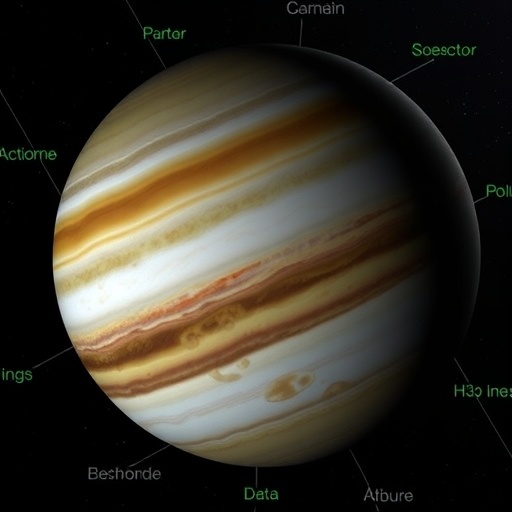
Jupiter’s aurora is doing more than lighting up the largest planet in the Solar System. New observations have provided the first unambiguous, direct detection of trihydrogen cations, or H₃⁺, in Jupiter’s polar plasma environment and have revealed that some of these electrically charged molecules are escaping the planet entirely. The discovery offers the clearest evidence yet that Jupiter’s upper atmosphere is not simply responding to the magnetosphere above it, but is actively supplying material to space through a previously unconfirmed pathway.
H₃⁺ is a small but extraordinarily important ion in hydrogen-rich atmospheres. It forms when hydrogen molecules are ionized by energetic solar radiation or by particles accelerated within a planet’s magnetic environment. In Jupiter’s auroral regions, intense electron precipitation provides an especially efficient source of ionization. Once produced, H₃⁺ radiates strongly in the infrared, making it a valuable tracer of atmospheric temperature, energy deposition and ionospheric dynamics. Its emissions have long allowed researchers to study Jupiter’s polar atmosphere from afar, but those observations could not directly determine how much H₃⁺ was present at particular altitudes or whether it was moving away from the planet.
The new study changes that picture by detecting H₃⁺ plasma in situ, directly within the auroral region rather than through infrared light integrated along a distant line of sight. That distinction is crucial. Remote observations combine emissions from broad regions of the atmosphere, making it difficult to separate structures at different heights or to follow the motion of individual plasma populations. An in situ measurement can identify the ions themselves and determine how their density and velocity vary within the surrounding space plasma. The result is direct evidence that H₃⁺ exists as a mobile, dynamically important component of Jupiter’s polar environment.
The measurements also revealed intermittent bursts of H₃⁺ flowing upward from the ionosphere. These outflows reached velocities greater than Jupiter’s escape speed, meaning that at least part of the ion population possesses enough kinetic energy to overcome the planet’s powerful gravitational field. Rather than rising briefly and falling back into the atmosphere, these ions can be carried outward into the magnetosphere and, in the fastest events, escape Jupiter altogether. The finding identifies H₃⁺ as a previously overlooked vehicle for removing both mass and energy from the Jovian atmosphere.
The estimated loss rate is on the order of 10²⁶ H₃⁺ ions per second. In planetary terms, that is a substantial flow, even though H₃⁺ represents only a trace component of Jupiter’s overwhelmingly hydrogen-dominated atmosphere. The escape does not imply that Jupiter is rapidly losing its atmosphere or that the planet’s structure is threatened. Jupiter is enormously massive, and its atmospheric reservoir is vast. Instead, the result reveals a persistent form of coupling between the ionosphere and magnetosphere, in which a chemically distinctive ion can transport atmospheric material into the surrounding plasma environment.
The researchers propose that the outflow begins in regions associated with upward electric currents above the auroral ionosphere. Jupiter’s aurora is powered by the interaction between the planet’s rapidly rotating magnetic field, its magnetosphere and charged particles moving along magnetic field lines. In these regions, electromagnetic energy can be transferred into the upper atmosphere through particle precipitation, electric fields and plasma waves. Plasma-wave interactions may first disturb and energize H₃⁺ near the ionosphere. The ions can then be accelerated further by electric potential structures that develop above the atmosphere, producing the observed high-speed outflows.
This mechanism illustrates why H₃⁺ is more than an infrared thermometer. As a molecular ion, it participates in the chemistry and electrical conductivity of the upper atmosphere. The abundance and distribution of H₃⁺ influence how easily electric currents can flow through the ionosphere, while the currents themselves help shape the electric fields that govern charged-particle motion. In this way, H₃⁺ may form part of a feedback system: auroral energy creates the ions, the ions alter ionospheric conductance, and the resulting electrodynamic environment helps regulate their transport into the magnetosphere.
The discovery also helps resolve a long-standing observational problem in planetary science. Jupiter’s auroral emissions are among the brightest and most complex in the Solar System, but infrared brightness alone cannot reveal the complete three-dimensional structure of the plasma above the clouds. A bright signal may represent dense plasma, high temperature, enhanced excitation or a combination of these factors. Direct detection of escaping H₃⁺ provides a physical link between the remote-sensing signatures and the actual movement of atmospheric ions. It gives researchers a way to test models of auroral heating, ionospheric conductivity and atmospheric escape against measurements made in the plasma itself.
Jupiter may not be unique. Other planets and moons with hydrogen-rich atmospheres, strong magnetic fields and infrared aurorae could host related processes. The same general chain—ion production, wave-driven energization, electric acceleration and eventual escape—could operate wherever auroral currents connect an atmosphere to a powerful magnetosphere. The new result therefore extends beyond a single planet. It suggests that molecular ions can serve as active messengers between atmospheric chemistry and space plasma physics, carrying energy and material from a planetary ionosphere into its magnetospheric surroundings. For Jupiter, the aurora is now shown to be not only a spectacular light display, but also an engine of atmospheric escape.
Cite Scienmag News
Russell Cooper. (August 13, 2026). Jupiter’s Polar Regions Release H₃⁺ Ions Into Space. Scienmag. https://scienmag.com/jupiters-polar-regions-release-h%e2%82%83%e2%81%ba-ions-into-space/
Russell Cooper. "Jupiter’s Polar Regions Release H₃⁺ Ions Into Space." Scienmag, 13 August 2026, https://scienmag.com/jupiters-polar-regions-release-h%e2%82%83%e2%81%ba-ions-into-space/. Accessed 3 September 2026.
Russell Cooper. "Jupiter’s Polar Regions Release H₃⁺ Ions Into Space." Scienmag. August 13, 2026. https://scienmag.com/jupiters-polar-regions-release-h%e2%82%83%e2%81%ba-ions-into-space/


