


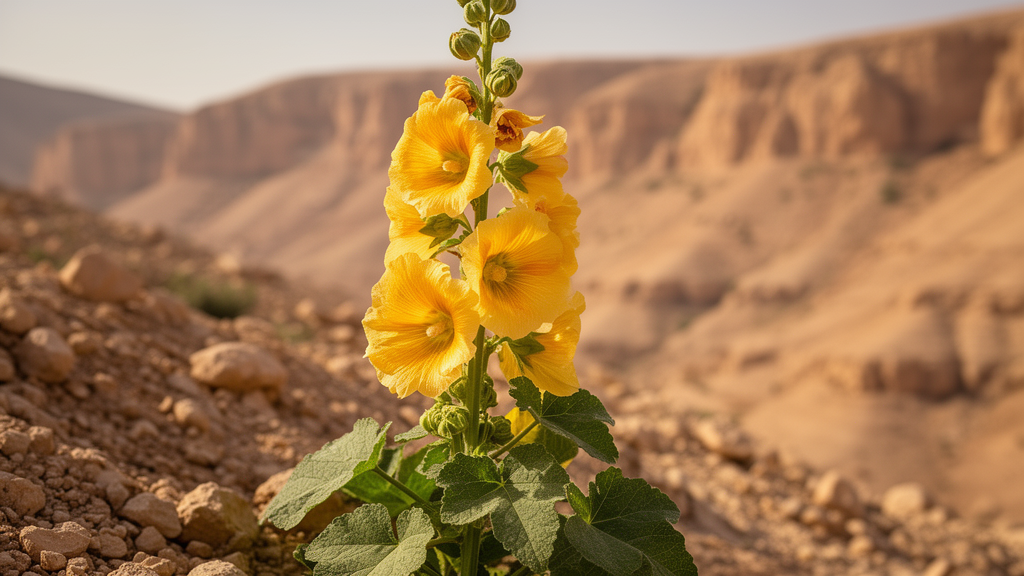
Deep in Jordan’s Eastern Desert, a yellow-flowered perennial that botanists have largely overlooked is now stepping into the phytochemical spotlight. Alcea chrysantha, a hollyhock relative endemic to the Mafraq–Safawi region and East Amman, has received its first comprehensive chemical portrait, and the findings suggest this unassuming member of the Malvaceae family could be a genuine reservoir of bioactive compounds. Researchers collected twenty whole flowering plants in April 2024, verified the species with a plant taxonomist at the University of Jordan, and archived voucher specimens under reference number 710 before subjecting the material to a battery of spectrophotometric and chromatographic analyses.
The study, published in Italian Botanist, set out to profile methanolic and aqueous extracts of the whole plant by measuring total phenolic and flavonoid contents, evaluating antioxidant activity through two complementary assays, and characterizing the essential oil by gas chromatography–mass spectrometry. The genus Alcea encompasses more than forty subspecies across Asia and Europe, and several of its members have long histories in traditional medicine for treating gastrointestinal disorders, dermatological inflammations, and respiratory tract infections. Those traditional applications imply the presence of potent bioactive molecules, yet A. chrysantha itself remained comparatively under-investigated, with a notable absence of documentation of its biological activities.
Extraction efficiency told the first part of the story. From twenty grams of dried, powdered whole plant, maceration in seventy percent methanol yielded ten percent of the starting mass as dried extract, while distilled water yielded only five percent. That doubling of yield foreshadowed the solvent-dependent differences that emerged throughout the work. Methanol, being an organic solvent of moderate polarity, is generally more effective at drawing out phenolic compounds and flavonoids, molecules whose hydroxyl-rich aromatic structures dissolve more readily in organic media than in pure water.
The quantitative results confirmed this expectation with striking clarity. Total phenolic content, expressed in gallic acid equivalents per gram of extract, reached 39.1 ± 3.7 mg GAE/g for the methanolic extract but only 12 ± 0.3 mg GAE/g for the aqueous extract. Total flavonoid content, quantified as quercetin equivalents, followed the same pattern at 29 ± 1.8 mg QE/g versus 8.3 ± 0.8 mg QE/g. These differences were statistically significant, with p values below 0.0001 across three replicates, and they align with prior work on related species such as Alcea dissecta, A. calvertii, A. pallida, and A. apterocarpa, where organic solvents consistently outperformed water at extracting phenols and flavonoids.
Antioxidant activity was then evaluated through two assays based on different chemical mechanisms. The DPPH radical scavenging assay measures the ability of an extract to neutralize a stable purple free radical, with absorbance read at 517 nanometers and results expressed as the IC₅₀, the concentration needed to inhibit fifty percent of radicals. The methanolic extract achieved an IC₅₀ of 712.3 ± 6.46 µg/mL, outperforming the aqueous extract at 810.6 ± 6.43 µg/mL. Ascorbic acid, the positive control, showed an IC₅₀ of roughly 4.0 µg/mL, underscoring that the plant extracts, while measurably active, remain far less potent than pure vitamin C on a mass-for-mass basis.
The ferric reducing antioxidant power assay provided a second, mechanistically distinct line of evidence. In this test, one hundred microliters of extract are mixed with freshly prepared FRAP reagent and incubated at thirty-seven degrees Celsius for thirty minutes, with absorbance measured at 593 nanometers and values expressed in Trolox equivalents per gram of dry weight. The methanolic extract delivered 3.86 ± 0.06 mg TE/g DW, more than three times the 1.23 ± 0.01 mg TE/g DW of the aqueous extract. The strong correlation between the two assays, despite their different underlying chemistry, reinforces the conclusion that the phenolic and flavonoid compounds concentrated in the methanolic extract are the principal drivers of antioxidant capacity, operating through hydrogen atom transfer, electron transfer, and metal ion chelation mechanisms.
The essential oil analysis revealed an entirely different facet of the plant’s chemistry. Two hundred grams of fresh material were hydrodistilled for four hours in a Clevenger apparatus, dried over anhydrous sodium sulfate, and analyzed by GC–MS against WILEY, NIST, and ADAMS-2007 mass spectral libraries with linear retention index comparisons. More than thirty compounds were identified, with total identified content reaching 98.92 percent. Hexadecanoic acid, commonly known as palmitic acid, dominated at 21.67 percent, followed by (9Z)-octadec-9-enoic acid, or oleic acid, at 11.82 percent, the long-chain hydrocarbon tricosane at 10.77 percent, tetradecanoic acid at 5.27 percent, and 1-docosene at 4.88 percent.
Classified by chemical family, the volatile composition was overwhelmingly aliphatic, with hydrocarbons accounting for 91.01 percent of the total. Sesquiterpenes contributed 4.18 percent, aromatics and phenolics 2.30 percent, monoterpenes 0.76 percent, and diterpenes a minor 0.68 percent. The authors caution that some components were tentatively identified on mass spectral data alone, meaning structural isomers cannot be definitively distinguished without retention index calculations. This fatty-acid-rich, hydrocarbon-dominated profile differs markedly from the terpenoid-heavy oils reported for A. pallida, A. apterocarpa, and A. rosea, enriching the chemical diversity of the genus with a composition that appears unique among its studied relatives.
Essential oils are known for broad biological effects, including antimicrobial, antifungal, antitumor, anti-inflammatory, and antioxidant activities, with documented relevance to airway disorders such as asthma and chronic bronchitis, as well as fungicidal, antiparasitic, insecticidal, medicinal, and cosmetic applications. The complex mixture of fatty acids, saturated and unsaturated esters, and hydrocarbons found in A. chrysantha therefore suggests significant medicinal value, even though the precise biological activities of this particular oil remain to be tested directly. The study’s statistical framework, using one-way ANOVA with Tukey’s post-hoc test at p < 0.05 and GraphPad Prism 8 software, ensured that the reported differences between extracts rest on solid quantitative ground.
Taken together, the findings position A. chrysantha as a promising medicinal plant with potential applications spanning the pharmaceutical, nutraceutical, food, and industrial sectors. The methanolic extract’s superior phenolic and flavonoid contents and stronger antioxidant performance confirm the key role of solvent selection in optimizing extraction, while the first-ever essential oil characterization adds a new dimension to the phytochemical knowledge of a species found nowhere else on Earth. As interest in natural bioactive compounds continues to grow, this endemic Jordanian hollyhock deserves further investigation into its therapeutic uses, and its unique chemical signature may yet yield molecules of genuine value to human health.
Subject of Research: Phytochemical analysis of methanolic, aqueous extracts, and essential oil composition of Alcea chrysantha ( Malvaceae )
Article Title: Phytochemical analysis of methanolic, aqueous extracts, and essential oil composition of Alcea chrysantha ( Malvaceae )
Article References: Darwish, M., Oran, S., Al-Qadiri, H., & Hudaib, M. (2026). Phytochemical analysis of methanolic, aqueous extracts, and essential oil composition of Alcea chrysantha (Malvaceae). Italian Botanist, 21, 1-12. https://doi.org/10.3897/italianbotanist.21.181944
Image Credits: AI Generated
DOI: 10.3897/italianbotanist.21.181944
Keywords: Phytochemical, analysis, methanolic, aqueous, extracts, essential, composition, Alcea, chrysantha, Malvaceae, scientific research
Cite Scienmag News
Drew Townsend. (October 17, 2026). Jordan’s Golden Hollyhock Reveals Antioxidant Riches in First Chemical Portrait. Scienmag. https://scienmag.com/jordans-golden-hollyhock-reveals-antioxidant-riches-in-first-chemical-portrait/
Drew Townsend. "Jordan’s Golden Hollyhock Reveals Antioxidant Riches in First Chemical Portrait." Scienmag, 17 October 2026, https://scienmag.com/jordans-golden-hollyhock-reveals-antioxidant-riches-in-first-chemical-portrait/. Accessed 17 October 2026.
Drew Townsend. "Jordan’s Golden Hollyhock Reveals Antioxidant Riches in First Chemical Portrait." Scienmag. October 17, 2026. https://scienmag.com/jordans-golden-hollyhock-reveals-antioxidant-riches-in-first-chemical-portrait/


