


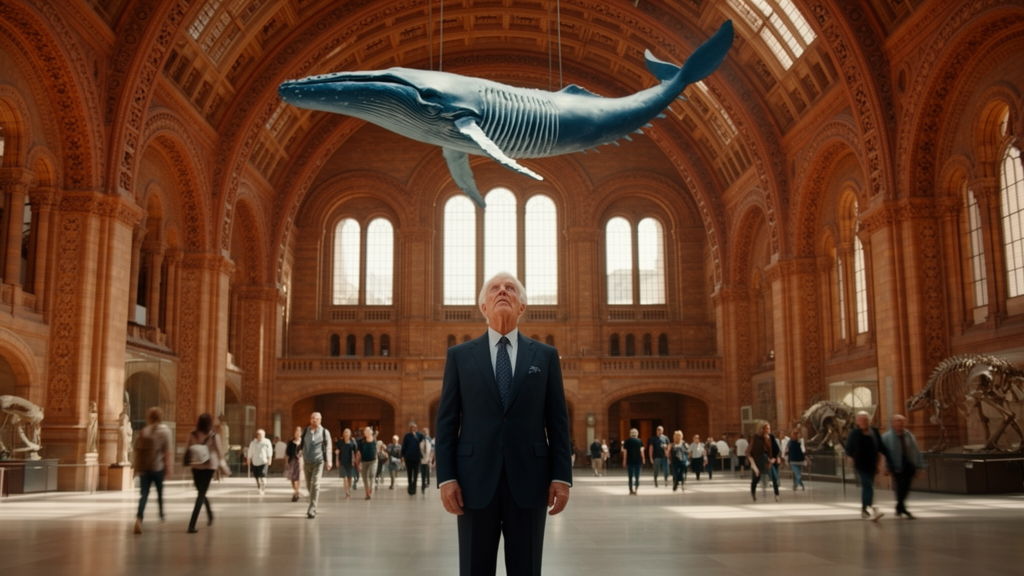
John Fordyce Peake, who died peacefully at his home in Blakeney, Norfolk, on 12 February 2024 at the age of 90, was one of the most consequential and most controversial figures ever to walk the corridors of London’s Natural History Museum. A new retrospective assessment published in the journal Natural History Collections and Museomics traces his remarkable journey from the sand dunes of the North Norfolk coast to the very summit of museum science administration, where in 1989 he became the institution’s first Associate Director for Science. The portrait that emerges is of a man who published comparatively little original research, yet whose fingerprints are on nearly every innovation that carried natural history museums from the Victorian age of cabinets and curiosities into the digital era of biodiversity databases, DNA laboratories, and global biopolitics.
Peake was born in Norwich on 4 June 1933, the son of a boot and shoe designer in a city long famous for that industry. His childhood was spent within easy reach of the Blakeney Point sand dunes and the Scolt Head Island National Nature Reserve, coastal systems whose ecology became the obsession of his youth. By 1955 he owned a Villiers-powered Ambassador motorcycle, an ideal vehicle for his emerging natural history interests, and that year he secured a National Trust grant to survey the animal communities of the Blakeney Point dunes. He graduated with second-class honours in zoology from University College London in July 1955, at a time when his mentors included Peter Medawar, J. B. S. Haldane, John Maynard Smith, and Alex Comfort. He registered for a doctorate in ecology, but the project collapsed when the dune system he had chosen to study was destroyed by rats, an ecological catastrophe that abruptly ended his formal research career before it had properly begun.
What followed instead was a Nature Conservancy studentship for work on the terrestrial molluscs of Scolt Head, including the genera Cepaea, Helix, and Helicella, funded by London University’s Central Research Fund with the eminent population ecologist Professor O. W. Richards as director of research. His first published paper, appearing in 1958, described the Western Palaearctic spider Clubiona similis as new to Britain, recognised in his Blakeney Point samples and critically identified by three of the most prominent British arachnologists of the era: Eric Duffey, George Locket, and Alfred Millidge. His second publication, an account of the island’s molluscs completed in May 1958, appeared two years later in the second edition of the influential coastal geomorphology volume Scolt Head Island, edited by James Steers, then regarded as Britain’s leading authority in the field. This early work brought him to the attention of the British Museum (Natural History), as the South Kensington institution was then known, and in November 1959 he was awarded a research fellowship to study geographical variation and speciation in the mainly European genus Helicella.
Peake joined the museum staff as a Senior Scientific Officer in the Mollusca Section in 1961, and his rise through the ranks was, by museum standards, meteoric. He was promoted to Principal Scientific Officer in 1969 at the age of 36, became Deputy Keeper of Zoology in 1971, Keeper of Zoology in 1985, and finally, following the appointment of Neil Chalmers as Director in 1988, the museum’s first Associate Director for Scientific Development in 1989, a post that has been maintained ever since under its current designation as Executive Director of Science. Yet his colleagues were often nonplussed by this steady ascent, because Peake’s published output of original research was modest even by the standards of a period not yet afflicted by the publish-or-perish imperative that prevails today. He was employed in a primary research role for only twelve years, from 1959 to 1971, and listed just 33 publications over his entire museum career.
The explanation lies in what managers value over bench scientists. Peake was, by all accounts, an ideas person in the sense described by Richard Lane: not brimming with original concepts, but enjoying the discussion and testing of new approaches in the hope that some might lead to more pressing scientific questions or more efficient applications. As Stephen Blackmore observed, John was interested in scientific trends beyond traditional museum research, importing ideas from his travels. His fieldwork had shaped this outlook profoundly. Despite being born with peculiar feet that his shoe-designer father ameliorated with a special type of shoe later marketed commercially, and despite contracting tuberculosis in his early years, which required surgical removal of a large part of one lung, Peake was an active and intrepid fieldworker. He participated in the Royal Society Expedition to the Solomon Islands from July to December 1965, investigating the highly diverse terrestrial snail fauna, an experience that converted him to the dynamic island biogeography of MacArthur and Wilson. He joined the Royal Society Expedition to Aldabra Atoll in the Indian Ocean for three weeks in 1967, made research visits to the Marquesas and Hawaiian Islands in the early 1970s, and shifted his research focus from microecology to macroecology across Old World island systems and archipelagos.
It was at Aldabra that Peake’s most prescient technological legacy took root. After the research station was built in 1972, he became a member of the Royal Society’s Aldabra Research Committee and obtained a Natural Environment Research Council grant to establish a data-recording unit for the atoll’s fauna and flora records. Financed by NERC and overseen by Peake, this was one of the world’s first biodiversity databases. Using a Friden Flexowriter housed in the Mollusca Section library, records based on material collected on the island were entered onto punched tape, which was then fed into a minicomputer. Although the records were never migrated from punched tape to a modern interface, the original record cards remain on Aldabra, as do complete printouts from the database, and the Seychelles Islands Foundation is now digitising the information. Peake had grasped, decades before the term biodiversity entered common usage, that biological specimen data held in museums could be transformed into accessible digital information serving scientists worldwide.
As Associate Director, Peake drove a series of innovations that transformed the museum’s scientific infrastructure. He was in the vanguard of introducing desktop computers and email throughout the institution before many other non-university organisations even had access. In the mid-1980s he made early contact with the pioneering DNA analyst Alec Jeffreys, prompting his desire to build on the molecular work of Chris Wright’s exceptional schistosomiasis group through the creation of the museum’s own DNA sequencing laboratory, a shift in museum work and emphasis that continues to have a major impact. Following a trip to Australia, where he met CSIRO and ESRI staff, he ensured the museum gained experience of GIS mapping by creating a special unit in the Botany Department. He also narrowed the zoology department’s research focus with an eye to contract and revenue-generating work, a tradition that has remained strong among the museum’s zoologists ever since, though it caused considerable distress at the time, notably when he redeployed the widely respected spider specialist Fred Wanless to work on nematodes.
Peake’s tenure coincided with acute financial pressures documented in Nature by the then Chairman of the museum’s Trustees, Sir Walter Bodmer, who outlined falling income from entrance charges introduced in 1987 and declining government grant-in-aid that no longer rose in line with inflation. Peake’s response included enthusiastic support for the contentious Disney World training of gallery staff, with £30,000 spent in 1989 on sending 11 staff to Florida to attend a Disney customer-care course, a decision that made national headlines. He also promoted contract work across all science departments, creating a culture clash with the entomologists in particular, who regarded it as their mission to create and freely publish identification guides for public use rather than hire out their identification expertise to other agencies. In the run-up to the adoption of the UN Convention on Biological Diversity in the early 1990s, Peake appointed Ian Gauld as an informal Biodiversity Ambassador to strengthen relationships with organisations such as the Instituto Nacional de Biodiversidad in Costa Rica, founded in 1989, which rapidly became influential in training parataxonomists and developing biological inventories. He supported the development of a tropical research station at Las Cuevas in the Chiquibul Forest of Belize, a joint initiative between the museum and the Government of Belize, and became an early advocate of specimen digitisation as a way of making collections accessible worldwide.
Following his retirement in 1992, Peake travelled extensively as a consultant, notably for the Global Environment Facility Indonesian Biodiversity Project for the renewal of Museum Zoologicum Bogoriense at Cibinong, Java, working in collaboration with John S. Burley of Harvard University’s Arnold Arboretum to create an international model for biodiversity conservation through technology transfer to a developing country. He served as Zoology Advisor from 1993 until the project’s premature cessation due to civil unrest in 1998. Despite the setback, MZB is now considered to hold the most significant scientific collections in Southeast Asia. At home, Peake became active in researching the local history of North Norfolk, authoring scholarly papers and editing The Glaven Historian, the journal of the Blakeney Area Historical Society. In the world of mollusc taxonomy, he is commemorated by two species named in his honour: Juventigulella peakei from Aldabra Atoll and Bocourtia peakei from Peru. The paradox he identified in 1989, that collections are both the glue that holds museums together and the glue that prevents them from developing and evolving, restricts our vision, remains a live question for every natural history museum confronting the digital age. Peake spent his career arguing that the answer lay in transformation, and the institutions that followed his lead are the proof that he was right.
Subject of Research: John Fordyce Peake (1933–2024) – with a retrospective assessment of his contributions to science and museum policy
Article Title: John Fordyce Peake (1933–2024) – with a retrospective assessment of his contributions to science and museum policy
Article References: Vane-Wright, R. I., Taylor, J. D., & Jackson, J. (2025). John Fordyce Peake (1933–2024) – with a retrospective assessment of his contributions to science and museum policy. Natural History Collections and Museomics, 2, 1-16. https://doi.org/10.3897/nhcm.2.168186
Image Credits: AI Generated
Keywords: John Peake, Natural History Museum, museum policy, biodiversity, collections, Aldabra, malacology, museomics, John, Fordyce, Peake, retrospective
Cite Scienmag News
Gavin Prescott. (October 17, 2026). John Peake, the controversial visionary who transformed London’s Natural History Museum. Scienmag. https://scienmag.com/john-peake-the-controversial-visionary-who-transformed-londons-natural-history-museum/
Gavin Prescott. "John Peake, the controversial visionary who transformed London’s Natural History Museum." Scienmag, 17 October 2026, https://scienmag.com/john-peake-the-controversial-visionary-who-transformed-londons-natural-history-museum/. Accessed 17 October 2026.
Gavin Prescott. "John Peake, the controversial visionary who transformed London’s Natural History Museum." Scienmag. October 17, 2026. https://scienmag.com/john-peake-the-controversial-visionary-who-transformed-londons-natural-history-museum/


