


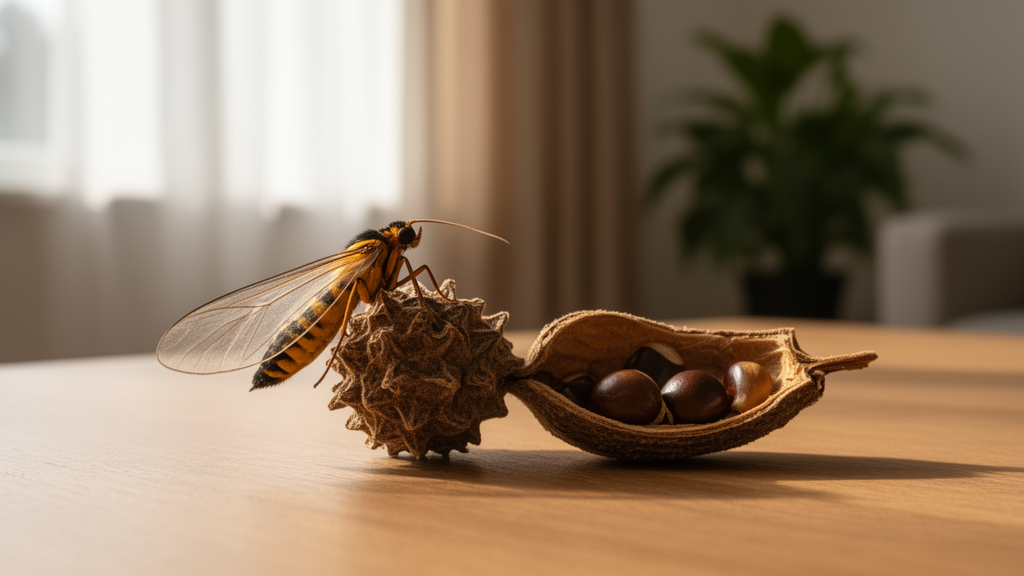
On a cold February evening in Port Talbot, South Wales, a town better known for its steelworks than for tropical insects, an unidentified moth flew at a window inside a family home. A dead specimen lay on the windowsill nearby. Daisy T. Cadet, who is not a lepidopterist, photographed the live insect and posted the image on Instagram. Within days, that single photograph had set in motion a chain of identifications, DNA barcoding sessions and museum comparisons that would end with the formal description of a species of clearwing moth entirely new to science, native to the rainforests of Guyana, and never before recorded from Europe.
The story began months earlier, when Cadet’s mother, Ashleigh Cadet, a professional photographer, returned on 18 October 2023 from a photographic assignment in central Guyana. Her boot bag, still carrying dried mud and debris from the trip, sat in a corner of the room where the moths appeared. When researchers at the Natural History Museum, London suggested searching the house’s roughly 85 indoor pot plants and any remaining cut flowers for hostplants and pupal exuviae, the search produced nothing. But a careful examination of the boot bag itself revealed two almost intact pupal exuviae and fragments of plant material, including a mud-caked piece of seedpod about the size of a British 50p coin, bearing two exit holes of almost exactly the same diameter as the pupal exuviae, along with larval galleries and frass mixed with silk.
The two adult specimens, one live and one dead, were promptly DNA barcoded at the Natural History Museum. The results placed them firmly within Carmenta Edwards, 1881, a large genus of clearwing moths in the family Sesiidae distributed throughout the Americas. The barcode sequence showed a minimum p-distance of 5.66% to the nearest hit on the BOLD identification engine, a distance far too great for the specimens to belong to any already barcoded species. Only DNA barcodes identified as Carmenta appeared among the top 50 hits. The genus had never previously been recorded from Europe or the United Kingdom, even accidentally, and the specimens represented an apparently seed-boring lineage from Central America and northern South America.
Phylogenetic analysis using Phyml 3.0, run with the model selected by the Bayesian Information Criterion, showed the mystery clearwing falling within a clade subtended by Carmenta mimosa, a species introduced to Australia and elsewhere as a biological control agent for the invasive weed Mimosa pigra. The new species sits in a subclade that includes C. foraseminis, a pest of cocoa pods, and two apparently undescribed species from Barro Colorado Island in Panama, with an apparent sister relationship to the latter. The holotype and paratype sequences are identical, and the species carries Barcode Index Number BOLD:AGA4441, publicly available on BOLD with GenBank accession numbers PP866044 and PP866043.
The plant fragment told its own molecular story. Dr Sandra Knapp of the Natural History Museum immediately suggested, on visual inspection alone, that the fragment was part of a seedpod of the leguminous tree genus Mora, a suggestion that proved correct. Researchers ground a small fragment of seed in liquid nitrogen, extracted DNA using a CTAB protocol, and amplified three plant DNA barcoding regions: matK, rbcL and ITS2. The matK marker produced a perfect 100% match with Mora excelsa Benth., a dominant, large buttress-rooted tree of riverine forest in central Guyana. The rbcL marker gave a 100% match with both M. excelsa and Stachyothyrsus stapfiana, a result consistent with the correct identity given the phylogenetic context. The ITS2 marker failed to match the hostplant tree, instead producing matches with species of the fungal genus Talaromyces, likely a contaminant or endophyte.
Morphological comparison then confirmed what the molecules suggested. The naming authors compared the specimens to all described species of Carmenta, examining type specimens and genitalia held at the Natural History Museum and photographic images of types held elsewhere, including the rediscovered syntypes of Sesia surinamensis Möschler, 1878, located in the Museum für Naturkunde, Berlin after being described as lost. Substantial differences emerged between the mystery clearwing and every shortlisted candidate. The closest taxa are C. whitelyi and an undescribed taxon referred to as C. cf. whitelyi, but the new species differs in the length of the branch of M3 and CuA1 in the hindwing, which is one-tenth rather than one-fifth of the distance between the edge of the discal cell and the termen, and in the shape of the discal spot and exterior transparent area of the forewing.
The new species has been named Carmenta brachyclados Sterling & Lees, 2024, the specific name derived from the Greek brachys, short, and klados, a branch, after that characteristic short hindwing vein branch. The holotype, a female with a wingspan of 18 millimetres, was found live indoors in Port Talbot on 4 February 2024, over three months after the seedpod fragment arrived in the country. The paratype, also a female, was found dead in the house. Both types, along with the pupal exuviae and the hostplant voucher, are deposited at the Natural History Museum, London. Under the updated ICZN Code, the type locality is properly described as Central Guyana, the place from which the name-bearing type began its unnatural journey, rather than the Welsh town where the adults emerged.
The discovery sheds light on the ecology of a little-known group of Neotropical seed-boring clearwings. The larva of C. brachyclados, at least in its latter stages, bores between the hardened surfaces of the seedpod of Mora excelsa, a part of the pod that is less nutritious than the fruits or seeds but potentially better defended against predation by ground-foraging mammals such as agoutis, squirrels and peccaries. Seeds of M. excelsa are among the most well defended of five Neotropical trees studied for antifeedant effects, and the tree is thought to form monospecific stands occupying as much as 85 to 95% of canopy abundance in Trinidad. The researchers suggest that boring into the hardened pod may allow the moth to avoid these antifeedants without necessarily affecting seed germination rates, since even damaged seeds of related species are highly tolerant of such damage and can often sprout.
The genus Carmenta is exceptionally diverse and phylogenetically polyphyletic as currently constituted. Multigene phylogenies have shown that the genera Alcathoe, Hymenoclea and Penstemonia all fall within Carmenta, and further evidence indicates that Aegerina and Euryphrissa do as well. The researchers highlight the need for a much more comprehensive phylogenetic revision of the group, and note that there must be other undescribed species ready to discover in the Neotropics. A few Carmenta species have pest status in Central and South America, notably C. foraseminis, which infests cocoa pods, and C. theobromae, also reported as a pest of guava, although DNA barcode data show confusion between C. surinamensis, C. theobromae and C. foraseminis, meaning identities in the pest literature should be taken with caution.
It is rare for a species of micromoth, and most unusual for a species of larger moth as that term is commonly used in the United Kingdom, to be newly described from specimens found in the country. The last time the latter occurred was with Thera britannica in 1925. The chances of two clearwing moths from the Neotropics successfully emerging in South Wales, over three months after arrival, from a small fragment of a tropical seedpod accidentally stuck to a photographer’s boot, carried halfway around the world in a boot bag to a cold Welsh winter, and being preserved in good condition together with their food source and pupal exuviae, seem extraordinarily remote. The finding stands as a striking example of how community science, assisted by social media, can capture and preserve biodiversity data from unlikely places, and how international travel continues to bring the world’s insects into contact with new observers.
Subject of Research: Discovery and description of Carmenta brachyclados, a new clearwing moth species from Guyana identified after its pupae emerged indoors in Wales.
Article Title: A success for community science: Carmenta brachyclados sp. nov. ( Lepidoptera , Sesiidae , Synanthedonini ), a clearwing moth from Guyana discovered with its hostplant indoors in Wales (United Kingdom)
Article References: Sterling, M. J., Cadet, D. T., Beasley, J., & Lees, D. C. (2024). A success for community science: Carmenta brachyclados sp. nov. (Lepidoptera, Sesiidae, Synanthedonini), a clearwing moth from Guyana discovered with its hostplant indoors in Wales (United Kingdom). Nota Lepidopterologica, 47, 201-218. https://doi.org/10.3897/nl.47.130138
Image Credits: AI Generated
DOI: 10.3897/nl.47.130138
Keywords: clearwing moth, Carmenta brachyclados, community science, DNA barcoding, Guyana, Wales, Sesiidae, Mora excelsa, entomology, new species, success, community
Cite Scienmag News
Patricia Pace. (October 17, 2026). New clearwing moth species traced from Guyana seedpod to Welsh living room. Scienmag. https://scienmag.com/new-clearwing-moth-species-traced-from-guyana-seedpod-to-welsh-living-room/
Patricia Pace. "New clearwing moth species traced from Guyana seedpod to Welsh living room." Scienmag, 17 October 2026, https://scienmag.com/new-clearwing-moth-species-traced-from-guyana-seedpod-to-welsh-living-room/. Accessed 17 October 2026.
Patricia Pace. "New clearwing moth species traced from Guyana seedpod to Welsh living room." Scienmag. October 17, 2026. https://scienmag.com/new-clearwing-moth-species-traced-from-guyana-seedpod-to-welsh-living-room/


