


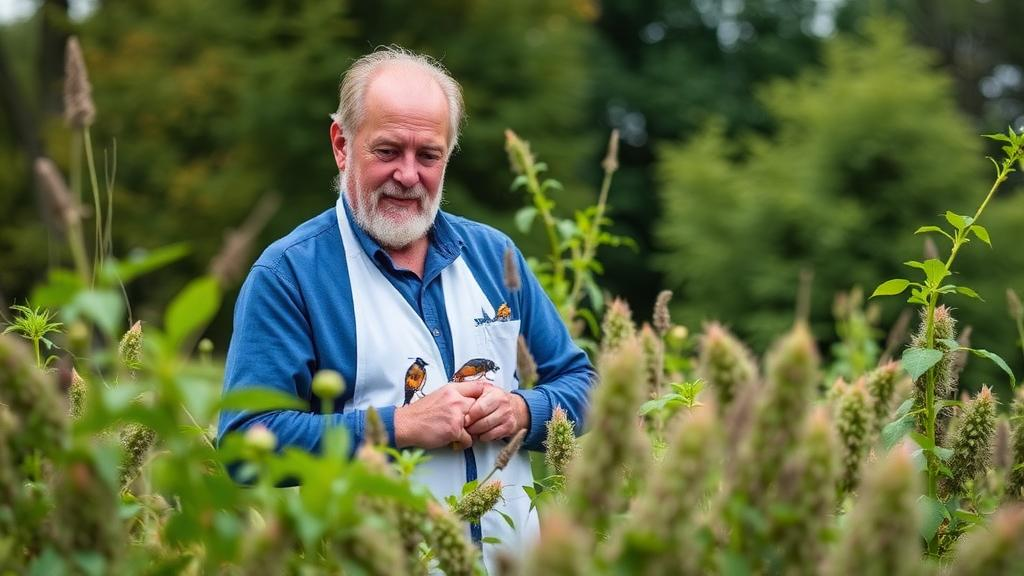
Jacques Derron, a Swiss agronomist and entomologist whose career linked laboratory science with practical decisions in farming, died suddenly on 29 July 2022 at the age of 77. Born on 16 September 1945 in Vully, a farming region beside Lake Morat, he developed an early fascination with insects, amphibians and the natural communities surrounding agricultural land. His professional path eventually led to Agroscope’s research site at Changins, where he joined the entomology service in January 1980 and served as its head until his retirement in 2008. The memorial published in Alpine Entomology traces a career devoted not simply to measuring pests, but to understanding the ecological systems in which crops, insects, natural enemies and human decisions interact.
Derron studied agronomy at the Swiss Federal Institute of Technology in Zurich, where entomology and integrated production attracted him. His diploma work focused on biological control of the cherry fruit fly, an early indication of the approach that would define his work: reducing dependence on broad-spectrum chemical treatments by manipulating interactions among organisms. After graduating, he and his wife, Monique, who was also an agricultural engineer, moved to São Tomé in the Gulf of Guinea. For three years he studied the entomofauna of cocoa plantations and documented insects across the island’s agricultural habitats. His fieldwork revealed a remarkable diversity, including new species of ladybirds, among them Nephus derroni and Thea moniqueae, which were named in recognition of Derron and his wife.
That research formed the basis of his 1977 doctoral thesis, “Ecological approach to the entomofauna of the cacao plantations of São Tomé,” supervised by Prof. Dr. V. Delucchi at the Institute of Entomology at ETH Zurich. The project was more than a taxonomic exercise. It asked how the composition, distribution and ecological relationships of insects varied among cocoa-growing environments. Such questions remain central to tropical agriculture, where the arrival of pests can disrupt yields and prompt rapid intervention, while natural enemies may provide less visible but equally important services. Derron’s São Tomé years also gave him a lasting interest in volcanic islands, a landscape type he continued to explore with Monique and their two daughters in later years.
Returning to Switzerland, Derron joined the plant protection service of the canton of Geneva in 1977. He investigated the barley yellow dwarf disease and the aphids that transmit its viruses, while also examining intervention thresholds for crop pests. These thresholds are not simply biological constants. They combine observations of pest pressure, the stage and condition of crops, the potential for natural control, treatment effectiveness and economic consequences. The purpose, as Derron described it, was to give farmers a decision-making tool that would indicate when plant-protection intervention was justified and worthwhile. This focus on action thresholds reflected a broader principle: pest management should be evaluated within the functioning of an agroecosystem rather than reduced to reaction after visible damage appears.
His move to Agroscope in 1980 broadened the range of problems he studied. He worked on epidemiological questions involving virus vectors in potatoes and cereals, investigated ways to limit insect damage in oilseed rape, and encountered some of the earliest cases of insecticide resistance in agricultural settings. He also helped develop intervention thresholds and participated actively in biological control through the release of trichogrammatid wasps against the European corn borer. These tiny parasitoid wasps lay their eggs in the eggs of pest moths, preventing the host insects from completing development. By placing the technique among broader measures of crop protection, Derron helped connect laboratory knowledge with field-scale management of plant pests.
Much of Derron’s influence came through collaboration. At the national level, he exchanged knowledge with cantonal authorities, interprofessional organizations, agricultural companies and farmers. Internationally, his involvement in the Euraphid project connected him to wider efforts to manage aphids and the viruses they carry across Europe. He also taught integrated production to agricultural students at ETH Zurich with colleagues from fields including plant pathology. In an era when crop-protection advice could be divided among specialists, his approach emphasized coordination. Effective control required entomological, agronomic, plant-health and economic knowledge, as well as reliable communication with the people who would apply the resulting recommendations.
Beyond individual pests, Derron recognized that sustainable plant protection required a syn-ecological view of the agricultural landscape. He examined exchanges among species, especially relationships between beneficial insects and crop pests, and studied agricultural biodiversity at a scale wider than a single field. Together with colleagues at Reckenholz and partners including the Federal Office of Agriculture, Agridea, the Research Institute of Organic Farming and Viticulture, the Swiss Ornithological Station, the Swiss Federal Institute for Forest, Snow and Landscape Research, and the universities of Basel and Bern, he contributed to establishing and evaluating early biodiversity-promotion areas, then known as ecological compensation areas. These habitats provide space and resources for organisms that may suppress pests or otherwise support the resilience of agricultural systems.
His work extended to ground beetles, or carabids, which inhabit both cultivated fields and semi-natural habitats and can serve as indicators of environmental conditions. Derron participated in field work for the updated Swiss Red List of Carabidae led by Info Fauna/CSCF. He also remained scientifically active after retiring from Agroscope, becoming absorbed in fungi and continuing to collect and identify beetles associated with mushrooms. One of his notable finds was Baranowskiella ehnstromi, described in the memorial as the smallest beetle in Europe, which he located in a wood-decaying fungus on willow. The discovery illustrates the persistence of his curiosity: whether examining a vineyard, a field margin or a decomposing mushroom, he treated every habitat as a possible source of new biological knowledge.
Derron published extensively on plant protection and entomology, supervised laboratory trainees and supported the work of students completing diplomas and doctoral theses. He was a member of the Swiss Society of Phytiatry, the Swiss Entomological Society, and mycological societies from Fribourg and La Côte. At the time of his death, he was involved in the “Inventory of Fungi of the Grande Cariçaie” project. His professional legacy therefore spans scientific output, education, institutional service and public engagement. Whether studying virus-carrying aphids, insect resistance, biological control or fungal habitats, he consistently pursued a systems-based question: what mix of ecological knowledge, field observation and practical judgment would allow agriculture to protect crops without losing sight of the wider environment?
Subject of Research: Integrated crop protection and insect ecology in Swiss agriculture
Article Title: In Memoriam: Dr. Jacques Derron – agronome et entomologiste (1945–2022)
Article References: Breitenmoser, S. (2022). In Memoriam: Dr. Jacques Derron – agronome et entomologiste (1945–2022). Alpine Entomology, 6, 153-154. https://doi.org/10.3897/alpento.6.98192
Image Credits: AI Generated
Keywords: Jacques Derron, entomology, integrated pest management, biological control, Agroscope, crop protection, insect vectors, agricultural biodiversity, intervention thresholds, carabid beetles, Memoriam, Jacques
Cite Scienmag News
Gavin Prescott. (October 19, 2026). Jacques Derron Built Pest Control Around Ecology, Evidence and Shared Knowledge. Scienmag. https://scienmag.com/jacques-derron-built-pest-control-around-ecology-evidence-and-shared-knowledge/
Gavin Prescott. "Jacques Derron Built Pest Control Around Ecology, Evidence and Shared Knowledge." Scienmag, 19 October 2026, https://scienmag.com/jacques-derron-built-pest-control-around-ecology-evidence-and-shared-knowledge/. Accessed 19 October 2026.
Gavin Prescott. "Jacques Derron Built Pest Control Around Ecology, Evidence and Shared Knowledge." Scienmag. October 19, 2026. https://scienmag.com/jacques-derron-built-pest-control-around-ecology-evidence-and-shared-knowledge/


