


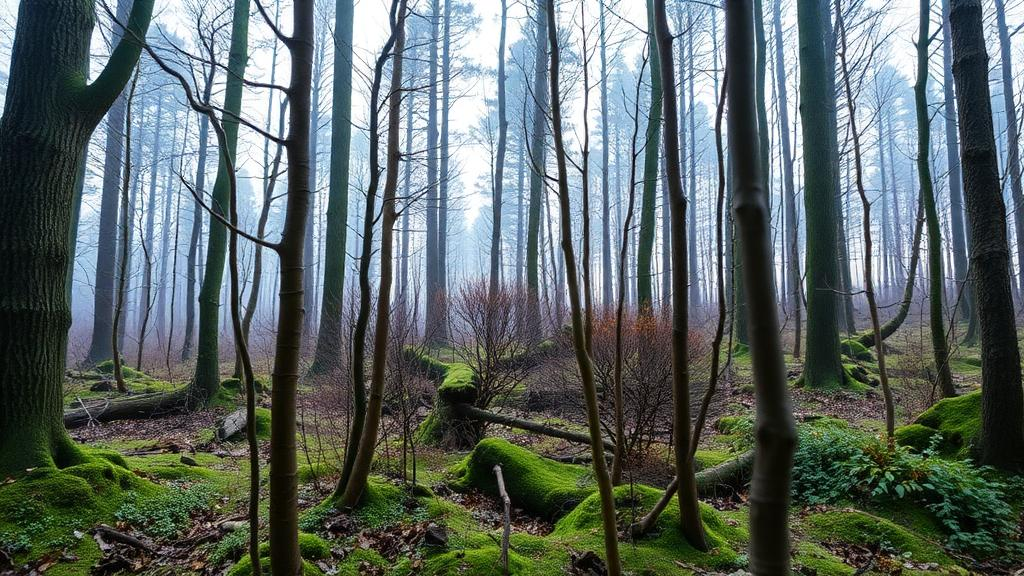
Deep in the South-Eastern Prealps of North-Eastern Italy, a forest has quietly defied the rules of mountain vegetation. The Cansiglio Forest, a Natura 2000 reserve spanning Veneto and Friuli Venezia Giulia, presents one of the most striking examples of an inverted vegetation series in the European Alps: Norway spruce forests at the bottom of a karstic plateau, mixed beech and silver fir forests on the steep slopes above, and pure beech forests at the very top. A new study published in Vegetation Classification and Survey has now dissected the compositional and ecological diversity of this remarkable site, combining modern multivariate statistics with classical phytosociology to classify its forest communities and explain the forces that shape them.
The research team sampled 25 vegetation plots, each approximately 250 square meters, within the experimental framework of the LIFE SPAN project, which had randomly distributed forest plots across the reserve. Every plot was composed of five circular subplots with a radius of 4 meters, one at the center and the others placed 12 meters apart in four diagonal directions. The botanists recorded all species using the seven-step Braun-Blanquet cover-abundance scale, transformed into percentage values for statistical analysis. The resulting dataset comprised a floristic matrix of 25 plots by 94 species, an environmental matrix of six field variables, and an indicator matrix containing Ellenberg indicator values, life forms, chorotypes, and phytosociological units.
To untangle the patterns hidden in this data, the researchers applied agglomerative cluster analysis using Bray-Curtis dissimilarity and Ward’s minimum variance algorithm, followed by non-metric multidimensional scaling ordination. They fitted environmental variables onto the ordination scores with permutation tests and used the indicspecies package with Pearson’s phi coefficient to identify diagnostic species for each community. Differences between groups were tested with one-way ANOVA and Tukey’s honestly significant difference test, or with the Kruskal-Wallis rank sum test and Dunn’s pairwise comparisons when the assumptions of normality and homogeneity were not met. The analysis revealed three clearly separated clusters, each corresponding to a distinct forest community with its own ecological signature.
The first cluster represents the Norway spruce community that dominates the floor of the Cansiglio plateau, a vast karstic plain known as a polje, bordered by a crown of steep mountains culminating in Monte Cavallo at 2,250 meters. This community, located at an average altitude of 1,135 meters, shows the lowest Ellenberg indicator values for temperature and soil reaction, and the highest values for moisture and light. Its tree layer is more open, and its herbaceous layer reaches the maximum cover percentage and the largest number of species, dominated by hemicryptophytes. Diagnostic species include Chaerophyllum hirsutum, Phegopteris connectilis, Maianthemum bifolium, Alchemilla xanthochlora, Myosotis sylvatica, Hypericum montanum, and Scrophularia nodosa, forming a lush carpet favored by the persistent dampness of the plateau floor.
The explanation for this seemingly paradoxical arrangement lies in thermal inversion, a phenomenon in which cold, denser air from the surrounding reliefs becomes trapped in the valley floor. The passes at Crosetta, 1,120 meters, and Campon, 1,050 meters, are higher than the plateau bottom, hindering the escape of cold air. As a result, winter temperatures can plunge to minus 30 degrees Celsius, causing prolonged snow cover and frequent fog. The climate data from the Cansiglio-Tramedere weather station, operating at 1,022 meters from 1994 to 2022, record an average annual precipitation of 2,050 millimeters and an average annual temperature of 6.1 degrees Celsius, with a maximum in November and secondary peaks in May and August. These conditions create a distinctly oceanic microclimate at the plateau bottom that favors spruce, while the upper slopes enjoy warmer air from the Friulian-Venetian plain that is optimal for beech.
The second cluster corresponds to a mixed forest of beech and silver fir, sometimes with Norway spruce, found mainly on the steepest and rockiest slopes of the Friulian side at an average altitude of 1,185 meters. These plots show the greatest canopy closure and the lowest herbaceous layer cover, with Cardamine trifolia and Anemone trifolia achieving the greatest frequency. The diagnostic species Circaea alpina, transgressive from the spruce forest class Vaccinio-Piceetea, attests to the fresh character of this community compared to the pure beech forest. Ellenberg indicator values are intermediate between the other two groups, with significant differences in light, temperature, and soil reaction. The chorological spectrum is led by Central European species, followed by Central-South European and Euro-Asian ones, and the predominant phytosociological group is Carpino-Fagetea sylvaticae.
The third cluster comprises 13 plots of almost pure beech stands, located mainly at the top of the massif at an average altitude of 1,228 meters on Western-facing slopes. Here Cardamine pentaphyllos, Cardamine enneaphyllos, and Geranium nodosum reach their maximum cover and frequency, while Lathyrus venetus occurs as a diagnostic species with low constancy. This community shows the highest indicator values for temperature and soil reaction but lower values for moisture and light. Central European species predominate in the chorological spectrum, followed by South-Eastern European ones, and the phytosociological composition is almost entirely Carpino-Fagetea, with only a small percentage of Vaccinio-Piceetea species.
The study’s syntaxonomic conclusions are significant for European vegetation science. The researchers propose that the mixed silver fir-beech forest and the pure beech forest represent two facies of the same association, Cardamino pentaphylli-Fagetum fagetosum, with the fir facies dominating on the coldest northern slopes and the pure beech facies on the highest and warmer belt, rather than a separate association such as Cardamino pentaphylli-Abietetum. Both communities can be placed within the meso-basiphytic beech forests and, thanks to the presence of Illyrian species such as Adenostyles alpina, Anemone trifolia, Aposeris foetida, Cardamine enneaphyllos, and Cyclamen purpurascens, within the Aremonio-Fagion alliance and the Lonicero alpigenae-Fagenion suballiance. This phytogeographical attribution reflects the importance of the Eastern Alps and Prealps as a migration route from Northern Apennine and Dinaric refugia during the last glacial period.
The anthropogenic spruce forest of the plateau presents a more difficult classification. Although many spruce forests in Friuli originated from beech forests converted through silvicultural practices, thermal inversion suggests a natural component in the case of Cansiglio. The presence of species such as Milium effusum, Ranunculus lanuginosus, Saxifraga rotundifolia, Senecio cacaliaster, and Stellaria nemorum could lead to identification with the association Senecioni cacaliaster-Piceetum, described for the megaforb-rich mountain spruce forests of the Carnic Alps, but the researchers emphasize that further surveys are needed to confirm this attribution and to investigate soil features in detail.
The history of the Cansiglio Forest adds another layer to this ecological puzzle. Forest management began in 1548 under the Republic of Venice, which cultivated the woods for the manufacture of boat oars, and ownership was divided between the two regions after the establishment of the Autonomous Region of Friuli Venezia Giulia in 1966. Palynological studies in the Palughetto mire report the presence of spruce forests in the Cansiglio plateau since 14,600 years before present, while beech was present since at least the early Holocene and became abundant only during the mid-Holocene, when cooling and moistening of the climate favored the expansion of beech forests across the European Alps. The reserve covers approximately 2,713 hectares, 88 percent of which is forest, on limestone and marl bedrocks of the Monte Cavallo formation deposited in a carbonate reef during the Middle-Upper Cretaceous. The karst phenomena create numerous cavities, caves, and sinkholes without a superficial hydrographic network, and the soils range from acidic Cutanic Alisols with pH 4.5 to 5.4 on the plateau to very thin Epileptic Phaeozems on the steep wooded slopes. Together, karst geomorphology, geographic position, glacial history, and centuries of human intervention have produced a forest whose compositional and ecological diversity now stands formally documented, offering a benchmark for the conservation and classification of Southern European mountain forests.
Subject of Research: Vegetation ecology and forest classification in the Cansiglio Forest, Italy
Article Title: Compositional and ecological diversity of Cansiglio forest (Friuli Venezia Giulia, Italy)
Article References: Sicuriello, F., Ferretti, F., Colangelo, P., & De Cinti, B. (2024). Compositional and ecological diversity of Cansiglio forest (Friuli Venezia Giulia, Italy). Vegetation Classification and Survey, 5, 225-236. https://doi.org/10.3897/vcs.118821
Image Credits: AI Generated
DOI: 10.3897/VCS.118821
Keywords: Cansiglio Forest, Natura 2000, thermal inversion, beech forests, Norway spruce, phytosociology, karst, Vegetation Classification and Survey, Compositional, ecological, diversity, Cansiglio
Cite Scienmag News
Margaret Porter. (October 17, 2026). Italy’s Cansiglio Forest Reveals Inverted Vegetation Puzzle Driven by Trapped Cold Air. Scienmag. https://scienmag.com/italys-cansiglio-forest-reveals-inverted-vegetation-puzzle-driven-by-trapped-cold-air/
Margaret Porter. "Italy’s Cansiglio Forest Reveals Inverted Vegetation Puzzle Driven by Trapped Cold Air." Scienmag, 17 October 2026, https://scienmag.com/italys-cansiglio-forest-reveals-inverted-vegetation-puzzle-driven-by-trapped-cold-air/. Accessed 17 October 2026.
Margaret Porter. "Italy’s Cansiglio Forest Reveals Inverted Vegetation Puzzle Driven by Trapped Cold Air." Scienmag. October 17, 2026. https://scienmag.com/italys-cansiglio-forest-reveals-inverted-vegetation-puzzle-driven-by-trapped-cold-air/


