


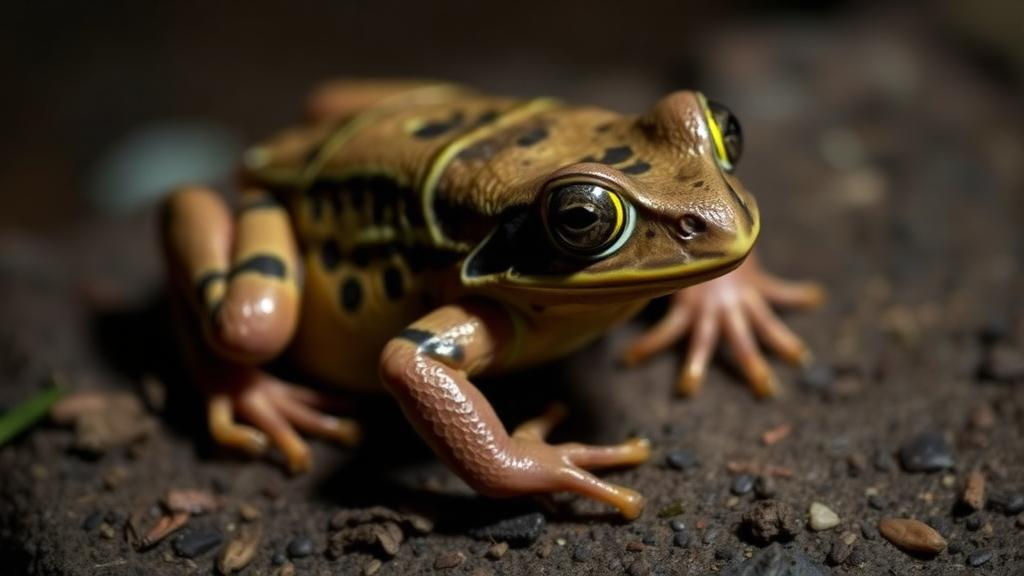
Deep in the southern reaches of Vietnam’s Truong Son Mountain Range, an endangered toad has just rewritten its own map. The Gert’s Horned Toad, Ophryophryne gerti, was long believed to survive only on the Langbian Plateau, confined to the protected forests of Bidoup Nui Ba and Chu Yang Sin National Parks. Now, a team of field biologists has documented the species roughly 66 kilometers further south, on the largely unprotected Di Linh Plateau, and its genetic profile carries a warning that conservationists cannot afford to ignore.
The discovery, published in the journal Nature Conservation, emerged from surveys conducted between July 2022 and September 2023 at four forest sites on the Di Linh Plateau, the southernmost extent of the Truong Son Range. These sites, spanning Gung Re Forest, Gia Bac Pass, the foothills of Bao Loc Pass, and Brayang Mountain, sit between 400 and 1700 meters above sea level. Until now, O. gerti had been recorded only at elevations of 700 to 2000 meters on the Langbian Plateau. The new records extend the species’ known range southward and document its presence at lower elevations, now understood to occur between 500 and 2000 meters.
Confirming that the Di Linh toads truly belonged to O. gerti required both morphological and molecular evidence. Adult males measured between 33.4 and 41.8 millimeters in snout-to-vent length, with heads wider than long, large eyes, and the species’ signature dorsolateral glandular ridges running from above each shoulder toward the groin. Sequencing of a 940 base pair fragment of the mitochondrial 12S rRNA–16S rRNA region showed that the new specimens matched previously published O. gerti sequences with 99 percent similarity. In a maximum likelihood phylogenetic analysis, all 22 newly collected specimens clustered with Langbian Plateau sequences with 97 percent bootstrap support, leaving no doubt about their conspecific status.
The phylogeny also placed O. gerti as the sister taxon to O. synoria, another Langbian Plateau endemic, with maximal bootstrap support of 100 percent. Together with O. elfina, these species form a geographically coherent southern Indochinese clade restricted to the Langbian Plateau and adjacent regions of Cambodia. The relatively shallow genetic divergence between O. gerti and O. synoria, with a p-distance of approximately 0.05, contrasts with the deeper divergence of roughly 0.11 separating this southern clade from relatives distributed in southern China and northern to central Indochina. This pattern suggests a more recent diversification of Langbian Plateau lineages, possibly shaped by regional geological or climatic processes acting on montane refugia.
Perhaps the most striking biological novelty of the study is the first description of the tadpole of O. gerti. Based on seven specimens at Gosner stages 25, 26, and 36, the larvae display an oval, depressed body with dorsolateral eyes, a sinistral spiracle, a pointed tail tip, and a wide, funnel-shaped oral disc that is entirely keratodont-free, bearing serrated jaw sheaths instead of the keratinized tooth rows typical of many stream-breeding frogs. Four transverse rows of submarginal papillae on the upper lip and five to six on the lower lip distinguish these tadpoles from previously described relatives such as O. elfina and O. microstoma. The morphology corresponds to a lotic-neustonic ecomorphotype, adapted to flowing-water environments where current velocity and substrate structure shape larval microhabitats.
Ecologically, both adults and tadpoles were found in small forest streams with rocky and gravelly substrates, situated within evergreen broadleaf and mixed broadleaf–bamboo forests. Tadpoles were concentrated in shallow waters with abundant leaf litter, sheltering within accumulations of organic debris on the streambed. Notably, larvae were documented in both the dry season in March and the rainy season from July to September, suggesting the species may reproduce year-round. At disturbed stream sites lacking forest cover on either bank, the species was entirely absent during the surveys, hinting at a tight ecological dependence on intact riparian forest.
Population genetic analyses revealed a star-like haplotype network for O. gerti, characterized by a single high-frequency central haplotype, H5, shared between the Di Linh and Bidoup–Nui Ba populations and surrounded by multiple low-frequency, mostly locality-specific satellite haplotypes. Ten haplotypes were detected across the species’ range, with a low pairwise Fst of 0.09 indicating recent or ongoing genetic connectivity between the two plateaus. Yet the Di Linh population carried five unique haplotypes, marking it as a reservoir of local genetic variation not found elsewhere.
The genetic diversity indices told a more nuanced story. The Di Linh population showed higher haplotype diversity, at Hd = 0.993, but slightly lower nucleotide diversity, at π = 0.00465, than the Bidoup–Chu Yang Sin population, which recorded Hd = 0.791 and π = 0.00485. This combination of many closely related haplotypes with limited overall sequence divergence is commonly interpreted as an accumulation of rare variants, potentially arising from recent demographic instability, founder effects, or localized mutation accumulation following environmental stress. Neutrality tests reinforced this contrast, with significantly negative values of Tajima’s D, Fu and Li’s D*, and Fu and Li’s F* in Di Linh, signaling an excess of rare variation, while positive values in Bidoup–Nui Ba and Chu Yang Sin pointed toward demographic contraction or population structure within relatively stable forest habitats.
These genetic warning signs align with the anthropogenic pressures bearing down on the Di Linh Plateau. Unlike the Langbian Plateau, where national parks provide formal protection, the Di Linh Plateau has no established protected areas, and agricultural expansion, particularly coffee cultivation, is transforming the landscape rapidly. Field observations indicate that stream reaches bordered by coffee plantations exhibit higher flow intensity and reduced amounts of organic debris compared to streams within natural forests. Such structural changes, including increased current velocity and enhanced substrate erosion in headwater streams, are consistent with documented effects of riparian forest loss and may disproportionately affect amphibians whose larval stages depend on stable, low-energy microhabitats within forested streams.
The findings position the Di Linh Plateau as an important conservation unit for O. gerti, harboring unique genetic variation that would be lost if its remnant forests disappear. Protecting and restoring riparian evergreen forests along headwater streams emerges as a priority, both to maintain the structural and ecological conditions required by stream-dependent amphibians and to preserve the evolutionary potential of a species already classified as endangered on the IUCN Red List. As habitat fragmentation continues to push O. gerti toward localized genetic instability, the window for safeguarding its future on the Di Linh Plateau may be narrowing with every hectare of coffee that replaces the forest.
Subject of Research: Distribution, larval morphology, and genetic diversity of the endangered toad Ophryophryne gerti in Vietnam
Article Title: New insights into the distribution, larval morphology, and genetic diversity of the endangered toad, Ophryophryne gerti ( Amphibia , Anura , Megophryidae ), in Vietnam
Article References: Le, D. T. T., Tran, T. G., Do, A. P. T., & Pham, H. M. (2026). New insights into the distribution, larval morphology, and genetic diversity of the endangered toad, Ophryophryne gerti (Amphibia, Anura, Megophryidae), in Vietnam. Nature Conservation, 63, 79-97. https://doi.org/10.3897/natureconservation.63.174035
Image Credits: AI Generated
DOI: 10.3897/natureconservation.63.174035
Keywords: Ophryophryne gerti, Gert's Horned Toad, Vietnam, Di Linh Plateau, Langbian Plateau, amphibian conservation, tadpole morphology, mitochondrial DNA, haplotype diversity, habitat fragmentation, Truong Son Range, endangered species
Cite Scienmag News
Margaret Porter. (October 17, 2026). Endangered Vietnamese toad found 66 km south of its known range. Scienmag. https://scienmag.com/endangered-vietnamese-toad-found-66-km-south-of-its-known-range/
Margaret Porter. "Endangered Vietnamese toad found 66 km south of its known range." Scienmag, 17 October 2026, https://scienmag.com/endangered-vietnamese-toad-found-66-km-south-of-its-known-range/. Accessed 17 October 2026.
Margaret Porter. "Endangered Vietnamese toad found 66 km south of its known range." Scienmag. October 17, 2026. https://scienmag.com/endangered-vietnamese-toad-found-66-km-south-of-its-known-range/


