


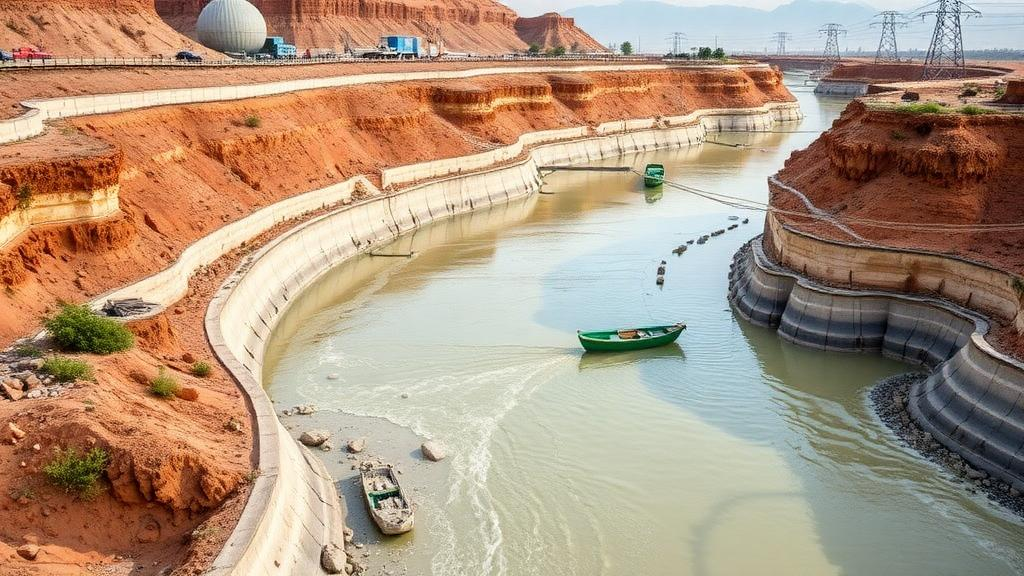
Beneath one of China’s most intensively farmed landscapes, the water that sustains crops, villages, and ecosystems is being replenished in ways that shift dramatically with the seasons and with distance along the river’s course. A new study of the Yellow River South Bank Irrigation District in Inner Mongolia has mapped those shifting recharge patterns in unprecedented detail, using the chemical and isotopic signatures locked inside water molecules to trace exactly where groundwater comes from and how that answer changes between spring, summer, and autumn. The findings, published in Environmental Geochemistry and Health, offer a template for understanding how large-scale irrigation reshapes hidden water resources in arid agricultural regions worldwide.
The research team, led by Nuan Yang of Xi’an University of Science and Technology together with Shen Qu and Ruihong Yu of Inner Mongolia University, focused on a question that has long frustrated hydrogeologists: in a landscape crisscrossed by irrigation canals, bordered by a major river, and fed by distant mountain runoff, which source dominates groundwater recharge at any given place and time? The stakes are considerable. The South Bank Irrigation District is one of the large canal-fed agricultural zones along the Yellow River, and its shallow aquifer is both a buffer against drought and a vulnerable pathway for salinity and agricultural contaminants to move through the landscape.
To untangle the picture, the researchers sampled three distinct water bodies: water flowing through the irrigation canal network, water in the Yellow River itself, and groundwater drawn from wells across the district. Sampling campaigns were carried out in April, July, and November, capturing the hydrological character of spring, summer, and autumn. Each sample was analyzed for its major hydrochemical composition, the suite of dissolved ions that reflects the rocks and soils the water has passed through, and for its stable isotope ratios, specifically the abundance of deuterium relative to hydrogen, expressed as δ²H, and of oxygen-18 relative to oxygen-16, expressed as δ¹⁸O.
Stable isotopes work as natural tracers because every water source carries a distinctive isotopic fingerprint set by where its moisture originally evaporated, how far it traveled, how much it evaporated en route, and at what temperature it fell as precipitation. The Yellow River, fed largely by distant headwaters, carries one isotopic signature; canal water, diverted and exposed to intense evaporation in shallow channels across an arid plain, carries another; and lateral runoff moving through the aquifer from upgradient areas carries yet another. By measuring these fingerprints in groundwater and comparing them against the potential end members, the team could quantify the proportional contribution of each recharge source rather than merely guessing at their relative importance.
The isotope analysis confirmed that groundwater in the district draws on three principal sources: lateral runoff entering from upgradient terrain, infiltration from the irrigation canal network, and seepage from the Yellow River. But the more striking result is how strongly the balance among these sources shifts across space and time. Moving from the upstream to the downstream reaches of the district along the flow path, the dominant recharge mechanism changes from lateral runoff, which supplies more than half of the groundwater in upstream zones, to canal infiltration, which exceeds fifty percent downstream. In the middle reaches during April, river infiltration takes over as the leading contributor, supplying more than forty percent of the recharge.
Summer tells a different story. In July, when irrigation demand peaks and the monsoon-influenced climate delivers most of the region’s sparse precipitation, groundwater recharge is dominated by lateral runoff and river infiltration working in tandem. Downstream, precipitation itself becomes a significant player, contributing more than forty percent of recharge, a reminder that even in semi-arid northern China, seasonal rainfall can briefly rival the engineered water deliveries that usually dominate the district’s water balance. By November, as the irrigation season winds down and autumn irrigation flushes salts from the soil ahead of the freezing winter, the pattern shifts again: canal infiltration and lateral runoff each supply more than thirty-five percent of the groundwater, with the river’s direct role receding.
These seasonal swings matter because they mean the aquifer is not a static reservoir but a dynamic system whose chemistry and vulnerability change with the agricultural calendar. During the spring irrigation flush, canal water percolating through the soil carries with it whatever salts and nutrients the fields have accumulated, so recharge at that time of year is chemically distinct from the cleaner recharge delivered by lateral runoff or river seepage. The isotopic evidence shows that the same physical parcel of aquifer can be fed by canal water in one season and by river water or precipitation in another, which has direct implications for predicting how contaminants move and how salinity evolves in the shallow groundwater.
To verify that the isotopic mixing results were physically plausible, the team turned to reverse hydrogeochemical modeling, a computational technique that calculates the mineral reactions required to transform one water composition into another along a flow path. The modeling, grounded in the classical geochemical framework developed by researchers such as Plummer and Appelo and Postma, validated the recharge sources identified by the isotopes and clarified the subsurface chemistry: groundwater composition in the district is governed predominantly by the dissolution and precipitation of multiple minerals, including the evaporite and carbonate phases typical of arid alluvial basins, while also being modulated by the seasonal turnover in recharge sources. In other words, the water’s chemistry records both the rocks it dissolves and the season in which it arrived.
The study’s methodology, which combines hydrochemical analysis, dual stable isotopes, Bayesian-style isotope mixing frameworks of the kind pioneered by Moore and Semmens and refined by Parnell and colleagues, and inverse geochemical modeling, reflects a broader trend in hydrogeology toward multi-tracer approaches that can disentangle complex human-modified water cycles. Earlier work by members of the same team had documented spatio-seasonal isotope patterns across the Inner Mongolia reaches of the Yellow River Basin and hydrochemical salinization in the irrigation area, and the new study extends that record by explicitly quantifying recharge proportions through time. Comparable approaches are now being applied from the Ganga basin in India to the Qaidam Basin in western China, as researchers confront aquifers increasingly dominated by irrigation returns rather than natural recharge.
For water managers, the message is that protecting groundwater in large irrigation districts requires seasonally and spatially targeted strategies rather than uniform policies. The canal network, so essential to agriculture, is also a dominant recharge pathway whose influence grows downstream, meaning water quality in the canal system propagates directly into the aquifer. The river’s contribution concentrates in the middle reaches and in summer, so river regulation and bank conditions there deserve particular attention. And because precipitation matters most downstream in summer, changes in rainfall patterns under a warming climate could alter the recharge balance in ways that canal operations alone cannot compensate. The authors argue that their results provide important insights for protecting vulnerable riverbank agricultural groundwater systems, and as irrigation intensifies across the world’s drylands, the isotopic detective work done along the Yellow River’s south bank offers a widely transferable playbook for keeping those hidden reserves both understood and safe.
Subject of Research: Spatio-temporal variation of groundwater recharge sources in a large Yellow River irrigation district
Article Title: Deciphering spatio-temporal variation of groundwater recharge patterns in the large irrigation district
Article References: Yang, N., Qu, S., Gao, A., Shi, J., Zhang, Z., Miao, P., & Yu, R. (2026). Deciphering spatio-temporal variation of groundwater recharge patterns in the large irrigation district. Environmental Geochemistry and Health, 48(16), Article 633. https://doi.org/10.1007/s10653-026-03526-9
Image Credits: AI Generated
DOI: 10.1007/s10653-026-03526-9
Keywords: groundwater recharge, stable isotopes, Yellow River, irrigation district, hydrogeochemistry, Inner Mongolia, canal infiltration, river infiltration, lateral runoff, reverse geochemical modeling, water resources, spatio-temporal variation
Cite Scienmag News
Sloane Callahan. (October 12, 2026). Isotopic Fingerprints Reveal How Irrigation Rewires Groundwater Beneath the Yellow River. Scienmag. https://scienmag.com/isotopic-fingerprints-reveal-how-irrigation-rewires-groundwater-beneath-the-yellow-river/
Sloane Callahan. "Isotopic Fingerprints Reveal How Irrigation Rewires Groundwater Beneath the Yellow River." Scienmag, 12 October 2026, https://scienmag.com/isotopic-fingerprints-reveal-how-irrigation-rewires-groundwater-beneath-the-yellow-river/. Accessed 12 October 2026.
Sloane Callahan. "Isotopic Fingerprints Reveal How Irrigation Rewires Groundwater Beneath the Yellow River." Scienmag. October 12, 2026. https://scienmag.com/isotopic-fingerprints-reveal-how-irrigation-rewires-groundwater-beneath-the-yellow-river/


