Groundwater beneath the Inner Mongolia Reaches of the Yellow River Basin is being replenished through three distinct pathways at once, according to a new open access study that combined hydrogen and oxygen isotope analysis with multivariate statistics across an entire large river basin. Researchers collected 396 shallow groundwater samples from 132 wells during wet, dry, and normal seasons and traced where the water came from, how it changed between seasons, and which physical processes drove those changes.
The study region spans roughly 96,400 square kilometers in western China’s Inner Mongolia Autonomous Region, stretching 843 kilometers across territory that is home to nearly 12.37 million people. Elevations range from 958 to 2,332 meters above sea level, and the climate is temperate continental monsoon, with mean annual temperatures of 4 to 8 degrees Celsius. Annual precipitation varies between 237 and 464 millimeters, about 70 percent of it falling between June and September, while average annual evaporation reaches roughly 1,500 millimeters, far exceeding the water that falls from the sky. That imbalance makes the region acutely dependent on groundwater, particularly for agriculture in major irrigation districts such as Hetao and Ordos.
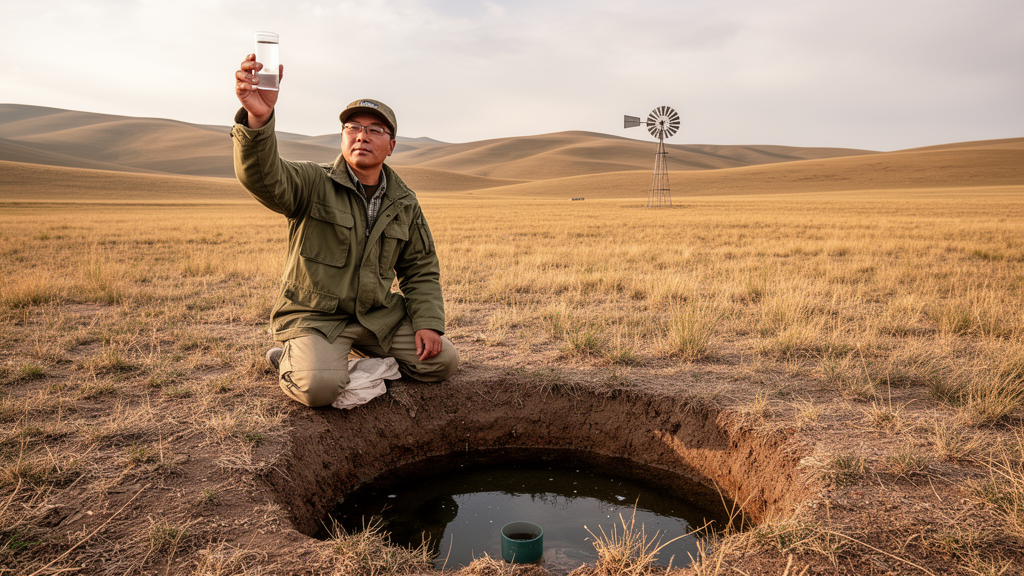
Previous investigations in this basin were largely restricted to single irrigation districts or single-season sampling campaigns, and most focused on groundwater quality problems such as arsenic and fluoride contamination rather than recharge dynamics. The new study addressed that gap by sampling the same 132 locations three times: in July 2021 during the wet season, October 2021 during the dry season, and April 2022 during the normal season. The wells tapped shallow, unconfined Quaternary pore water at depths between 2 and 10 meters, mostly near main streams, irrigation canals, tributaries, and seasonal rivers.
The researchers measured the isotopic composition of the groundwater using a liquid water isotope analyzer, reporting values relative to Vienna Standard Mean Ocean Water with precisions of 0.1 per mil for oxygen-18 and 0.3 per mil for deuterium. They also analyzed 97 rainwater samples collected between June and July 2021 in five cities, which allowed them to construct a local meteoric water line with the equation δD = (6.90 ± 0.24)δ18O − 2.04 ± 2.06. That line has a noticeably lower slope and intercept than the global meteoric water line, a deviation the authors attribute to secondary evaporation of raindrops as they fall through the dry semi-arid air.
To identify where the moisture originates, the team ran the HYSPLIT backward trajectory model using NCEP/NCAR reanalysis data, launching 96-hour backward trajectories daily from the Baotou meteorological station at 500 meters above ground level. During the wet season, more than 70 percent of precipitation derived from westerly air masses, including 62 percent from the Arctic Ocean and 14 percent from the Eurasian continent, while 24 percent arrived from the southeast Pacific. Because that wet-season moisture path first crosses high-elevation terrain, the resulting precipitation is depleted in heavy isotopes. During the dry and normal seasons, moisture came predominantly from dry, high-latitude inland westerlies, producing isotopically heavier but much smaller amounts of rainfall whose recharge signal was negligible.
The groundwater data told a more complicated story. Oxygen-18 values ranged from −12.9 to −7.4 per mil in the wet season, −13.0 to −7.2 per mil in the dry season, and −12.6 to −4.2 per mil in the normal season, with means shifting from −10.4 to −9.7 to −9.4 per mil. Deuterium excess moved in the opposite direction, declining from a mean of 11.4 per mil in the wet season to 7.4 per mil in the dry season and 5.5 per mil in the normal season. Groundwater samples plotted near the local meteoric water line, confirming precipitation as a primary recharge source, but the seasonal regression lines had progressively lower slopes and intercepts, indicating that precipitation evaporated substantially before and during infiltration.
Mapping the isotopes with kriging interpolation revealed two isotopically distinct zones. Zone I, containing the Hetao and Ordos irrigation districts, showed enriched oxygen-18 and deuterium excess values mostly between 0.0 and 6.0 per mil, below the global average of about 10 per mil, consistent with strong evaporative influence on lateral runoff recharge and on infiltrating irrigation water. Zone II, at higher elevation, showed depleted oxygen-18 and deuterium excess often above 10 per mil and sometimes above 15 per mil, a pattern the authors interpret as a possible signature of recharge from deep groundwater, or paleowater, and of direct infiltration of isotopically light mountain precipitation. The team notes that this deep-groundwater interpretation rests on qualitative isotope evidence, because dating isotopes such as tritium and carbon-14 were not available to verify recharge ages.
Seasonal comparisons sharpened the picture. Using thresholds of ±0.2 per mil for oxygen-18 and ±1 per mil for deuterium excess, derived from twice the measurement precision, the researchers found that from the wet to the dry season 75 percent of the area showed oxygen-18 increases and 83 percent showed deuterium excess decreases, pointing to evaporation acting on groundwater runoff and possibly on isotopically enriched irrigation return flow. Between the dry and normal seasons, evaporation remained evident but weaker, with 53 percent of the area showing oxygen-18 enrichment and 72 percent showing deuterium excess depletion, while the area with no isotopic change grew, reflecting similar meteorological conditions in those two seasons. In quadrant analysis of paired seasonal differences, the largest groups of samples showed enriched oxygen-18 with depleted deuterium excess, while a smaller but growing group showed the opposite pattern, which the authors link to increasing influence of deep groundwater as surface-water recharge weakened in low-precipitation seasons.
To separate the overlapping drivers, the team ran a principal component analysis on inter-seasonal differences in seven variables: oxygen-18, deuterium excess, sodium, chloride, nitrate, fluoride, and total dissolved solids. Three components with eigenvalues above 1 explained 73.108 percent of the variance for the dry-minus-wet period and 80.756 percent for the normal-minus-dry period. The first component, loaded on sodium, chloride, and total dissolved solids and accounting for 29.017 percent and then 40.800 percent of variance, was interpreted as recharge from deep groundwater, whose high salinity in this region is documented in earlier work. High scores for this component appeared first in high-elevation recharge areas and then spread across nearly the whole basin by the normal season, which the authors read as expanding vertical leakage from deep aquifers rather than lateral migration of deep water bodies, given the slow shallow groundwater flow rates of roughly 5 to 20 meters per year.
The second component, explaining 24.475 percent and 25.020 percent of variance in the two periods, paired rising oxygen-18 with falling deuterium excess and marked lateral runoff recharge affected by evaporation, strongest in the middle and lower reaches where hydraulic gradients are gentler, residence times longer, and water tables shallower. The third component, loaded on fluoride and nitrate differences, captured recharge from irrigation return flow. Its high scores during the dry-minus-wet period clustered in the upper and middle reaches flowing through the Hetao and Ordos districts, where annual water diversion exceeds 5 billion cubic meters, and shifted toward the lower reaches in the second period as irrigation intensity declined. The authors stress that the study provides qualitative identification of recharge mechanisms rather than quantitative estimates of each component’s contribution, and they flag limitations including possible evaporative artifacts in very shallow samples, spatial representativeness limits of the single-station trajectory modeling, sparse sampling in remote high-altitude areas, and the subjectivity inherent in interpreting principal components. Future work with numerical flow modeling, high-frequency isotope monitoring, and dating isotopes is expected to convert this qualitative framework into quantitative recharge estimates for large semi-arid basins.
Subject of Research: Spatio-temporal variations and driving mechanisms of shallow groundwater recharge in the Inner Mongolia Reaches of the Yellow River Basin, studied with hydrogen and oxygen isotopes and principal component analysis.
Article Title: Spatio-temporal variations and driving mechanisms of groundwater recharge in the Inner Mongolia Reaches of the Yellow River Basin, China: an approach combining isotope hydrology and statistics
Article References: Ren, X., Duan, L., Miao, Y., Qu, S., Bai, X., Zhang, W., Ma, H., Miao, P., & Yu, R. (2026). Spatio-temporal variations and driving mechanisms of groundwater recharge in the Inner Mongolia Reaches of the Yellow River Basin, China: an approach combining isotope hydrology and statistics. Applied Water Science, 16(11), Article 297. https://doi.org/10.1007/s13201-026-02989-6
Image Credits: AI Generated
DOI: 10.1007/s13201-026-02989-6
Keywords: groundwater recharge, Yellow River Basin, Inner Mongolia, stable isotopes, deuterium excess, HYSPLIT, principal component analysis, irrigation return flow, paleowater, semi-arid hydrology, Hetao Irrigation District, water sustainability
Cite Scienmag News
Violet Maxwell. (October 28, 2026). Isotopes Reveal Three Hidden Pathways Feeding Shallow Groundwater in Inner Mongolia. Scienmag. https://scienmag.com/isotopes-reveal-three-hidden-pathways-feeding-shallow-groundwater-in-inner-mongolia/
Violet Maxwell. "Isotopes Reveal Three Hidden Pathways Feeding Shallow Groundwater in Inner Mongolia." Scienmag, 28 October 2026, https://scienmag.com/isotopes-reveal-three-hidden-pathways-feeding-shallow-groundwater-in-inner-mongolia/. Accessed 28 October 2026.
Violet Maxwell. "Isotopes Reveal Three Hidden Pathways Feeding Shallow Groundwater in Inner Mongolia." Scienmag. October 28, 2026. https://scienmag.com/isotopes-reveal-three-hidden-pathways-feeding-shallow-groundwater-in-inner-mongolia/