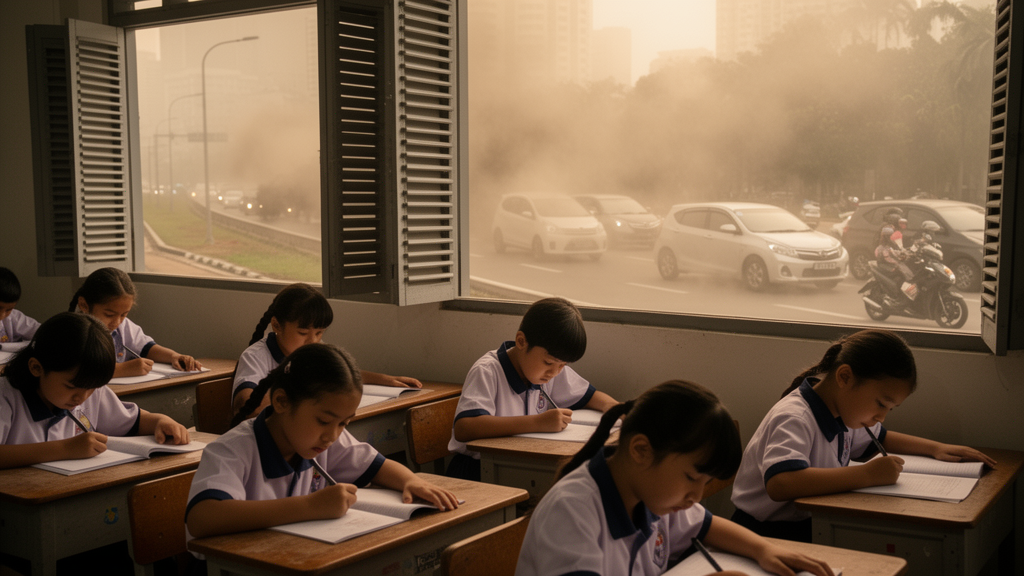
Children attending primary schools in Kuala Lumpur are breathing air in which fine particulate pollution is dominated by traffic-related combustion products, according to a new study published in the Asian Journal of Atmospheric Environment. Researchers measured polycyclic aromatic hydrocarbons, or PAHs, bound to fine particulate matter (PM2.5) inside classrooms and in school compounds across 18 public primary schools in the Malaysian capital, and found that vehicle emissions from both gasoline and diesel engines were the primary contributors to the pollution. The work also estimated cancer risks for children aged 7 to 12 years, and while outdoor risk estimates fell within the acceptable range set by the United States Environmental Protection Agency, several indoor estimates exceeded the upper threshold, pointing to classroom air as a key concern.
The study, led by Mohamad Firdaus Ismail and Noorlin Mohamad with colleagues at Malaysian institutions, collected samples from May to September 2017 in schools located in the Federal Territory of Kuala Lumpur. The team deployed two identical low-volume samplers at each school, one indoors and one outdoors, operating at a flow rate of 5 litres per minute. Indoor samplers were placed at the back of classrooms at least one metre off the floor, while outdoor units sat about five metres from the classroom building and at least one metre above the ground.
Back in the laboratory, the filters underwent ultrasonic extraction with a one-to-one mixture of dichloromethane and n-hexane, repeated three times, before analysis by gas chromatography-mass spectrometry. The researchers spiked samples with deuterated internal standards, phenanthrene d-10 and perylene d-12, and reported percentage recoveries ranging from 68.47 to 105.39 percent. Field blanks and procedural blanks were used to correct all concentration data, and detection limits for individual PAHs ranged from 0.01 to 0.23 nanograms per cubic metre depending on the compound. Fifteen of the sixteen priority PAHs designated by the USEPA were detected in the samples; naphthalene was absent, which the authors attribute to its high volatility keeping it in the gas phase rather than bound to particles.
The measurements revealed that PM2.5 mass concentrations were similar indoors and outdoors, with no statistically significant difference between the two environments. Indoor levels ranged from 12.2 to 69.4 micrograms per cubic metre with an overall mean of 42.5, while outdoor levels ranged from 13.1 to 64.8 micrograms per cubic metre with a mean of 40.8. Notably, the 24-hour averages exceeded both the World Health Organization 24-hour guideline value of 15 micrograms per cubic metre and the Malaysian Ambient Air Quality Standard of 35 micrograms per cubic metre. The total concentration of the 15 measured PAHs averaged 4.34 nanograms per cubic metre indoors and 5.62 nanograms per cubic metre outdoors, with individual site means ranging from 1.39 to 8.89 indoors and 2.01 to 12.6 outdoors.
The composition of the PAH mixture told a consistent story about its origins. High molecular weight PAHs with five and six aromatic rings accounted for more than 60 percent of the total in both environments, a pattern typically associated with pyrogenic sources such as vehicle exhaust and high-temperature combustion. Benzo(ghi)perylene was the single most abundant compound, making up 19.5 percent of the total PAH concentration. At some schools, three-ring compounds dominated indoors, reaching more than 40 percent at two sites, which the authors suggest may reflect petrogenic sources such as evaporated petroleum products or indoor-related sources. The distribution of ring sizes varied considerably from school to school, with five-ring PAHs exceeding 40 percent at several outdoor sites and six-ring compounds reaching as much as 52 percent indoors at one location.
To trace the pollution back to its sources, the team applied two complementary approaches. Diagnostic ratios between pairs of PAHs with similar physicochemical properties indicated that pyrogenic sources dominated: the ratio of low to high molecular weight PAHs stayed below 1 at all sites, and ratios for indeno(1,2,3-cd)pyrene relative to benzo(ghi)perylene pointed mainly to petroleum combustion of liquid fuels rather than unburned petroleum. The authors caution that diagnostic ratios are the most basic method of source identification and can be altered by atmospheric degradation and chemical interactions with oxidants, so they complemented this analysis with principal component analysis of the PAH concentration data.
The statistical analysis reinforced the traffic signal. Principal components explained between 50.8 and 86.2 percent of the total variance in indoor samples and 58.5 to 89.4 percent in outdoor samples. The first principal component, dominated by benzo(a)pyrene, benzo(ghi)perylene, indeno(1,2,3-cd)pyrene, benzo(b)fluoranthene and benzo(k)fluoranthene, was attributed to traffic-related emissions and high-temperature combustion. Schools with strong loadings for these marker compounds, including sites S1, S4, S5, S7, S10, S13, S16 and S18, were typically located within 100 metres of major roadways. The study had deliberately selected schools across different traffic proximities, from less than 50 metres to more than 100 metres from roads, and across residential, commercial and mixed land-use settings.
The health risk assessment focused on benzo(a)pyrene equivalent concentrations, which weight each PAH by its toxicity equivalency factor. Benzo(a)pyrene itself contributed up to 84.2 percent of the total toxic equivalent outdoors and 66.1 percent indoors, underscoring its role as the key surrogate for PAH carcinogenicity. Total equivalent concentrations ranged from 0.169 to 3.26 nanograms per cubic metre outdoors and 0.06 to 2.06 nanograms per cubic metre indoors, with the highest values recorded at the sites with the highest particle mass concentrations. These figures were four to five times higher than previously reported values for urban ambient air in Kuala Lumpur, though they remained well below levels reported for schools in Portugal and China, which reached nearly 20 and 45 times higher respectively.
Estimated target carcinogenic risks for children aged 7 to 12 ranged from 2.64 times 10 to the minus 6 to 9.55 times 10 to the minus 5 outdoors, all within the USEPA acceptable range of 10 to the minus 6 to 10 to the minus 4. Indoors, however, values ranged from 2.04 times 10 to the minus 5 to 1.87 times 10 to the minus 4, and at several sampling sites the estimates exceeded the upper threshold, corresponding to the schools with the highest high molecular weight PAH concentrations. The authors attribute the elevated indoor estimates partly to longer exposure durations, approximately eight hours indoors compared with about one hour outdoors during the school day. They note that the overall findings align with previous work suggesting a relatively low cancer risk in school environments, while emphasising that children remain a sensitive population because of their developing respiratory and immune systems, higher breathing rates and greater pollutant intake relative to body weight.
The researchers conclude that because traffic-related emissions were identified as the dominant contributor, priority should be given to improving traffic management around school zones, restricting vehicle idling during student drop-off and pick-up periods, and reducing congestion during peak school hours. They also recommend maintaining adequate classroom ventilation, regularly inspecting ventilation systems, and improving vegetation buffers between roads and school buildings. The study provides baseline information on PM2.5-bound PAHs in indoor and outdoor school air in urban Kuala Lumpur, and the authors call for further detailed investigation of indoor air quality and its health implications, along with the development of specific mitigation strategies and air quality guidelines for school indoor environments.
Subject of Research: PM2.5-bound PAH pollution and children's health risk in urban primary schools
Article Title: Unveiling distribution and health risks of polycyclic aromatic hydrocarbons (PAHs) bound to PM2.5 in indoor and outdoor environments of urban primary schools
Article References: Ismail, M. F., Fadzil, M. F., Naim, N. N. M., Yusof, K. M. K. K., Othman, M., Latif, M. T., Wahid, N. B. A., & Mohamad, N. (2026). Unveiling distribution and health risks of polycyclic aromatic hydrocarbons (PAHs) bound to PM2.5 in indoor and outdoor environments of urban primary schools. Asian Journal of Atmospheric Environment, 20(1), Article 15. https://doi.org/10.1007/s44273-026-00094-3
Image Credits: AI Generated
DOI: 10.1007/s44273-026-00094-3
Keywords: PM2.5, polycyclic aromatic hydrocarbons, Kuala Lumpur, primary schools, children's health, traffic emissions, indoor air quality, carcinogenic risk, benzo(a)pyrene, source apportionment, GC-MS, air quality monitoring
Cite Scienmag News
Russell Cooper. (October 28, 2026). Traffic fumes dominate classroom air at Kuala Lumpur primary schools, study finds. Scienmag. https://scienmag.com/traffic-fumes-dominate-classroom-air-at-kuala-lumpur-primary-schools-study-finds/
Russell Cooper. "Traffic fumes dominate classroom air at Kuala Lumpur primary schools, study finds." Scienmag, 28 October 2026, https://scienmag.com/traffic-fumes-dominate-classroom-air-at-kuala-lumpur-primary-schools-study-finds/. Accessed 29 October 2026.
Russell Cooper. "Traffic fumes dominate classroom air at Kuala Lumpur primary schools, study finds." Scienmag. October 28, 2026. https://scienmag.com/traffic-fumes-dominate-classroom-air-at-kuala-lumpur-primary-schools-study-finds/