


Australia’s youth sport needs a major overhaul if it is to re-engage those who drop out of sport and encourage effective participation and greater inclusion and diversity, according to Flinders University researchers.

Credit: Flinders University
Australia’s youth sport needs a major overhaul if it is to re-engage those who drop out of sport and encourage effective participation and greater inclusion and diversity, according to Flinders University researchers.
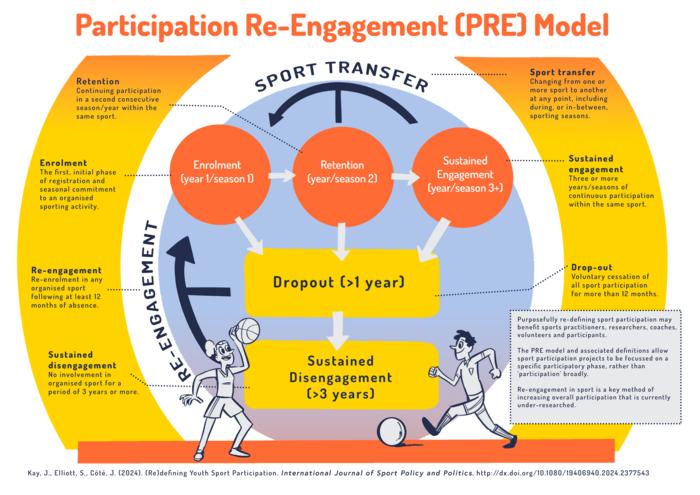
A new study published in the esteemed International Journal of Sport Policy and Politics unveils a new dynamic map of youth participation in sport called the ‘Participation Re-Engagement (PRE) Model.’
The PRE model identifies seven phases of sport participation, which can be applied across distinct levels of sport participation, including informal and organised sport.
It is hoped that the model could offer a way to recognise more opportunities to encourage young people to play sports.
“The phenomenon of sport participation is often summarised simplistically as starting a sport and stopping a sport. Yet being a part of sport can change over time as people move through various stages and phases of involvement,” says PhD student James Kay from the College of Education, Psychology and Social Work.
“The PRE model maps out a way for sporting clubs and organisations to think about participation in a flexible and dynamic way, which is crucial for maximising retention and re-engagement efforts,” he says.
“Importantly, our PRE model denotes that dropout from sport is quite common, where people might need to take breaks due to injuries, study load, or building a career. But this doesn’t have to be viewed as an end point, but an untapped turning point. It could be an opportunity for clubs to re-engage with young people and rebuild participation,” he says.
The ‘Participation Re-Engagement (PRE) Model’ phases of sport participation:
- Enrolment and entry – the first, initial phase of registration and seasonal commitment to an organised sport.
- Retention – continuing participation in a second consecutive season/year within the same sport.
- Sustained engagement – three or more years/seasons of continuous participation within the same sport.
- Sport transfer – changing from one or more sports to another at any point, including during, or in-between, sporting seasons.
- Dropout – voluntary cessation of all sport participation for more than 12 months.
- Sustained disengagement – no involvement in organised sport for a period of 3 years or more.
- Re-engagement – as re-enrolment in any organised sport following at least 12 months of absence.
Mr Kay says that over recent years that there has been considerable progress across Australia in encouraging the engagement of young people (aged 5-24 years) in sport. But there is a problem with disparate approaches and systems for intervention and assessing actual participation.
“Our PRE model has the potential to offer more detailed information on young peoples’ involvement in sporting activities over a longer period, and to assess and understand their choices,” he says.
This information could provide a more comprehensive foundation for researchers, policymakers, government funding agencies, and clubs/organisations in ways to encourage ongoing sporting participation.
“A renewed definition of sport participation, one that includes more stages of someone’s engagement with sport, has the scope to help break down barriers to groups previously excluded from organised sport, which is currently an Australian government priority,” says Mr Kay.
“Whilst the model would initially be implemented in organised sport, there is potential for it to be applied beyond youth sport settings to other areas of physical activity, exercise, and recreational leisure,” he adds.
The paper, (Re)defining youth sport participation by James Kay, Associate Professor Sam Elliott and Professor Jean Côté (Queens University, Canada) has been published in International Journal of Sport Policy and Politics, DOI 10.1080/19406940.2024.2377543
Journal
International Journal of Sport Policy and Politics
Method of Research
Computational simulation/modeling
Subject of Research
People
Article Title
(Re)defining youth sport participation
Article Publication Date
23-Jul-2024
COI Statement
No author has any competing interests related to this manuscript.
Cite Scienmag News
Courtney Benton. (August 19, 2024). Is it time to redefine youth sport participation? Scienmag. https://scienmag.com/is-it-time-to-redefine-youth-sport-participation/
Courtney Benton. "Is it time to redefine youth sport participation?" Scienmag, 19 August 2024, https://scienmag.com/is-it-time-to-redefine-youth-sport-participation/. Accessed 3 September 2026.
Courtney Benton. "Is it time to redefine youth sport participation?" Scienmag. August 19, 2024. https://scienmag.com/is-it-time-to-redefine-youth-sport-participation/

