


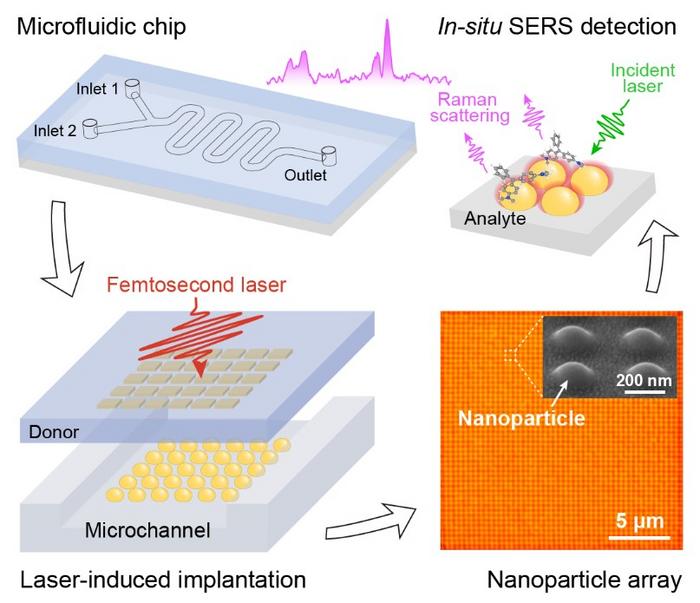
A highly sensitive and reusable surface-enhanced Raman spectroscopy (SERS) microfluidics system was developed by Shanghai Jiao Tong University (SJTU) researchers, which was able to achieve a detection limit lower than 10 ppt (part per trillion) of harmful substances.

Credit: By Yongxiang Hu, Yu Zhou, Guohu Luo, Dege Li and Minni Qu.
A highly sensitive and reusable surface-enhanced Raman spectroscopy (SERS) microfluidics system was developed by Shanghai Jiao Tong University (SJTU) researchers, which was able to achieve a detection limit lower than 10 ppt (part per trillion) of harmful substances.
The work, reported in the International Journal of Extreme Manufacturing, could broaden the applications of ultrasensitive, effective, and low-cost microfluidic detection in biomedical diagnosis, environmental monitoring, and food safety.
Integrating plasmonic nanoparticles into microfluidic chips with high accuracy and stability is the basis of highly sensitive and reusable sensing.
“How to assemble well-designed nanoparticles into microchannels is a critical problem,” said Dr. Hu, the author of the paper and professor at SJTU’s School of Mechanical Engineering. “In most research, the SERS-active substrate is fabricated separately in advance and then integrated with microfluidic chips, suffering from low fabrication efficiency and expensive costs. We need to find a fast and affordable technique. Here we are saying, why not implant nanoparticles into the microchannel directly?”
In recent years, direct femtosecond laser structuring has been used to develop many high-sensitive microfluidic SERS systems, offering various flexible SERS-active interface fabrication routes.
Nanoparticles can be synthesized in microchannels for SERS detection with resolution as low as 10-10 mol/L using laser-induced photoreduction. However, laser-reduced nanoparticles are susceptible to oxidization when exposed to air, which will affect their service lifetime. Moreover, the laser-fabricated structures are challenging to control in a uniform manner, limiting the improvement of sensitivity and reproducibility.
Using femtosecond laser-induced forward transfer (fs-LIFT) technology, the SJTU researchers implanted the nanoparticle in a square lattice with a uniform pitch of about 400 nm, achieving a mean deviation of only 3%. A remarkable electromagnetic field enhancement resulted in a detection limit lower than 10-11 mol/L. Furthermore, the fabricated array shows excellent reusability after several physical and chemical cleaning, because of the robust embedment of fs-LIFT implanted nanoparticles.
Thanks to the high stability and sensitivity, SJTU’s researchers used this method to fabricate a SERS microfluidic system and monitor the online oxidation reaction, which helps infer the reaction path.
The researchers are continuing the work, hoping to improve the sensitivity further by reducing the particle size and arrangement pitch. They expect the technology to be used in biomedical detection for disease screening and diagnosis applications in the future.
About IJEM:
International Journal of Extreme Manufacturing (IF: 16.1, consecutive 1st in the Engineering, Manufacturing category) is a new multidisciplinary and open-access and double anonymou peer-reviewed journal uniquely covering the full spectrum of extreme manufacturing.
The journal is devoted to publishing original articles and reviews of the highest quality and impact in the areas related to the science and technology of manufacturing functional devices and systems with extreme dimensions (extremely large or small) and/or extreme functionalities, ranging from fundamental science to cutting-edge technologies that support the manufacturing of high-performance products involving emerging techniques and breaking the limits of currently known theories, methods, scales, environments, and performance.
Visit our webpage, Like us on Facebook, and follow us on Twitter and LinkedIn.
Journal
International Journal of Extreme Manufacturing
Article Title
Femtosecond laser-induced nanoparticle implantation into flexible substrate for sensitive and reusable microfluidics SERS detection
Article Publication Date
24-May-2024
Cite Scienmag News
Denise Maddox. (August 19, 2024). Nanoparticle array implantation for sensitive and reusable detection. Scienmag. https://scienmag.com/nanoparticle-array-implantation-for-sensitive-and-reusable-detection/
Denise Maddox. "Nanoparticle array implantation for sensitive and reusable detection." Scienmag, 19 August 2024, https://scienmag.com/nanoparticle-array-implantation-for-sensitive-and-reusable-detection/. Accessed 3 September 2026.
Denise Maddox. "Nanoparticle array implantation for sensitive and reusable detection." Scienmag. August 19, 2024. https://scienmag.com/nanoparticle-array-implantation-for-sensitive-and-reusable-detection/

