


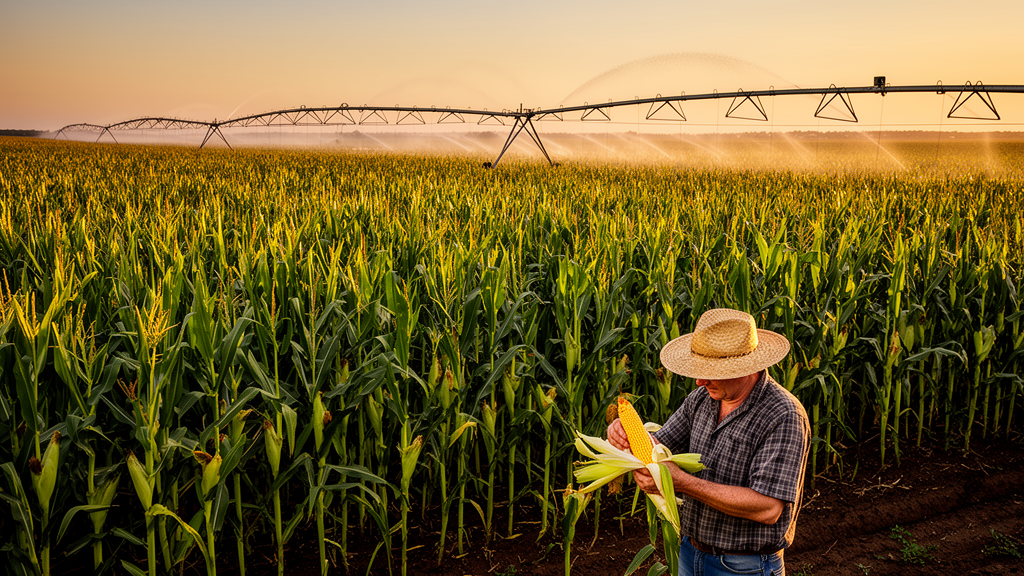
The world’s most fertile soils are under a double squeeze. In the black-earth Mollisol belts of the American Midwest and northeastern China, farmers must grow more maize than ever to feed a growing and increasingly unstable global food system, yet every extra tonne of grain risks washing away the very topsoil that makes these regions the granaries of the world. A new modelling study published in npj Sustainable Agriculture has now mapped, in unusual detail, which combinations of farming technologies can raise yields, stabilise them against drought, and still keep soil erosion in check across two of the planet’s most important maize-producing basins.
The research team, led by Yingqi Zhang of China Agricultural University together with collaborators in the United States, New Zealand, Australia and Switzerland, focused on two transcontinental counterparts: the Upper Mississippi River Basin in the north-central United States and the Songhua River Basin in northeastern China. Together, the Mollisol regions of the Northern Hemisphere contribute roughly half of global maize output, a crop that supports more than twenty percent of the world’s population. Between 2001 and 2018, average maize yields in the Upper Mississippi basin reached about 10 tonnes per hectare, a full 4 tonnes per hectare ahead of the Songhua basin. Yet neither region was secure: both showed yield variation above ten percent from year to year, the signature of moderate instability driven largely by rainfall.
To untangle the causes, the researchers built a fully calibrated version of the Soil and Water Assessment Tool, a process-based hydrological model used in thousands of peer-reviewed studies worldwide. They divided the Mississippi basin into 14 zones with 131 subbasins and nearly 9,800 hydrological response units, and the Songhua basin into 15 zones with 168 subbasins and almost 5,000 such units. Streamflow was calibrated against US Geological Survey gauging stations and Chinese counterparts, sediment yield at five stations in each basin, and maize growth parameters against official yield statistics from the USDA and Chinese provincial data. Performance metrics, including Nash-Sutcliffe efficiency values generally above 0.60 and bias figures well within accepted benchmarks, indicated the model faithfully captured both water movement and crop growth.
The climatic contrast between the two basins emerged as a central explanation for the yield gap. The American basin receives around 940 millimetres of rain annually, with average maximum and minimum temperatures of 14.9 and 3.5 degrees Celsius. The Chinese basin, by comparison, gets only about 524 millimetres, dropping near 400 millimetres in drought years, and runs markedly cooler, with minima averaging minus 1.1 degrees. Lower precipitation and reduced heat accumulation mean the Songhua region frequently cannot meet the water and temperature demands of high-yielding maize. The study also found that year-to-year rainfall variability tracked yield variability closely in both basins, with coefficients of variation of roughly 16 percent in China and 12 percent in the United States.
Extreme droughts exposed the fragility of rainfed farming in both regions. In 2012, precipitation in the Upper Mississippi basin fell to 695 millimetres, about 26 percent below normal, and maize yields plummeted to 7.6 tonnes per hectare. That same year, the Songhua basin received a nearly identical 644 millimetres, briefly erasing the usual transpacific yield difference. In 2007, severe drought in northeastern China cut yields to just 4.7 tonnes per hectare, far below the long-term average. These episodes underline a point the authors emphasise throughout: raising average yield means little if a single bad season can erase years of gains, and any credible improvement strategy must be judged on stability as well as productivity.
The team then simulated three individual technologies: high-density planting, irrigation, and germplasm improvement using modern high-yielding hybrids. Dense planting proved a quiet conservation hero. It added only modest yield gains of 0.8 tonnes per hectare in the United States and 0.5 tonnes in China, neither statistically significant, but it cut soil erosion by roughly 30 percent in both basins, thanks to denser canopies intercepting rainfall and shielding the soil surface. Irrigation delivered the opposite trade-off. It lifted yields by 11 percent in the American basin and a striking 33 percent in the Chinese one, and slashed yield variability to coefficients of variation near 4 to 5 percent, effectively buffering crops against drought. But by wetting the soil and increasing runoff, irrigation raised erosion by more than 10 percent, and by nearly 20 percent in the Songhua basin.
Germplasm improvement, simulated by adjusting crop parameters for traits such as growing degree days, leaf area index, light utilisation and harvest index, raised yields to 13.1 tonnes per hectare in the American basin and 9.4 tonnes in the Chinese one without increasing erosion at all. The catch is time: breeding gains arrive slowly, constrained by long research cycles and high technical barriers. No single technology, the study concluded, could simultaneously maximise yield, stabilise it and protect the soil. Even under the best individual intervention, Chinese yields still trailed the American baseline by between 0.6 and 3.4 tonnes per hectare.
The integrated scenarios told a far more encouraging story. Combining irrigation with dense planting raised yields by 16 percent in the United States and 41 percent in China, while the denser canopy offset much of the erosion triggered by added water, cutting it by about 22 percent in the Songhua basin. All irrigation-based combinations kept yield variability below 5 percent, transforming high-risk zones in the drought-prone western Songhua basin and the upper Mississippi into low-variability areas. When germplasm improvement was layered on top, yields surged by an additional 31 percent in the American basin and 75 percent in the Chinese one, in some Chinese scenarios exceeding the American baseline by up to 3 tonnes per hectare. Even so, a stubborn residual gap of about 1.5 tonnes per hectare remained between the two countries under management-only strategies, pointing squarely at genetics as the final frontier.
The economics reinforced the case for integration. Net returns from the various technologies ranged from 533 million to about 2.1 billion US dollars in the American basin, and from roughly 2.1 billion to 9.9 billion dollars in the Chinese basin, where maize prices run nearly twice as high. Irrigation did carry environmental costs, adding about 34 million dollars in erosion control and 6 million dollars in sediment dredging in China, but these were small against the stable yield income it generated. Crucially, pairing irrigation with dense planting converted an environmental liability into a net conservation gain, making the combined package both the most profitable and the most sustainable of the practical options. The authors note that profitability, not technical efficiency alone, ultimately drives farmer adoption.
The study is candid about its limits. Irrigation was simulated without constraints on water availability, which may overstate its real-world scalability, and the germplasm scenario remains hypothetical, with breeding costs excluded from the economic analysis. The model also does not yet fully capture how topsoil loss suppresses yields, meaning the findings may actually be conservative. Still, the simulations were cross-validated against a meta-analysis of 118 field studies and 2,543 data points, screened with the help of large-language AI tools and verified by human reviewers, with over 94 percent of simulated responses falling within empirical ranges. The broader message is clear: irrigation and dense planting form a safety net securing yield and stability, while improved germplasm is the peak pusher needed to maximise potential. For the world’s black-soil breadbaskets, the future lies not in choosing one technology, but in stacking them wisely.
Subject of Research: Sustainable maize intensification and soil erosion control in Mollisol regions of China and the United States
Article Title: Maximizing maize yields while minimizing soil erosion in Mollisol regions of China and the United States
Article References: Zhang, Y., Zhang, X., Ding, B., Li, Y., Qi, J., Clothier, B., Minasny, B., Abbaspour, K. C., Liu, X., Wang, P., Geng, X., Feng, P., Li, B., Sun, D., Zhang, R., Han, Y., & Chen, Y. (2026). Maximizing maize yields while minimizing soil erosion in Mollisol regions of China and the United States. npj Sustainable Agriculture, 4(1), Article 81. https://doi.org/10.1038/s44264-026-00192-3
Image Credits: AI Generated
DOI: 10.1038/s44264-026-00192-3
Keywords: maize, Mollisol, soil erosion, irrigation, planting density, germplasm improvement, yield stability, SWAT model, Upper Mississippi River Basin, Songhua River Basin, sustainable agriculture, drought
Cite Scienmag News
Alan Morgan. (October 8, 2026). Irrigation, Dense Planting and Better Seeds Could Close the Maize Gap Between China and the US. Scienmag. https://scienmag.com/irrigation-dense-planting-and-better-seeds-could-close-the-maize-gap-between-china-and-the-us/
Alan Morgan. "Irrigation, Dense Planting and Better Seeds Could Close the Maize Gap Between China and the US." Scienmag, 8 October 2026, https://scienmag.com/irrigation-dense-planting-and-better-seeds-could-close-the-maize-gap-between-china-and-the-us/. Accessed 8 October 2026.
Alan Morgan. "Irrigation, Dense Planting and Better Seeds Could Close the Maize Gap Between China and the US." Scienmag. October 8, 2026. https://scienmag.com/irrigation-dense-planting-and-better-seeds-could-close-the-maize-gap-between-china-and-the-us/


