


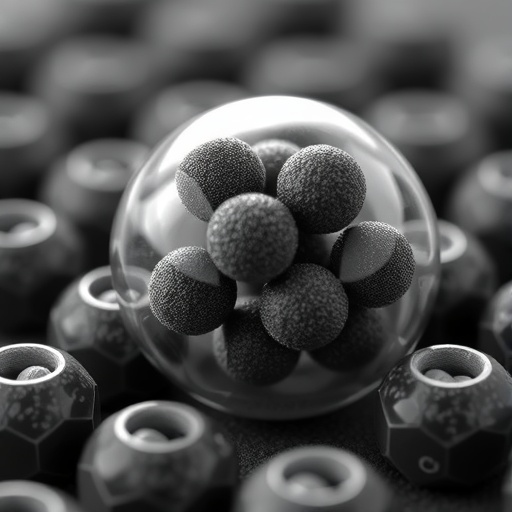
In the quest to revolutionize energy storage while minimizing environmental harm, researchers at Saarland University are pioneering an innovative approach that leverages hollow carbon spheres infused with iron oxide. Traditional lithium-ion batteries, known for their widespread use in portable electronics and electric vehicles, face significant sustainability challenges due to their reliance on scarce and environmentally problematic materials such as cobalt and nickel. Furthermore, the toxic solvents required for electrode preparation exacerbate ecological concerns. This has inspired the scientific community to explore alternative materials that could offer high performance with reduced ecological footprints.
The groundbreaking work emerging from Saarland University involves the utilization of nanoscale hollow carbon spheres known as carbon spherogels. Developed originally at the University of Salzburg by Professor Michael Elsaesser’s team, these spherical nanostructures are approximately 250 nanometers in diameter and exhibit remarkable porosity, contributing to a large surface area ideal for electrochemical applications. By ingeniously incorporating finely dispersed iron oxide nanoparticles within these hollow spheres, the combined team has demonstrated a promising path toward sustainable battery electrodes that stand to outperform conventional materials both in capacity and environmental compatibility.
The analogy to Salzburg’s iconic Mozartkugeln, chocolate-covered balls filled with nougat and marzipan, provides a tangible mental image of these hollow carbon spheres. Yet, unlike the confectionery, the carbon spherogels are meticulously engineered to serve as high-capacity, reversible lithium-ion storage media. The high surface area and porous network architecture facilitate efficient electrolyte penetration and enhanced lithium ion transport kinetics. The key challenge, as explained by postdoctoral researcher Stefanie Arnold, has been to develop a controlled chemical synthesis methodology that fills the internal cavities of these spheres with metal oxides that substantially boost energy storage performance.
Initial attempts employed titanium dioxide to fill these cavities; however, its lithium ion storage capabilities proved limited. This led the researchers to pivot towards iron oxide — a material commonly associated with rust — which presented distinct advantages from sustainability, availability, and electrochemical perspectives. Iron is abundant globally, easy to recycle, and theoretically capable of delivering high lithium storage capacities. Utilizing a scalable synthesis technique involving iron lactate precursors, the Salzburg team integrated varying amounts of iron into the carbon framework, resulting in robust, porous composites with evenly distributed iron nanoparticles.
An intriguing discovery revealed during electrochemical testing is the progressive activation of the iron component inside the carbon spherogel matrix during battery cycling. Contrary to expectations, the storage capacity did not degrade but improved with usage, reaching optimal performance after around 300 charge-discharge cycles. This phenomenon results from the gradual oxidation reaction of elemental metallic iron particles to iron oxide within the carbon matrix. This electrochemical activation phase ensures that the entire hollow cavity becomes saturated with active iron oxide, maximizing lithium ion storage capacity in a dynamic, self-improving manner.
Despite the promising results, challenges remain before iron-loaded carbon spherogels can be deployed industrially. Chief among these is the sluggish activation kinetics, which require extensive cycling to fully realize capacity enhancements. Accelerating this activation would enable batteries to achieve peak performance more rapidly, a critical factor for practical applications. Additionally, while the current research focuses on the anode material, the complementary cathode must be identified and optimized to construct a complete, functional lithium-ion battery with these novel components.
Looking beyond lithium-ion systems, this versatile carbon spherogel technology has the potential to extend to sodium-ion batteries, an emerging alternative technology particularly favored by Chinese automotive manufacturers. The synthesis platform allows the incorporation of diverse metallic and metal oxide species within a single, scalable process, opening avenues for tailoring electrode properties across various energy storage technologies. This adaptability represents a substantial leap forward in materials engineering for next-generation battery electrodes.
Complementing the material synthesis efforts, the EnFoSaar project led by Stefanie Arnold addresses the broader lifecycle considerations of battery technology. Efficient recycling strategies are paramount to closing the loop on critical metals like lithium, thereby reducing dependency on finite resources and minimizing environmental impact. EnFoSaar is an ambitious initiative, backed by €23 million from the Saarland state government, that aims to develop industrial-scale dismantling techniques and closed-loop systems. This holistic approach aligns energy materials research with circular economy principles and sustainable energy futures.
Volker Presser, a prominent energy materials professor at Saarland University and head of the related research groups, emphasizes the environmental implications of this research. By replacing toxic constituents with iron-based electrodes, the batteries of the future could drastically reduce hazardous waste and resource depletion. Moreover, the scalable nature of the carbon spherogel production points to feasible large-scale manufacturing avenues. This might enable the creation of economically viable buffer storage solutions critical for integrating variable renewable energy sources into power grids.
The comprehensive integration of chemistry, materials science, and electrochemical engineering showcased by this research underscores the evolving landscape of energy storage innovation. The team’s detailed mechanistic studies of iron oxide formation and carbon matrix interaction highlight the sophisticated interplay between material structure and battery performance. These insights pave the way for fine-tuning electrode architectures that maximize energy density, cycle life, and sustainability concurrently.
Looking forward, the researchers remain dedicated to overcoming existing limitations such as the slow activation rates and cathode development. Enhanced understanding of the physicochemical processes involved in iron oxide evolution within carbon spherogels may unlock strategies to expedite activation and stabilize cycling performance. Concurrently, exploring alternative electrolyte formulations compatible with these electrodes could further improve efficiency and durability.
In summation, the intellectual synergy between the Saarland and Salzburg research groups heralds a promising future where eco-friendly, high-capacity lithium-ion batteries made from abundant and recyclable materials become a reality. Their work exemplifies how fundamental nanomaterials engineering can translate into practical, scalable technologies addressing both energy storage needs and environmental concerns. As battery demand surges worldwide, innovations like iron-loaded carbon spherogels stand to play a pivotal role in crafting a sustainable energy landscape for the 21st century and beyond.
News Publication Date: 29-Jan-2026
References:
Borhani, S., Thi Thao, L., Zickler, G. A., Quade, A., Elsaesser, M. S., Presser, V., Arnold, S. (2026). Iron-Loaded Carbon Spherogels as Sustainable Electrode Materials for High-Performance Lithium-Ion Batteries. Chemistry of Materials. DOI: 10.1021/acs.chemmater.5c02442
Keywords
Materials science, Materials engineering, Metals, Alternative energy, Electrochemical energy, Green energy, Energy storage
Cite Scienmag News
Faith Mcneil. (February 5, 2026). Iron Oxide-Filled Carbon Spheres Boost Battery Storage Capacity. Scienmag. https://scienmag.com/iron-oxide-filled-carbon-spheres-boost-battery-storage-capacity/
Faith Mcneil. "Iron Oxide-Filled Carbon Spheres Boost Battery Storage Capacity." Scienmag, 5 February 2026, https://scienmag.com/iron-oxide-filled-carbon-spheres-boost-battery-storage-capacity/. Accessed 4 September 2026.
Faith Mcneil. "Iron Oxide-Filled Carbon Spheres Boost Battery Storage Capacity." Scienmag. February 5, 2026. https://scienmag.com/iron-oxide-filled-carbon-spheres-boost-battery-storage-capacity/


