


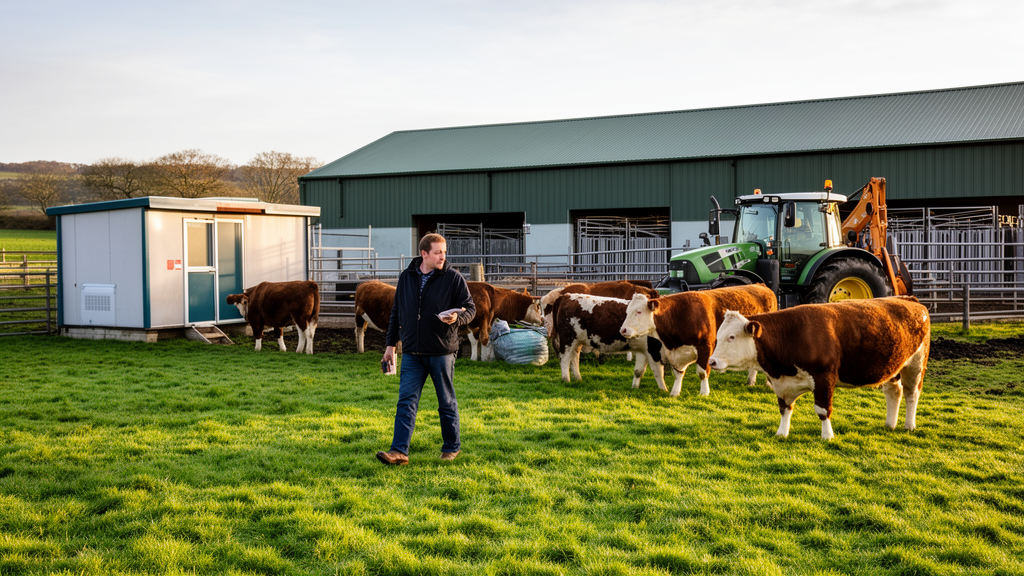
A single Irish farm that finishes dairy-bred cattle consumed nearly 12 units of energy for every unit of edible beef energy produced during the finishing stage, according to a case study published in Frontiers in Sustainable Resources Management. The farm-gate energy accounting estimated an Edible Energy Return on Energy Invested, or EEROI, of 0.08:1 when operational and embodied inputs were included. Annual edible energy output was estimated at 81,490.71 megajoules, while total inputs reached 958,938 MJ. The result characterizes one grass-based operation in Tipperary and does not establish that Irish beef production as a whole has the same energy profile.
The farm buys approximately 100 Holstein Friesian steers from Ireland’s dairy herd each year at about 20 months of age. The animals graze during summer, are housed from November until the following March, and leave for slaughter at roughly 30 months. The analysis followed them only from arrival at the farm to departure, counting the edible energy represented by the additional carcass weight gained during that period. Because the starting carcass-equivalent weight could not be measured directly, it was estimated from recorded live weights and a literature-derived dressing percentage. The EEROI is therefore an accounting estimate for a specified system boundary rather than a direct measurement of the edible energy in every animal.
Across 132 cattle purchased in 2023 and 2024, the average live weight on arrival was 438 kilograms. Applying a dressing percentage of 50.75% produced an estimated carcass-equivalent weight of 222.285 kilograms per animal. The average cold carcass weight at slaughter in 2025 was 330 kilograms, implying a carcass-weight gain of 107.715 kilograms during finishing. The researchers estimated that 81% of that gain was edible by humans and assigned the beef an energy content of 9.34 MJ per kilogram. This yielded an estimated 814.91 MJ of edible energy gained per animal and 81,490.71 MJ for the farm’s annual output of 100 cattle.
The energy denominator included fuel and electricity, fertiliser, plastic silage wrap, transport of inputs, labour and recurring farm expenses. It also included the embodied energy of cattle housing, machinery, concrete yards and water tanks, water pumps and polyethylene pipes. Operational energy was the energy needed to run equipment and buildings, whereas embodied energy represented the energy used to manufacture or construct them. The investigators annualized machinery over 20 years, cattle housing over 50 years, water pumps over 10 years and polyethylene pipes over 50 years. Where direct measurement was unavailable, they used farm inventories, published energy intensities, assumed service lives or financial proxies, and they subjected selected uncertain categories to sensitivity analysis.
Buildings, machinery and diesel were the three largest inputs, together accounting for 72.52% of estimated annual energy demand. Housing contributed 270,000 MJ after its embodied energy was distributed over an assumed 50-year life. Machinery, including maintenance, contributed 221,816 MJ when annualized over 20 years, while diesel use accounted for 203,613 MJ. Fertiliser supplied by nitrogen, phosphate and potash contributed 135,515 MJ. The plastic used to wrap approximately 600 silage bales accounted for 75,012 MJ. Electricity was comparatively small at 27,520 MJ, or 1.63% of total inputs, after conversion from delivered electricity to primary energy at 6.4 MJ per kilowatt-hour.
The study also reported a separate scenario based only on annual recurring inputs: fertiliser, silage-wrap plastic, diesel, electricity, transport, labour and non-capital farm expenses. Under that scenario, inputs totaled 458,504 MJ and EEROI was 0.18:1, meaning that 5.63 units of recurring energy were used for each unit of edible energy gained. This alternative was distinct from the study’s formal sensitivity analysis. The comparison shows the effect of including annualized embodied energy from infrastructure and other longer-lived costs, which substantially increased the overall external energy requirement of the finishing system.
Uncertainty in buildings, machinery and the currency-based estimate for farm expenses was examined by increasing or reducing those three categories by 50%. When they were raised by half, estimated total inputs increased to 1,211,776 MJ and EEROI fell to 0.07:1. Reducing them by half lowered inputs to 706,101 MJ and raised EEROI to 0.12:1. Even at that endpoint, the estimated edible output remained below the energy invested. These calculations reinforce the accounting result that infrastructure embodied energy was not a minor addition: buildings, machinery and farm expenses made a large contribution to the low full-system return, although the precise ratio varied with assumptions about capital and maintenance energy.
Renewable sources were estimated to provide 2.48% of the farm’s total energy inputs. That calculation applied national average shares to measured farm consumption: 41.3% of electricity came from renewable sources in 2024, and 8.4% of diesel came from renewable sources. Renewable contributions were therefore attributed to both electricity and diesel. The renewable-share calculation treated electricity on a final-energy basis, consistent with national statistics, whereas the principal EEROI calculation used primary-energy conversion for electricity. Because electricity represented only 1.63% of total inputs, the analysis found that decarbonising Ireland’s electricity supply had little effect on the farm’s overall energy dependence.
The examined operation occupies 52 hectares, including 50 hectares of pasture, on relatively shallow, moderately stony mineral loam soils. Its management includes rotational grazing, a reduced stocking rate, low fertiliser use, and no herbicides or pesticides; clover is encouraged through low spring nitrogen applications, and manure collected during overwintering is spread on pasture in spring. The farm is certified under Bord Bia’s national quality-assurance scheme. Despite these low-intensity grazing practices, the accounting shows that the system depends substantially on industrially manufactured machinery, concrete, plastics, fertiliser and fuel. EEROI does not by itself measure land use, greenhouse-gas emissions, water use, animal welfare or economic viability, so the ratio cannot by itself establish the overall environmental performance of beef finishing.
Several limitations constrain how the result should be interpreted. The analysis covers one farm and therefore cannot automatically be generalized to other Irish beef-finishing systems. Energy used before the cattle arrived was outside the boundary, as were transport to slaughter, slaughter and subsequent processing. Some quantities were measured directly, including fuel and electricity consumption, while others came from inventories, assumed service lives, published energy intensities or conversion of monetary expenses into energy. The incoming carcass-equivalent weight was also estimated rather than measured directly. The author describes the work as the first EEROI analysis of an Irish beef-finishing system and proposes further investigation of measures that could reduce reliance on non-renewable inputs and of the energy resilience of comparable farms.
Subject of Research: Edible energy return and external energy inputs in one Irish dairy-bred beef finishing farm
Article Title: The edible energy return on investment in dairy-bred beef finishing in Ireland
Article References: Kelly, M. (2026). The edible energy return on investment in dairy-bred beef finishing in Ireland. Frontiers in Sustainable Resource Management, 5, Article 1948659. https://doi.org/10.3389/fsrma.2026.1948659
Image Credits: AI Generated
DOI: 10.3389/fsrma.2026.1948659
Keywords: EEROI, dairy-beef, beef finishing, Ireland, energy accounting, embodied energy, agriculture, renewable energy, food systems, agricultural sustainability, edible, energy
Cite Scienmag News
Alan Morgan. (October 21, 2026). Irish dairy-beef case study returns 0.08 units of edible energy per unit invested. Scienmag. https://scienmag.com/irish-dairy-beef-case-study-returns-0-08-units-of-edible-energy-per-unit-invested/
Alan Morgan. "Irish dairy-beef case study returns 0.08 units of edible energy per unit invested." Scienmag, 21 October 2026, https://scienmag.com/irish-dairy-beef-case-study-returns-0-08-units-of-edible-energy-per-unit-invested/. Accessed 21 October 2026.
Alan Morgan. "Irish dairy-beef case study returns 0.08 units of edible energy per unit invested." Scienmag. October 21, 2026. https://scienmag.com/irish-dairy-beef-case-study-returns-0-08-units-of-edible-energy-per-unit-invested/


