


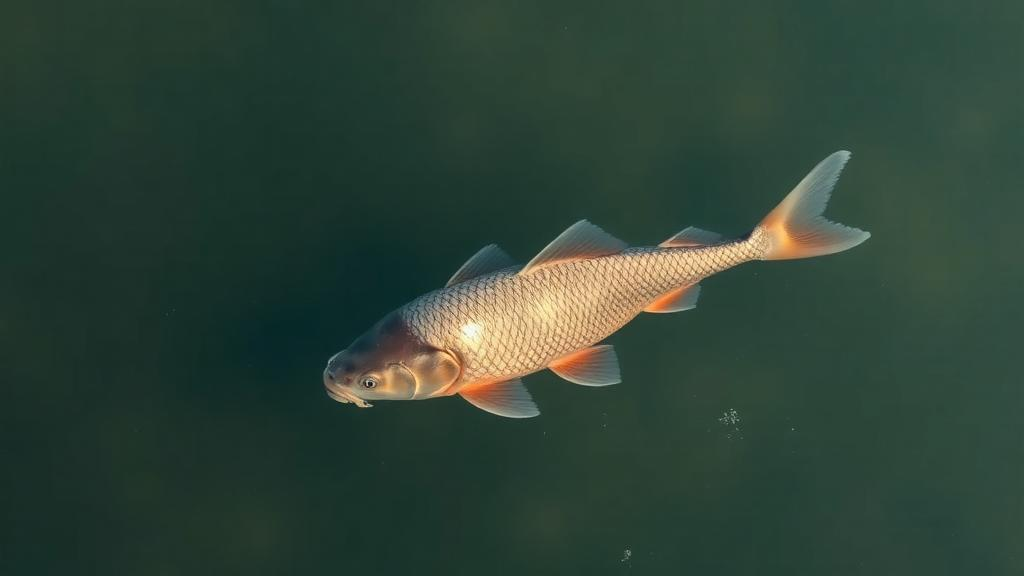
Silver carp, one of the world’s most successful aquatic invaders, is quietly expanding its foothold in Thailand’s most important river system, and scientists have now tracked its spread using nothing more than the genetic traces the fish leaves behind in the water. A multi-year environmental DNA survey across the Chao Phraya River Basin has documented a steady rise in the species’ presence, from detectable signals at roughly a third of monitored sites in 2019 to positive detections at every one of 39 sampling locations by 2023. The findings, published in the journal NeoBiota, offer one of the most systematic applications of eDNA monitoring in a tropical Asian watershed and carry significant implications for how the region manages invasive species.
Silver carp, Hypophthalmichthys molitrix, is a large filter-feeding cyprinid native to East Asia that has been introduced around the world for aquaculture. Its appeal to fish farmers is easy to understand: the species grows quickly and its plankton-filtering habit can help improve water quality in polyculture ponds. But escapees from culture facilities have repeatedly established self-sustaining populations in natural waterways, and the consequences have been documented most dramatically in North America. Introduced to the United States in the 1970s and 1980s for private aquaculture and wastewater treatment, silver carp escaped containment during floods in the 1990s and colonised the Mississippi River drainage, where established populations have disrupted native food webs by competing with indigenous planktivores, including freshwater mussels, larval fishes and paddlefish. The species also poses a distinctive safety hazard: when startled by boat motors, it can leap up to three metres out of the water, a behaviour that contributed to its classification as an injurious species under United States federal regulation by 2007.
In Thailand, silver carp has long been cultivated in freshwater aquaculture and is commonly sold alongside its close relative, the bighead carp, under the collective label of Chinese carps. This commercial aggregation has created a persistent blind spot for managers. Official records from Thailand’s Department of Fisheries report production and capture statistics for both species combined under the general category of Chinese major carps, making it impossible to assess the individual distribution of either species from conventional data alone. Traditional monitoring approaches, which rely on fishery production statistics, localised surveys and capture-based sampling, also struggle to detect low-density populations during the critical early stages of colonisation and are logistically difficult to deploy across large watersheds.
Environmental DNA analysis offers a way around these limitations. The technique detects genetic material that organisms naturally shed into the water through mucus, faeces, gametes and sloughed tissue, allowing species to be identified from water samples without ever capturing or seeing the animal. First demonstrated for aquatic species detection in 2008, eDNA has since proven particularly effective for finding rare, cryptic or invasive species across broad spatial scales at relatively low cost. Yet despite the high vulnerability of Southeast Asia to biological invasions and the region’s extensive aquaculture development, systematic eDNA applications in tropical Asian rivers have remained scarce.
To fill that gap, researchers conducted water sampling at 39 sites spread across the five major river systems of the Chao Phraya Basin: the Ping, Wang, Yom and Nan rivers and the main Chao Phraya channel. The basin covers roughly 160,000 square kilometres of central and northern Thailand and supports 328 species of finfish, along with intensive agriculture and major urban populations. Sampling campaigns were carried out in November 2019, December 2021 and December 2023, timed for the post-monsoon period when river conditions are stable and favourable for eDNA detection. At each site, three replicate one-litre surface samples were collected from about half a metre depth, yielding 351 samples over the three years.
The laboratory workflow was designed with unusually strict contamination controls. All equipment was decontaminated with bleach and ethanol, filtration syringes were individually sealed until use, bottles were assigned to a single site, and fresh sterile gloves were worn at every location. Field blanks of sterile water were exposed to ambient conditions and processed alongside environmental samples to monitor for airborne or handling contamination. DNA was extracted from glass fibre filters using a modified commercial protocol with doubled Proteinase K and extended incubation to maximise yield, then purified to remove PCR inhibitors. An internal positive control based on a synthetic DNA fragment from a jellyfish species that cannot occur in freshwater was used to verify that no sample suffered from inhibition, and none did.
Detection relied on a species-specific quantitative PCR assay targeting the silver carp mitochondrial ND2 gene, previously validated for North American surveillance programmes. Specificity was confirmed both computationally, through database searches showing no full matches to non-target taxa, and experimentally, by screening genomic DNA from fifteen related and unrelated fish species found in Thai waters, none of which produced amplification. Using a serial dilution series of synthetic DNA, the team established both the limit of detection and the limit of quantification at 17.24 copies per reaction, allowing every result to be classified as a positive detection, a below-quantification signal or a non-detection. No amplification occurred in any field, extraction or qPCR negative control.
The temporal pattern was unambiguous. In 2019, silver carp eDNA was detected at 12 of 39 sites, about 31 percent, with most signals below the quantification threshold. By 2021, detectable DNA appeared at 34 sites, and by 2023 positive detections had reached 23 sites, or 59 percent, with the remaining 16 sites all showing below-quantification signals. No site remained completely negative in the final survey year. River-specific dynamics varied: the Yom River showed the most consistent and substantial signals, with one site climbing from 86.66 copies per reaction in 2019 to 177.06 in 2023, while the main Chao Phraya channel consistently yielded the strongest concentrations, peaking at 401.48 copies per reaction. The Ping River showed recent establishment, with its first quantifiable detections appearing only in 2023.
To separate true presence from the uncertainties of molecular detection, the researchers applied Bayesian hierarchical occupancy models that partition error across three stages: whether the species’ DNA was truly present at a site, whether it was captured in a water sample, and whether the qPCR assay detected it. Estimated occurrence probabilities remained moderate, between roughly 0.40 and 0.51, lower than the raw detection frequency because the model conservatively discounts weak, near-threshold signals. Laboratory true-detection probabilities were consistently high at about 0.90, and false-positive probabilities were minimal, confirming the reliability of the framework. Environmental covariates told an interesting story: none showed a supported effect on site occupancy, but temperature strongly influenced the laboratory false-positive probability in 2023, suggesting that water conditions mainly shaped detectability rather than actual species presence.
The comparison with official fisheries statistics revealed a striking divergence. While wild capture of Chinese carps in basin provinces declined from about 1,273 metric tons in 2019 to 1,055 in 2023, eDNA detections rose steadily, and several upstream sites with positive molecular signals had no corresponding capture records at all. Conversely, some provinces with large-scale aquaculture production showed only weak eDNA signals nearby, possibly reflecting effective containment or hydrological dilution. The authors argue that this contrast demonstrates how molecular surveillance can complement traditional assessments by providing species-level and site-level resolution that aggregated catch statistics cannot match. With silver carp now detectable throughout the basin, they conclude that preventive management opportunities may already have been missed, and that eDNA monitoring should be integrated into regional biosecurity programmes, prioritised around aquaculture facilities and hydrologically connected river reaches where escape risk is highest.
Subject of Research: Environmental DNA monitoring of invasive silver carp distribution in Thailand's Chao Phraya River Basin
Article Title: Tracing the rise of silver carp ( Hypophthalmichthys molitrix ) in Thailand with eDNA
Article References: Osathanunkul, M., Osathanunkul, K., Ounjai, S., Jutagate, T., & Suwannapoom, C. (2026). Tracing the rise of silver carp (Hypophthalmichthys molitrix) in Thailand with eDNA. NeoBiota, 105, 209-228. https://doi.org/10.3897/neobiota.105.165755
Image Credits: AI Generated
DOI: 10.3897/neobiota.105.165755
Keywords: silver carp, environmental DNA, invasive species, Chao Phraya River Basin, Thailand, aquaculture, Bayesian occupancy modelling, qPCR, biosecurity, freshwater monitoring, Hypophthalmichthys molitrix, river ecology
Cite Scienmag News
Violet Maxwell. (October 18, 2026). Invisible traces reveal silver carp spreading through Thailand’s largest river basin. Scienmag. https://scienmag.com/invisible-traces-reveal-silver-carp-spreading-through-thailands-largest-river-basin/
Violet Maxwell. "Invisible traces reveal silver carp spreading through Thailand’s largest river basin." Scienmag, 18 October 2026, https://scienmag.com/invisible-traces-reveal-silver-carp-spreading-through-thailands-largest-river-basin/. Accessed 18 October 2026.
Violet Maxwell. "Invisible traces reveal silver carp spreading through Thailand’s largest river basin." Scienmag. October 18, 2026. https://scienmag.com/invisible-traces-reveal-silver-carp-spreading-through-thailands-largest-river-basin/


