


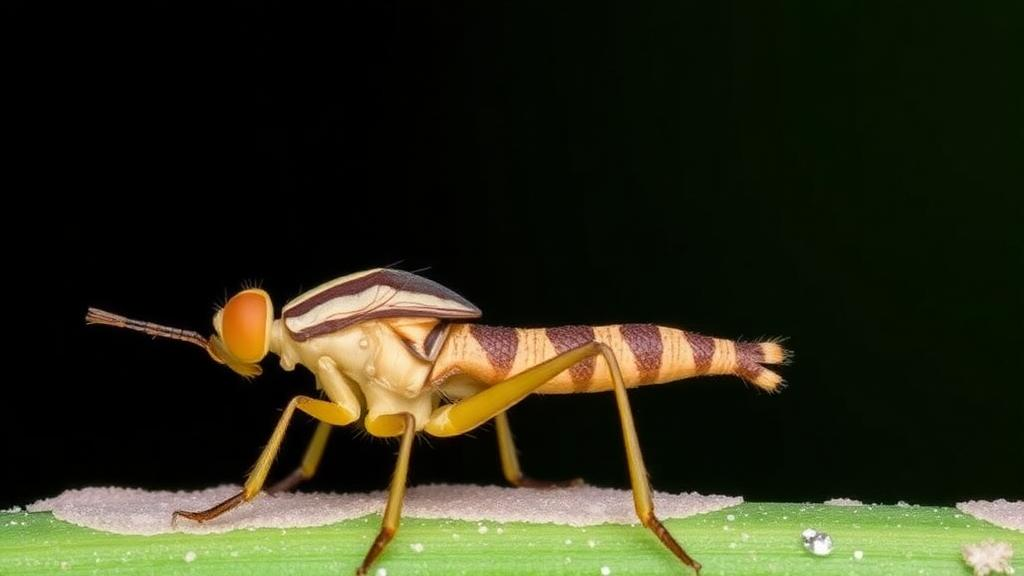
Panama’s rivers and streams have quietly surrendered another secret: eight species of caddisflies never before recorded in the country, a discovery that pushes the Central American nation’s known caddisfly fauna to 533 species across 15 families and 56 genera. The finding, published in the journal Neotropical Biology and Conservation, is the latest salvo in a remarkably productive scientific campaign that has more than doubled Panama’s documented caddisfly diversity in less than a decade.
Caddisflies, the insect order Trichoptera, are among the most ecologically important yet underappreciated residents of freshwater ecosystems. Their aquatic larvae are famous for constructing elaborate protective cases from silk, sand grains, pebbles, and even snail shells, behaviors that have made them beloved subjects of stream ecology classes worldwide. Beyond their charm, caddisfly larvae are voracious grazers and filter feeders that help regulate nutrient and energy flow through streams, and they serve as a critical food source for fish, birds, and other predators. Because many species are sensitive to pollution, habitat degradation, and altered flow regimes, their presence or absence is a reliable signal of environmental quality, making them staples of freshwater biomonitoring programs.
The new records stem from sustained fieldwork led by the Aquatic Invertebrate Research Group at the Universidad Autónoma de Chiriquí, working through the university’s Museum of Freshwater Fish and Invertebrates, known by its Spanish acronym MUPADI. Over the past eight years, this team, together with collaborating taxonomists, has lifted Panama’s caddisfly inventory from 257 species to more than 500, a pace of discovery that few countries in the Neotropics can match. The effort has also added two entire families and 11 genera to the national list, dramatically reshaping scientists’ understanding of how caddisfly diversity is distributed across the isthmus.
The eight newly recorded species span an impressive range of caddisfly lineages. Among the net-spinning family Hydropsychidae, one of the largest in the Neotropics with nearly 500 described species, the team documented Leptonema turrialbum, previously known from Costa Rica. The family Polycentropodidae contributed Polyplectropus bravoae, a species whose range now stretches from Mexico and Belize down through Central America into Panama. From the microcaddisflies of the family Hydroptilidae, the largest family in the entire order with almost 2,700 species, two additions were logged: Mayatrichia ayama, a species whose distribution now extends from Canada and the United States through Central America, and Bredinia selva, known from Costa Rica.
The remaining additions came from families with distinctive biologies. Mortoniella stilula, a member of the family Glossosomatidae, the so-called little black caddisflies, adds to a genus already represented in Panama by 16 species. Contulma talamanca belongs to the Anomalopsychidae, a small and enigmatic family whose Panamanian membership had previously been signaled only by an undescribed species, making this the first formally named Contulma confirmed for the country. Helicospyche planata, a member of the helicopsychids or snail-case caddisflies whose larvae build spiral shells resembling tiny snail homes, was known from Mexico and Nicaragua. Finally, Marilia crea, from the modest family Odontoceridae, joins just two other Marilia species previously recorded in Panama.
Each record rests on painstaking taxonomic detective work. Because most caddisfly species cannot be reliably identified from external appearance alone, the researchers relied on the fine architecture of male genitalia, structures whose shapes and armatures are often unique to each species. Specimens were preserved in alcohol, their genitalia treated overnight in a dilute potassium hydroxide solution to clear soft tissues, washed in weakly acidified alcohol, and then examined under a dissecting microscope. The voucher specimens, the physical anchors that make each species claim verifiable for future researchers, are deposited in the MUPADI collection in Chiriquí Province.
Equally important is the sampling methodology that produced the specimens. Rather than relying on sporadic collecting, the team deployed an integrated scheme combining ultraviolet light traps, which exploit the strong attraction of nocturnal adult caddisflies to specific wavelengths, with Malaise traps, tent-like interception devices that passively capture insects moving through flight corridors along streams. Malaise traps were run for periods of at least seven days, while light traps typically operated for single overnight sessions. Collections were repeated monthly, generally from January through June, at each site. This persistence, the researchers suggest, is precisely why the species count has climbed so steeply: single-visit sampling inevitably misses species whose flight seasons or nightly activity patterns fall between collecting events.
The collecting sites themselves trace a revealing geographic pattern. Most of the new records come from watersheds in Chiriquí and Veraguas provinces in western Panama, from lowland rivers such as the Río Platanal at just 84 meters above sea level to the protected forests of Bosque Protector Palo Seco at over 1,000 meters, where Contulma talamanca was captured. Several species showed clear habitat preferences: Mayatrichia ayama, for instance, was most commonly taken in large, lowland rivers, while others turned up at single mid-elevation sites. Because five of the eight species were previously known only from Costa Rica and neighboring countries, the records underscore how incompletely charted the insect faunas along the Mesoamerican corridor remain, even in a country as biologically intensively studied as Panama.
Notably, Panama now appears to harbor more than 250 species of microcaddisflies in 21 genera, which by the researchers’ internal count represents the highest country-level hydroptilid diversity in the entire Neotropical region, the zone encompassing South and Central America, the Caribbean, and tropical Mexico. That a nation smaller than South Carolina holds a continental diversity record for a major insect family illustrates both the richness of Panamanian freshwater habitats and how much sampling effort was historically lacking elsewhere in the region.
The paper marks the seventh publication since 2015 devoted solely to new caddisfly country records for Panama, and it sets the stage for a new national checklist, the first since a 2015 benchmark that tallied 236 fewer species. The researchers emphasize that much work remains: projects currently sampling entirely new localities across Panama are expected to generate further records, and each publication serves not only to formally document species occurrences for other scientists but also to help organize and track what they describe as a burgeoning and highly biodiverse fauna. As freshwater systems worldwide face mounting pressure from agriculture, deforestation, and climate change, knowing exactly which species live where becomes an increasingly urgent baseline. In Panama’s streams, the caddisflies are still writing that baseline one species at a time.
Subject of Research: New country records of caddisflies expanding the documented Trichoptera diversity of Panama
Article Title: The Trichoptera of Panama. XXV. Eight new country records of caddisflies ( Insecta , Trichoptera )
Article References: Armitage, B. J., Aguirre, Y. P., Ríos Gonzalez, T. A., Rodriguez, V., Blahnik, R. J., & Harris, S. C. (2024). The Trichoptera of Panama. XXV. Eight new country records of caddisflies (Insecta, Trichoptera). Neotropical Biology and Conservation, 19(1), 17-24. https://doi.org/10.3897/neotropical.19.e117513
Image Credits: AI Generated
DOI: 10.3897/neotropical.19.e117513
Keywords: caddisflies, Trichoptera, Panama, Neotropics, freshwater insects, biodiversity, aquatic invertebrates, taxonomy, new species records, Hydroptilidae, Chiriquí, Mesoamerica
Cite Scienmag News
Gavin Prescott. (October 18, 2026). Eight New Caddisfly Species Recorded in Panama, Pushing National Count to 533. Scienmag. https://scienmag.com/eight-new-caddisfly-species-recorded-in-panama-pushing-national-count-to-533/
Gavin Prescott. "Eight New Caddisfly Species Recorded in Panama, Pushing National Count to 533." Scienmag, 18 October 2026, https://scienmag.com/eight-new-caddisfly-species-recorded-in-panama-pushing-national-count-to-533/. Accessed 18 October 2026.
Gavin Prescott. "Eight New Caddisfly Species Recorded in Panama, Pushing National Count to 533." Scienmag. October 18, 2026. https://scienmag.com/eight-new-caddisfly-species-recorded-in-panama-pushing-national-count-to-533/


