


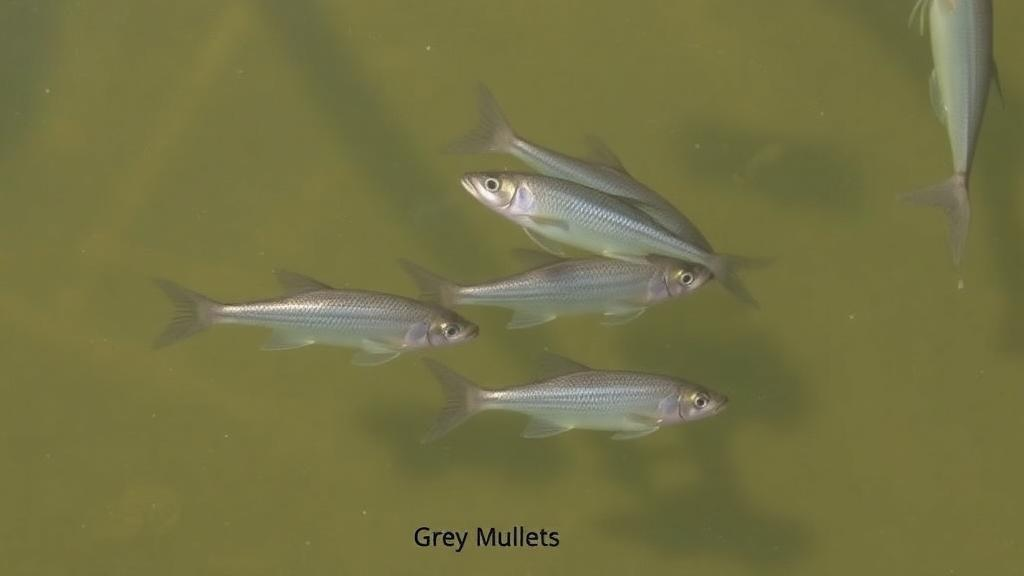
Deep in the semi-arid heart of Tunisia, the Sidi Saad Reservoir has quietly become a natural laboratory for one of the Mediterranean’s most adaptable fish families. A new study published in Acta Ichthyologica et Piscatoria has compared, for the first time in such detail, the reproductive biology and growth patterns of two grey mullet species coexisting in a Tunisian dam reservoir: the flathead grey mullet Mugil cephalus and the thinlip grey mullet Chelon ramada. The findings, based on more than 700 specimens collected across a full year, reveal two closely related species that have carved out distinctly different life-history strategies under identical environmental conditions, with direct consequences for how Tunisia manages its growing inland fisheries.
Mullets are euryhaline fish, meaning they tolerate a wide range of salinities, and they play a crucial ecological role in Tunisian freshwater and estuarine ecosystems. Although typically associated with marine and brackish habitats, several mullet species regularly migrate into freshwater environments. This salinity tolerance makes them good bioindicators of environmental change and anthropogenic pressure. In Tunisia, the family Mugilidae is represented by six species, and together they constitute the most fished group in the country’s dam reservoirs, accounting for 34 percent of the total catch. Between 2000 and 2017, fish production in Tunisian dam reservoirs grew from 843.5 tonnes to about 1,360 tonnes, and efforts are underway to boost mullet production further to meet domestic demand.
Sidi Saad Reservoir itself is an imposing piece of infrastructure. Filled in 1981, it spans 1,700 hectares, holds 209 million cubic meters of water, and reaches a maximum depth of 30 meters. It provides irrigation water for the Kairouan Plain and protects the region against flooding. Since 2011, it has been recognized as a Ramsar site, underscoring its ecological significance. Yet the reservoir faces considerable human pressures, including industrial and agricultural pollution that have caused nutrient enrichment and water quality problems. Classified as mesotrophic, it frequently experiences eutrophication events, toxic cyanobacterial blooms, and pollution from surrounding activities, making it an environment where fish must cope with fluctuating conditions.
The research team collected 204 specimens of Mugil cephalus and 530 specimens of Chelon ramada from local fishermen using gillnets across four seasons in 2016: winter, spring, summer, and autumn. Fresh specimens were transported to the Higher Institute of Marine Biology Laboratory, where total length was measured to the nearest millimeter and weights recorded with a precision of 0.01 grams. Sexing was performed by direct gonadal inspection through dissection, and gonads were examined macroscopically to determine sex and maturity stage. Water parameters, including temperature, salinity, dissolved oxygen, and pH, were measured in situ with a portable multi-parameter probe, while nitrite, nitrate, and orthophosphate levels were analyzed in the laboratory.
One of the most striking results concerns the size at which each species reaches sexual maturity. For Mugil cephalus, the length at which 50 percent of females were mature was 34.13 centimeters, while for males it was 33.29 centimeters. For Chelon ramada, the corresponding sizes were noticeably smaller: 30.5 centimeters for females and 29.4 centimeters for males. Both species attained sexual maturity during the second year of life, and in both cases males matured at relatively smaller sizes than females. This means that Mugil cephalus reaches sexual maturity at a larger size compared to Chelon ramada, a difference that could reflect niche differentiation between the two species as they adapt to the same reservoir environment.
The timing of reproduction also differed between the two species. The gonadosomatic index, a measure calculated as the ratio of gonad weight to eviscerated body weight multiplied by 100, revealed that the spawning season for Mugil cephalus extends from August to October. Gonads began developing after June, and the maximum GSI value was 4.2 for females and 2.8 for males in August before declining in October. For Chelon ramada, the reproductive period occurs from October to December, with gonads starting development after July and peak GSI values of 3.4 for females and 1.8 for males in October. This staggered spawning schedule, with the two species reproducing in successive windows from late summer through early winter, suggests temporal partitioning of reproductive effort that may reduce competition between them.
The sex ratios of both populations showed a slight but consistent female dominance. Of the 204 Mugil cephalus specimens captured, 110 were females and 94 were males, yielding an overall sex ratio of 1.17 biased towards females, though the chi-square test showed no significant difference. Of the 530 Chelon ramada specimens, 275 were females and 255 were males, with an overall ratio of 1.06, also not significantly different from parity. Females predominated in all months for Mugil cephalus, while for Chelon ramada females dominated every month except March and April. In both species, females dominated the larger length classes, a pattern relatively common among mullets and likely attributable to differential growth favoring females along with increased natural mortality of males at smaller sizes and ages.
Growth analysis using the von Bertalanffy equation painted a picture of two species with contrasting growth trajectories. For Mugil cephalus, the asymptotic length was 77.87 centimeters with a growth coefficient of 0.1147 per year and a theoretical age at zero length of -2.41 years. For Chelon ramada, the asymptotic length was 52.01 centimeters with a higher growth coefficient of 0.1782 per year and a theoretical age of -1.41 years. These parameters indicate that Mugil cephalus has a higher growth potential and larger maximum size than Chelon ramada, consistent with previous findings that the flathead grey mullet grows faster in freshwater environments. Length-weight relationships showed primarily isometric growth for both species, meaning weight increases proportionally with length, although the combined-sex category for Mugil cephalus showed positive allometric growth, frequently denoting appropriate environmental circumstances, gonadal development, or optimal feeding conditions.
Principal Component Analysis revealed how strongly seasonal environmental variables shape the biology of both species. For Mugil cephalus, the first two principal components explained 64.1 percent of total variance, with temperature, salinity, and transparency loading positively alongside the gonadosomatic index, while dissolved oxygen, nitrate, and nitrite loaded negatively. Summer stood out from all other seasons, and statistical correlations confirmed that temperature, salinity, and transparency are key factors determining the gonadosomatic index of this species. For Chelon ramada, the pattern was similar but inverted in sign: dissolved oxygen, nitrate, and nitrite loaded positively while temperature, salinity, and transparency loaded negatively. In both cases, summer water physicochemical parameters, mainly temperature, salinity, and transparency, determine the biological parameters of males and females, while winter, spring, and autumn seasons overlapped in their biological profiles.
These findings carry substantial implications for fisheries management and aquaculture in Tunisia and the broader Mediterranean region. Understanding the differences between these two coexisting species is crucial for improving species selection in polyculture systems, designing sustainable fisheries management plans, and enhancing productivity in inland aquaculture. The study’s authors note that knowledge of mullet biology is essential because past experiments on several fisheries showed this resource is fragile and particularly sensitive to overexploitation. However, the research was conducted at a single reservoir over a one-year sampling period, which may limit generalizability. The authors call for broader spatial and temporal coverage, multi-year monitoring to assess temporal variability, and the integration of environmental and genetic data, along with histological and molecular techniques to enhance the accuracy of sex and maturity assessments. Such work would contribute to more informed and adaptive fisheries management in Tunisian dam ecosystems, where mullets represent both an economic opportunity and an ecological indicator of environmental health.
Subject of Research: Reproductive biology and growth of grey mullets in a Tunisian reservoir
Article Title: Comparative analysis of reproductive and growth parameters in Mugil cephalus and Chelon ramada ( Actinopterygii , Mugiliformes , Mugilidae ) from a Tunisian reservoir
Article References: Hajlaoui, W., Mili, S., Mahmoudi, E., Belhassen, D., Hedfi, A., Ben Ali, M., & Missaoui, H. (2025). Comparative analysis of reproductive and growth parameters in Mugil cephalus and Chelon ramada (Actinopterygii, Mugiliformes, Mugilidae) from a Tunisian reservoir. Acta Ichthyologica et Piscatoria, 55, 197-209. https://doi.org/10.3897/aiep.55.156936
Image Credits: AI Generated
Keywords: grey mullet, Mugil cephalus, Chelon ramada, Tunisia, reservoir fisheries, fish reproduction, Comparative, analysis, reproductive, growth, parameters, Mugil
Cite Scienmag News
Violet Maxwell. (October 18, 2026). Grey mullets in a Tunisian dam reveal contrasting life histories with implications for inland fisheries. Scienmag. https://scienmag.com/grey-mullets-in-a-tunisian-dam-reveal-contrasting-life-histories-with-implications-for-inland-fisheries/
Violet Maxwell. "Grey mullets in a Tunisian dam reveal contrasting life histories with implications for inland fisheries." Scienmag, 18 October 2026, https://scienmag.com/grey-mullets-in-a-tunisian-dam-reveal-contrasting-life-histories-with-implications-for-inland-fisheries/. Accessed 18 October 2026.
Violet Maxwell. "Grey mullets in a Tunisian dam reveal contrasting life histories with implications for inland fisheries." Scienmag. October 18, 2026. https://scienmag.com/grey-mullets-in-a-tunisian-dam-reveal-contrasting-life-histories-with-implications-for-inland-fisheries/


