


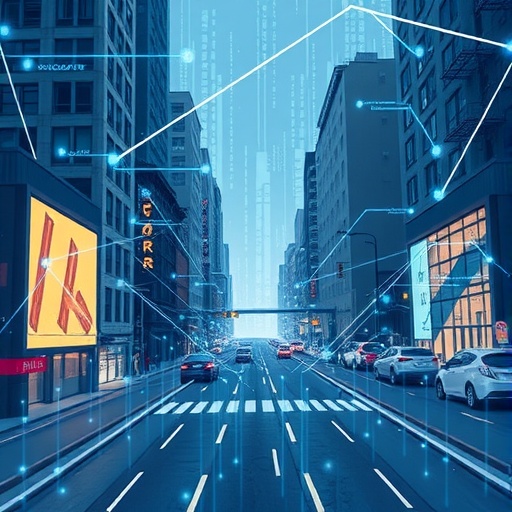
A new study in npj Urban Sustainability suggests that the biggest weakness in today’s smart cities may not be their sensors or networks, but the “invisible gap” between how urban AI systems are built and how they are secured in real life. As cities increasingly rely on machine learning for traffic control, utility management, and public-service decision-making, attackers may exploit the overlooked assumptions that connect models, data pipelines, and deployments.
Researchers Xu, Seto, and Weng analyze the security blind spots that emerge when AI systems move from controlled environments into chaotic urban settings. The work highlights that many defenses focus on isolated components—such as authentication for devices or firewalls for servers—while underestimating the ways AI can be manipulated through data poisoning, adversarial inputs, and model-stealing strategies.
A key technical theme is that AI security often depends on the integrity of the data used to train or continuously update models. If malicious actors can inject subtle corrupted measurements—whether from compromised sensors, intercepted communication, or tampered datasets—the AI’s behavior can drift without obvious signs. This can degrade service quality, bias outcomes, or create operational instability while remaining difficult to attribute.
The paper also points to adversarial examples: small perturbations crafted to cause misclassification or incorrect predictions. In an urban environment, such attacks may be feasible through spoofing of camera inputs, manipulating signals interpreted as vehicle or pedestrian movement, or triggering failure modes in perception systems.
Beyond inference-time attacks, the authors discuss risks to the learning lifecycle itself. When models are updated using streaming data, security must extend to the mechanisms that select, verify, and approve new training samples. Without rigorous checks, an attacker can gradually steer a system toward harmful goals.
Importantly, the study emphasizes that “air gaps” are not present—urban AI systems are interconnected. Models interact with downstream controllers, dashboards, and automated workflows. A security failure in one layer can cascade, turning a seemingly minor manipulation into large-scale disruptions.
For city planners and engineers, the message is clear: AI governance must be treated like critical infrastructure security. The team calls for defenses that account for the entire end-to-end pipeline, not just perimeter protection.
In short, the invisible gap is the mismatch between AI engineering practice and security requirements. Closing it will require continuous monitoring, stronger data provenance, adversarial-aware evaluation, and careful control of how models learn and change over time.
Cite Scienmag News
Courtney Benton. (July 17, 2026). Invisible Gaps in Urban AI Security Threaten City Systems. Scienmag. https://scienmag.com/invisible-gaps-in-urban-ai-security-threaten-city-systems/
Courtney Benton. "Invisible Gaps in Urban AI Security Threaten City Systems." Scienmag, 17 July 2026, https://scienmag.com/invisible-gaps-in-urban-ai-security-threaten-city-systems/. Accessed 3 September 2026.
Courtney Benton. "Invisible Gaps in Urban AI Security Threaten City Systems." Scienmag. July 17, 2026. https://scienmag.com/invisible-gaps-in-urban-ai-security-threaten-city-systems/


