


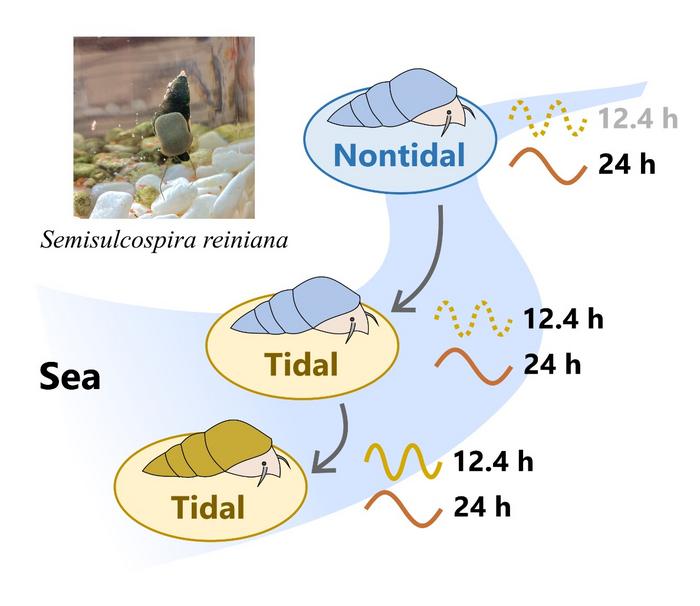
Organisms, including humans, follow a schedule that coordinates important bodily functions such as sleep-wake cycles, metabolism, hormone production, cognitive function, and feeding habits to environmental cycles. While most organisms possess circadian rhythms synchronized with the 24-hour day-night cycle, they have also developed other internal clocks to suit their local environments. Marine animals have evolved circatidal rhythms, aligning activities with the 12.4-hour tidal cycle, complementing circadian rhythms.

Credit: Takumi Yokomizo from The Center for Ecological Research, Kyoto University
Organisms, including humans, follow a schedule that coordinates important bodily functions such as sleep-wake cycles, metabolism, hormone production, cognitive function, and feeding habits to environmental cycles. While most organisms possess circadian rhythms synchronized with the 24-hour day-night cycle, they have also developed other internal clocks to suit their local environments. Marine animals have evolved circatidal rhythms, aligning activities with the 12.4-hour tidal cycle, complementing circadian rhythms.
Researchers from Chiba University have discovered that snails living in downstream tidal areas have biological rhythms synchronized with the tidal cycles, unlike those in nontidal regions. This observation raises the question of whether circatidal rhythms develop due to differences in habitat or are caused by genetic variations between the populations.
Building on their previous findings, Associate Professor Yuma Takahashi, along with Dr. Takumi Yokomizo from Chiba University (at the time of the study, and currently a post-doc researcher at the Center for Ecological Research, Kyoto University), revealed that freshwater snails living in tidal environments gradually adjust their biological rhythms to synchronize with the tidal cycles. The study published in the journal Heredity on March 27, 2024, offers insights into the adaptability and potential divergence of biological rhythms in response to tidal environments.
“This study revealed genetic and non-genetic changes in biological rhythms while adapting to tidal environments in a freshwater snail. This result could lead to an understanding of the role of biological clocks in the adaptation to rhythmic environment, which is one of the most important issues in chronobiology,” says Dr. Takahashi. The researchers collected freshwater snails (Semisulcospira reiniana) from tidal and nontidal areas along the Kiso River in Japan, 20 km apart. Snails were divided into two groups: one exposed to a regular 24-hour light-dark cycle, while the other experienced a simulated 12-hour tidal cycle, alternating between submersion during high tide and exposure to air during low tide.
Following a 4-week entrainment period, the researchers analyzed the behavior and genetic expression patterns of the snails in darkness at a constant temperature of 23°C. Among the snails from non-tidal areas, there were no significant differences in the intensity of the circadian and circatidal rhythms between the two groups. However, snails from tidal areas that were exposed to the simulated tidal cycle showed stronger circatidal rhythms compared to the control group. Interestingly, both the tidal and non-tidal populations exposed to the simulated tide showed an increase in the number of circatidal oscillating genes and a decrease in the circadian oscillating genes (genes that fluctuate in activity in tune with the tidal and diurnal cycle, respectively). Snails that had already adapted to the tidal cycles in the rivers in their early life had a greater number of circatidal oscillating genes compared to the nontidal population.
These results imply that the expression rhythms of genes controlled by the biological clock are sensitive to environmental changes, and can be influenced by genetic changes that result from environmental adaptation. “Our study focused on the flexibility of biological clocks and found their potential to change biological rhythms according to dominant environmental cycles,” says Dr. Takahashi.
Disruptions to biological rhythms can negatively impact various physiological processes. The findings of this study may enhance our understanding of how organisms adapt to changing environmental conditions and prove valuable in the treatment of chronobiological diseases in the future.
About Associate Professor Yuma Takahashi from Chiba University
Dr. Yuma Takahashi is an Associate Professor at the Graduate School of Science, Chiba University. He has a Ph.D. from the University of Tsukuba and has held research fellowships at the University of Tsukuba and Tohoku University. His research focuses on integrating hierarchies and time scales and includes topics like gene expression variation, developmental fluctuations, phenotypic plasticity, and rapid adaptation. Dr. Takahashi has published numerous articles on damselflies, Drosophila, and freshwater snails, exploring the genetic and environmental factors shaping their evolutionary trajectories. He has won numerous awards, including the Miyaji Award from the Ecological Society of Japan and the Population Ecology Young Scientist Award.
Journal
Heredity
Method of Research
Experimental study
Subject of Research
Animals
Article Title
Plasticity of circadian and circatidal rhythms in activity and transcriptomic dynamics in a freshwater snail
Article Publication Date
27-Mar-2024
COI Statement
The authors declare no competing interest.
Cite Scienmag News
Drew Townsend. (May 27, 2024). Investigating the origin of circatidal rhythms in freshwater snails. Scienmag. https://scienmag.com/investigating-the-origin-of-circatidal-rhythms-in-freshwater-snails/
Drew Townsend. "Investigating the origin of circatidal rhythms in freshwater snails." Scienmag, 27 May 2024, https://scienmag.com/investigating-the-origin-of-circatidal-rhythms-in-freshwater-snails/. Accessed 3 September 2026.
Drew Townsend. "Investigating the origin of circatidal rhythms in freshwater snails." Scienmag. May 27, 2024. https://scienmag.com/investigating-the-origin-of-circatidal-rhythms-in-freshwater-snails/

