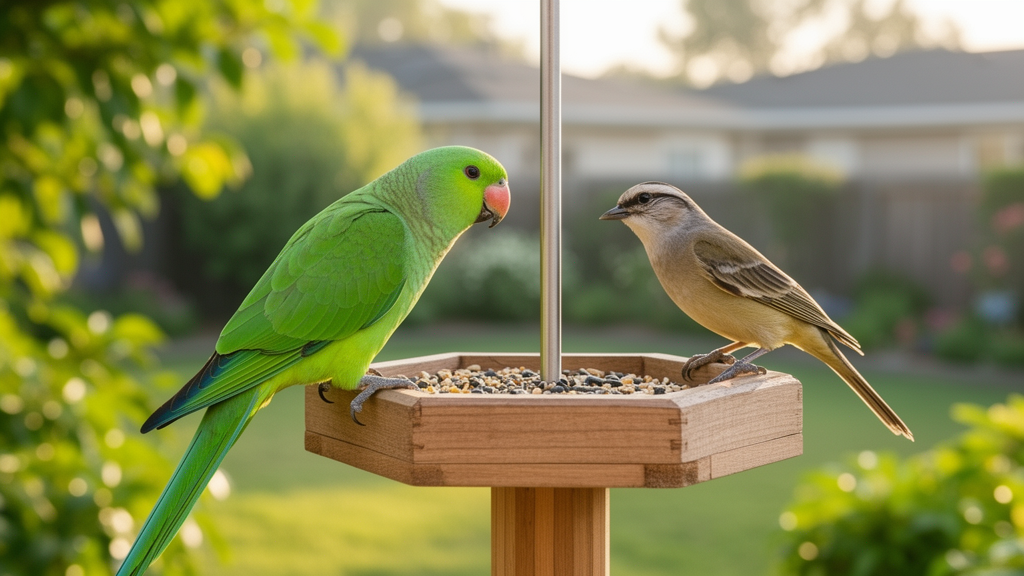
An invasive species often blamed for spreading disease to native wildlife may be less of a microbial threat than its reputation suggests. A new study of monk parakeets in Madrid finds that, despite years of intimate cohabitation with native birds, the invasive parrots show no evidence of passing gut bacteria or viruses to the species that share their nests and feeding grounds.
Monk parakeets (Myiopsitta monachus) are unusual among invasive birds. They build massive communal nest structures that other species move into, and they reach high densities in urban environments. That combination of physical proximity and abundance has made them a prime suspect in debates over pathogen transmission from alien species to native avifauna. Yet empirical studies actually testing horizontal transmission between monk parakeets and native birds have remained scarce, according to the research team behind the new work.
To fill that gap, researchers sampled 117 nestlings in Madrid, Spain, covering three species: invasive monk parakeets, stock doves (Columba oenas) that co-nest inside parakeet nest structures, and Eurasian tree sparrows (Passer montanus) foraging in areas both invaded and not invaded by parakeets. The team combined 16S rRNA gene amplicon sequencing of the gut microbiome with targeted qPCR screening for viruses, then analysed the data using iterative PERMANOVA, generalised linear mixed models and differential abundance analyses.
The results, published in the journal Animal Microbiome, reveal a striking split between the invasive and native birds. Monk parakeets carried a significantly simplified gut bacterial community dominated by Lactobacillus, a pattern the authors interpret as a microbial founder effect combined with strict physiological filtering inside the host gut. In other words, the parakeet microbiome is strongly shaped by the parakeet itself rather than by the environment it shares with other birds.
Multivariate analyses reinforced that picture. Both the overall bacterial communities and the potentially pathogenic fractions were strictly segregated by host identity. Whether a native bird shared communal nests with parakeets, as the stock doves do, or merely foraged in the same urban spaces, as the tree sparrows do, made no measurable difference: the natives showed no increased pathogen overlap with the invader, no altered bacterial loads and no structural changes to their microbiomes associated with parakeet presence.
Univariate models pointed to strong host-specific filtering as the mechanism behind this separation. Several potentially pathogenic taxa showed complete mathematical separation between host species, driven by strict host-specific exclusions. Mycobacterium lineages, for example, were found exclusively in tree sparrows and never in parakeets. Other key lineages, including Pantoea, Stenotrophomonas, Rickettsiella and Nocardia, were significantly enriched in native tree sparrows relative to the invasive parakeets, again suggesting that each host species maintains its own distinct microbial community regardless of contact.
The viral screening added a further layer of reassurance. All four targeted high-risk viral pathogens tested negative across every sample collected in the study. The researchers emphasise that this is a snapshot of nestlings at specific sites, and targeted screening covers only the pathogens chosen for testing, but within that scope the feared viral spillover did not appear.
The authors conclude that strong phylogenetic and physiological filters determine what they call the parakeet microbiome, preventing widespread bacterial spillover to native birds even under conditions of intimate co-nesting and spatial sympatry. On that basis, they argue their results do not support the view of monk parakeets as major disease transmitters in urban ecosystems.
For wildlife managers, the findings carry a practical message. Control measures aimed at invasive parakeets are often justified partly on disease-risk grounds, and the researchers suggest that overestimating that risk can misdirect management effort. Basing control decisions on empirical evidence of actual transmission, rather than on assumed threat, would allow programmes to be adapted to the threats the species genuinely poses. The study is published as open access research, shared early as a citable, peer-reviewed accepted manuscript carrying a permanent DOI, with a final version of record to follow.
Subject of Research: Gut microbiota divergence and pathogen transmission between invasive monk parakeets and native birds in Madrid
Article Title: Gut microbiota divergence and pathogen transmission risk between invasive monk parakeets and native sympatric hosts
Article References: Blanco-González, J., Cayuela, L., Rodríguez-Solís, D. R., Banda, E., Martínez-Miranzo, B., Aguirre, J. I., Diaz de Tuesta Garcia, J. A., Navarro, A., García, R., Enríquez, F., Ortiz, J. C., & López-Rull, I. (2026). Gut microbiota divergence and pathogen transmission risk between invasive monk parakeets and native sympatric hosts. Animal Microbiome. https://doi.org/10.1186/s42523-026-00646-6
Image Credits: AI Generated
DOI: 10.1186/s42523-026-00646-6
Keywords: monk parakeet, invasive species, gut microbiome, pathogen transmission, stock dove, Eurasian tree sparrow, 16S rRNA, qPCR, urban ecology, Madrid, host-specific filtering, Animal Microbiome
Cite Scienmag News
Morgan Morrow. (October 27, 2026). Invasive monk parakeets show little sign of passing pathogens to native birds. Scienmag. https://scienmag.com/invasive-monk-parakeets-show-little-sign-of-passing-pathogens-to-native-birds/
Morgan Morrow. "Invasive monk parakeets show little sign of passing pathogens to native birds." Scienmag, 27 October 2026, https://scienmag.com/invasive-monk-parakeets-show-little-sign-of-passing-pathogens-to-native-birds/. Accessed 28 October 2026.
Morgan Morrow. "Invasive monk parakeets show little sign of passing pathogens to native birds." Scienmag. October 27, 2026. https://scienmag.com/invasive-monk-parakeets-show-little-sign-of-passing-pathogens-to-native-birds/