


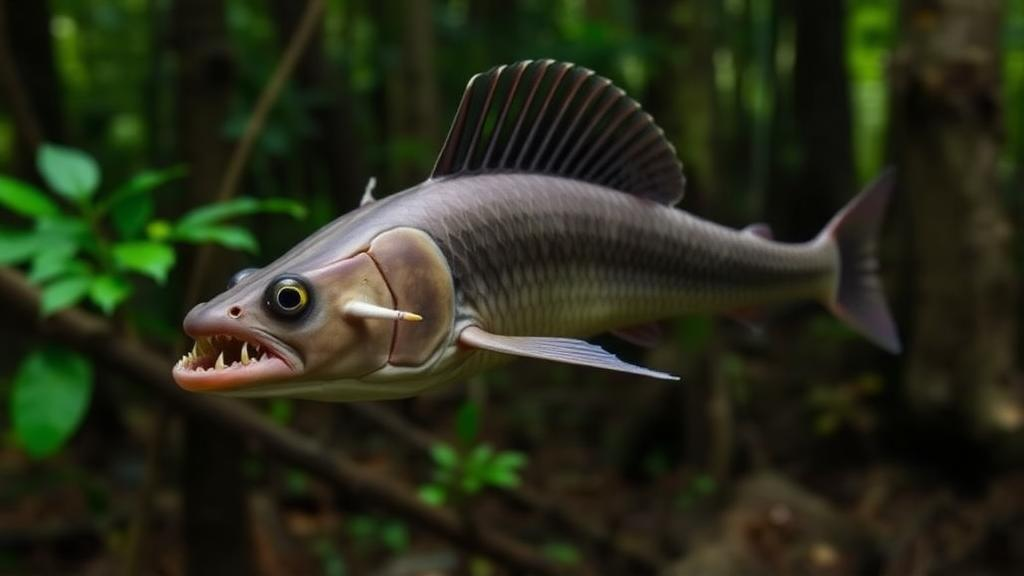
An invasive South American fish has now been documented deep inside one of Mexico’s most treasured wild landscapes. Researchers report the first record of the Amazon sailfin catfish, Pterygoplichthys pardalis, in the central-western area of the Calakmul Forest, the largest tropical forest in Mexico. The finding, published in the journal Acta Ichthyologica et Piscatoria, marks the first time any armored catfish of the genus Pterygoplichthys has been recorded in this remote corner of the Yucatan Peninsula, and it raises urgent questions about how far this hardy invader is spreading through the region’s waterways.
The specimen was captured on 9 December 2024 in Chan Laguna, one of three lagoons that make up the Noh, Chama, and Chan Laguna hydrological system in the municipality of Escárcega, Campeche. A local fisherman caught the fish in a gillnet with a mesh size of 7.62 cm during a research campaign on fish diversity in the Yucatan Peninsula. The researchers immediately recognized it as a Pterygoplichthys specimen, a group of fish easily identified by the bony armor plates covering their bodies and by their distinctive sail-like dorsal fins.
Laboratory examination confirmed the identification. The fish was a male with a total length of 316 mm and a total weight of 280.3 g. It displayed the characteristic leopard-like spots of variable size on its ventral area, a key coloration pattern used to distinguish P. pardalis from related species, along with 11 spines in its dorsal fin. The specimen was deposited in the Ichthyological Collection of the Faculty of Higher Studies Iztacala of the National Autonomous University of Mexico under catalog number CIFI 2401, creating a permanent physical record of the invasion.
Armored catfish of the genus Pterygoplichthys are naturally distributed in southern Central America and South America, where the Amazon sailfin catfish inhabits marginal lagoons and floodplains along the Amazon River and the confluence areas of its main tributaries. The species is one of the most popular in the global aquarium trade, and this commercial popularity is widely believed to be the origin of its global spread. When unwanted aquarium pets are released into local waters, they can establish self-sustaining populations with remarkable ease, thanks to their armor, their ability to breathe air, and their tolerance of poor water quality.
Since 1993, when the species was first recorded in the United States, P. pardalis has been documented across the Caribbean and Central America, including Jamaica, Puerto Rico, Guatemala, the Dominican Republic, and Panama. It has also reached Europe, with records in Serbia, and Asia, where it has been reported in India, the Philippines, Malaysia, Vietnam, Taiwan, Thailand, Indonesia, Israel, Bangladesh, and Sri Lanka. In Mexico, armored catfish have been present since 2003 and are currently found in many regions, including the basins of the Balsas River, the El Infiernillo dam in Michoacán-Guerrero, the Coatzacoalcos, Tonalá, and Papaloapan rivers in Veracruz, the coastal plains of Nayarit and Sinaloa, and especially the Grijalva-Usumacinta system in Chiapas, Tabasco, and Campeche.
Until now, however, no scientific report had documented any Pterygoplichthys species in the Calakmul forest area. The new record is therefore a significant expansion of the known range of this invader into a region of exceptional conservation value. The Calakmul region lies in the southeast of Mexico, in the center of the Yucatan Peninsula, and its western part contains the Noh, Chama-Ha, and Chan Laguna system, also called Silviltuc, Las Maravillas, and Chan Laguna. The Noh Lagoon covers an estimated 6.7 square kilometers, Chama-Ha Lagoon 6.8 square kilometers, and Chan Laguna just 0.45 square kilometers. These lagoons communicate with each other during the rainy season through streams, small ponds, and low-lying swampy areas, and the system is connected to the Candelaria River basin by small streams that reach the Chan Laguna area. The climate is warm subhumid with summer rains, average temperatures between 26 and 28 degrees Celsius, and average total annual rainfall of 1277 mm.
The researchers believe the presence of the species in the area is recent. In sampling campaigns carried out in 2022, there were no reports by fishermen of this type of fish, and previous works in the region do not mention its presence. According to comments from local residents and fishermen, Chan Laguna partially dried up in 2023 and only returned to its previous water levels at the end of 2023 and in 2024, following heavy rains. The two largest lagoons, Noh and Chama-Ha, have not experienced drought events and may serve as reservoirs for local fish fauna, allowing natural repopulation of the smaller lagoon as an adaptation to interannual water fluctuation.
The most likely route of introduction points to the Candelaria River basin. These waters come from nearby parts of the basin, where the presence of Pterygoplichthys was recently reported, although there was already a record of its presence there 10 years earlier. The hydrological connection between the Noh, Chama-Ha, and Chan lagoons and the upper basin of the Candelaria River is temporary, mainly occurring with the flooding of the Tigre and Caribe rivers during the rainy season. Fishermen in the area mention that the first records of this fish in the lagoon were made in that year and that its presence is still scarce. Sampling and interviews with fishermen from the Noh and Chama-Ha lagoons showed that, so far, the fish occurs only in Chan Laguna, and the composition of the catch in the two neighboring lagoons will be monitored.
The effects caused by the presence of armored catfish in the area have not yet been evaluated, but based on previous evidence from other invaded regions, researchers expect serious ecological damage. Documented impacts elsewhere include a decrease in native fish species, a decline in the abundance of submerged aquatic vegetation caused by increased suspended material from the fish’s feeding behavior, changes in nutrient cycles, and increased erosion of shorelines due to the burrows the fish build for nesting. There are also socioeconomic effects, such as damage to fishing gear, particularly gillnets, and injuries to fishermen during the process of removing the spiny fish from nets.
In some areas of Mexico, the consequences have already been severe. At the El Infiernillo dam in Michoacán, armored catfish have caused fishing activity to be abandoned, driven by declining catches of commercial species and rising costs from net losses. The researchers stress that the constant spread of armored catfish in Mexico makes it necessary to carry out studies that analyze and evaluate the factors favoring this expansion, and to implement early warning systems that help control or prevent new areas of Mexico from being invaded. Further research is needed to understand the dispersal pathways of this fish, as well as its potential effects on native fish populations and local fisheries, before the armored invader tightens its grip on one of Mexico’s most important tropical forests.
Subject of Research: Biology
Article Title: First record of armored catfish, Pterygoplichthys pardalis ( Actinopterygii , Siluriformes , Loricariidae ), in the central west area of Calakmul Forest (southern Mexico)
Article References: Wakida-Kusunoki, A. T., Del Moral-Flores, L. F., García-Mercado, E., & Galindo-Hernández, J. H. (2025). First record of armored catfish, Pterygoplichthys pardalis (Actinopterygii, Siluriformes, Loricariidae), in the central west area of Calakmul Forest (southern Mexico). Acta Ichthyologica et Piscatoria, 55, 175-180. https://doi.org/10.3897/aiep.55.151390
Image Credits: AI Generated
Keywords: invasive species, armored catfish, Pterygoplichthys pardalis, Calakmul, Mexico, Yucatan Peninsula, freshwater fish, biodiversity, aquarium trade, Candelaria River, First, record
Cite Scienmag News
Margaret Porter. (October 19, 2026). Invasive armored catfish reaches heart of Mexico’s Calakmul Forest for first time. Scienmag. https://scienmag.com/invasive-armored-catfish-reaches-heart-of-mexicos-calakmul-forest-for-first-time/
Margaret Porter. "Invasive armored catfish reaches heart of Mexico’s Calakmul Forest for first time." Scienmag, 19 October 2026, https://scienmag.com/invasive-armored-catfish-reaches-heart-of-mexicos-calakmul-forest-for-first-time/. Accessed 19 October 2026.
Margaret Porter. "Invasive armored catfish reaches heart of Mexico’s Calakmul Forest for first time." Scienmag. October 19, 2026. https://scienmag.com/invasive-armored-catfish-reaches-heart-of-mexicos-calakmul-forest-for-first-time/


