


Deep inside the galleries that wood-boring beetles carve beneath the bark of Europe’s dead and dying trees, a slender black insect has been hiding in plain sight for more than a century. Entomologists had long assumed that only two species of the genus Colydium lived in the Western Palearctic region: Colydium elongatum and Colydium filiforme. Both are members of the saproxylic guild, the community of organisms that depends on dead wood, and both live inside the tunnels of other wood-dwelling insects. But when researchers began examining specimens collected during ecological and faunistic surveys across several European countries, they noticed two distinct morphological forms that had been tentatively assigned to C. elongatum. That observation set in motion a study that has now formally described a third species, Colydium noblecourti sp. nov., and rewritten the identification framework for the entire genus in Europe.
The new species, described in the Deutsche Entomologische Zeitschrift by Guillem Parmain, Andreas Eckelt, Rudolf Schuh and colleagues, was named in honour of Thierry Noblecourt, a French entomologist who spent many years with the French National Forest Office and built a network of specialists working on saproxylic beetles. The holotype, an adult male, was collected in the Lainzer Tiergarten, a woodland on the western edge of Vienna, at 320 metres above sea level. Around 250 paratypes from across Europe and beyond accompany it, drawn from dozens of private and institutional collections. The species is recorded from thirteen countries: Austria, Andorra, Bosnia, Croatia, Czech Republic, France, Germany, Iran, Italy, Slovakia, Slovenia, Spain and Turkey.
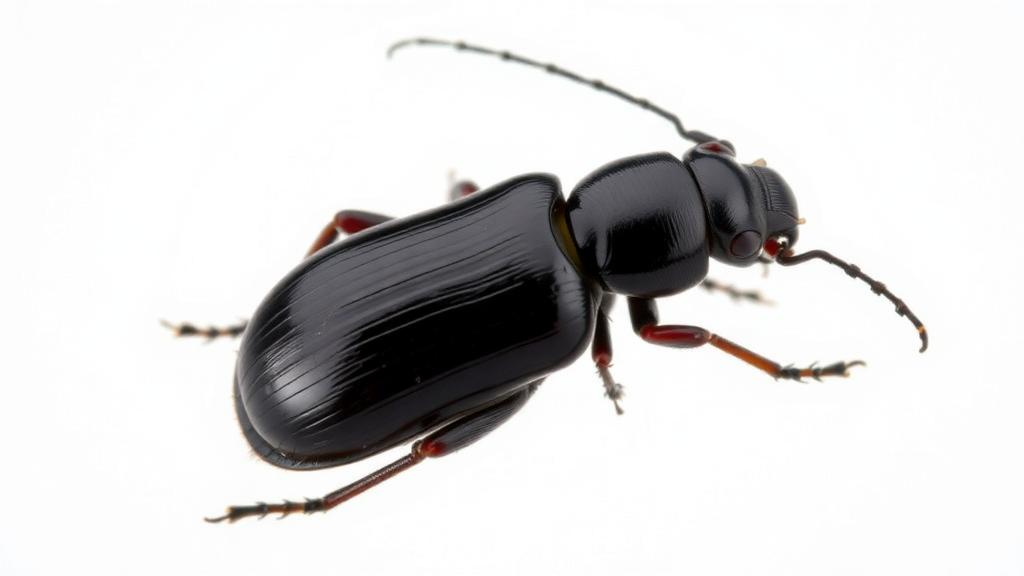
What makes the discovery remarkable is not just that a new beetle has been added to the European fauna, but that it had been misidentified for so long. The genus Colydium was revised in 1999 and currently contains 32 species worldwide, yet only two were thought to inhabit the Palearctic area. The family Zopheridae, to which the genus belongs, is represented in the Palearctic by 287 species grouped into 46 genera. Colydium species are small, elongate beetles, typically between 5 and 7.4 millimetres long, uniformly black in the case of the new species, with reddish-brown legs and antennae. They live under the bark of dead or dying trees, inside the galleries of other wood-dwelling insects, and their ecology remains largely unstudied. They may prey on other beetles or their larvae living under the bark, or they may only clean the galleries, a relationship that could be predatory or commensal depending on the circumstances.
The researchers studied 830 specimens of Colydium from various collections, including type specimens for the European species examined through high-quality photographs provided by the Zoological Museum of Kiel University. Morphological terminology followed standard references, and the team measured the total length to maximum elytral width ratio and the pronotal length to maximum pronotal width ratio of 313 specimens representing all three species. The measurements revealed that these ratios, which have been used in most identification keys to separate C. elongatum from C. filiforme, are not diagnostic. The total length to elytral width ratio shows mutual overlap among the three species, with no distinct clusters. The pronotal length to width ratio similarly shows no significant specific differences. A principal component analysis confirmed the absence of obvious clustering in the morphometric data.
This finding vindicates a suggestion made by Węgrzynowicz in 1999 that the pronotal ratio may be inefficient for separating the two then-known species. The researchers now understand why: a third species was complicating identification. The new species can be distinguished from C. elongatum by the uniformly black colour of its elytra, whereas C. elongatum shows a brown humeral region or an obscurely reddish elytral base. The pronotum of the new species is more globose apically, its admedian lines are weak, irregular and interrupted or absent, and the carina on elytral interval 5 does not reach the elytral apical rim. The sculpture on the lateral parts of abdominal ventrites 2, 3 and 4 is less developed than on ventrite 1, or even absent, and the apical margin of abdominal ventrite 5 is obtusely angled in the middle rather than semicircular. The aedeagus shows parameres that are broader, lamelliform, s-shaped in lateral aspect, and inclined toward each other rather than lying in the same plane.
Compared with C. filiforme, the new species again differs in the uniformly black colour of its elytra, since C. filiforme shows a distinctively reddish elytral base. The pronotum is generally less elongate, with the pronotal length to width ratio reaching only 1.56 compared with up to 1.65 in C. filiforme. The male genitalia provide the most reliable separation: the median lobe of the new species is longer, and its apex is acutely angled but never prolonged into a narrow tip, whereas in C. filiforme the apex is sharply angled but not prolonged. The researchers conclude that the male genitalia are the most efficient criterion for separating the three species, and they present an illustrated and updated identification key for the Western Palearctic species of Colydium based on external characters and genital morphology.
To test whether the morphological differences correspond to genuine species boundaries, the team analysed mitochondrial cytochrome oxidase subunit 1 barcode sequences from 29 Colydium specimens, with an outgroup sequence from Lasconotus jelskii. Samples from 14 individuals collected by the authors in Austria and Italy were processed at the Canadian Centre for DNA Barcoding according to a standard high-throughput protocol. The sequences were made publicly available through the Barcode of Life Data System. Using Kimura’s 2-parameter model, the researchers calculated intra- and interspecific variation, and a maximum likelihood tree was constructed with MAFFT alignment, ModelFinder model selection and IQ-TREE inference under an edge-linked partition model with 1,000 ultrafast bootstraps. The analysis showed the three European species forming distinct clades with robust bootstrap support. The mean interspecific distance within the genus is 4.83 percent, with a minimum of 4.1 percent and a maximum of 5.6 percent. The new species shows a distance of 4.3 percent to its closest neighbour, C. filiforme, and more than 4.5 percent to C. elongatum, confirming that the morphological differences are sufficient to distinguish the species clearly.
The ecology of the new species adds another layer of interest. All previous publications on Palearctic Colydium show similar behaviour across the species: they live in the galleries of other saproxylic beetles, and there is no clear evidence whether they are predators or cleaners, or possibly both depending on the stage of development. C. elongatum inhabits deciduous trees such as oak, beech and walnut in Central Europe, but has also been reported from conifers in France and Greece. C. filiforme has hitherto been found exclusively on oak. The new species seems to show a slight preference for coniferous trees, including pine, silver fir and Norway spruce, although it has also been found on beech and hornbeam. One of the authors collected it several times in eastern Austria on dead but still standing black pine under mouldy or rotten bark, where the specimens were hiding in abandoned galleries of scolytine bark beetles or longhorn beetles. Collecting was largely carried out from December to April, with less success during other parts of the year. Label data from other collections record the species in galleries of Xyloterus lineatus on Norway spruce, in galleries of Orthotomicus laricis on Norway spruce, under bark of burnt spruce, in window traps on dead silver fir, and at night on trunks of beech.
The distribution data reveal a species that is more or less rare depending on the country. In France, the new species appears more common than C. filiforme, whereas in Germany and the Czech Republic the reverse is true. C. elongatum is the most widespread of the three, known from 33 European countries, and is considered of least concern in Italy but endangered in Norway. C. filiforme is known from 23 countries, is rare in Western Europe but more common in the east, and is included in the European list of primeval forest relict beetles, confirming its high conservation importance. It is considered near threatened in Italy and endangered in Norway. The new species is only known from the records provided in the present study, and more data are needed to assess its real conservation status. The researchers assume that it will be found in other European countries as well.
The discovery carries a broader message for European biodiversity. Widely distributed species can sometimes hide a complex of several cryptic species, and closely studying morphology and male genitalia in association with genetic analysis is an efficient way to detect them. The researchers believe that many species remain undiscovered in Europe, simply hidden among more common ones. The case of Colydium noblecourti shows that even well-studied regions can yield surprises when researchers look closely at the insects that live in the hidden world beneath tree bark. The new species is a reminder that the saproxylic community, which plays a vital role in nutrient cycling and forest regeneration, still holds secrets that only careful morphological and molecular work can reveal. As dead wood becomes increasingly scarce in managed forests, understanding the true diversity and ecology of these beetles becomes ever more urgent for their conservation.
Subject of Research: The genus Colydium Fabricius in Europe (Coleoptera, Zopheridae, Colydiinae) with description of a new species, Colydium noblecourti sp. nov.
Article Title: The genus Colydium Fabricius in Europe ( Coleoptera , Zopheridae , Colydiinae ) with description of a new species, Colydium noblecourti sp. nov.
Article References: Parmain, G., Eckelt, A., & Schuh, R. (2024). The genus Colydium Fabricius in Europe (Coleoptera, Zopheridae, Colydiinae) with description of a new species, Colydium noblecourti sp. nov.. Deutsche Entomologische Zeitschrift, 71(2), 289-301. https://doi.org/10.3897/dez.71.121389
Image Credits: AI Generated
Keywords: genus, Colydium, Fabricius, Europe, Coleoptera, Zopheridae, Colydiinae, description, species, noblecourti, scientific research
Cite Scienmag News
Gavin Prescott. (October 19, 2026). The genus Colydium Fabricius in Europe (Coleoptera, Zopheridae, Colydiinae) with description of a new species, Colydium noblecourti sp. nov. Scienmag. https://scienmag.com/the-genus-colydium-fabricius-in-europe-coleoptera-zopheridae-colydiinae-with-description-of-a-new-species-colydium-noblecourti-sp-nov/
Gavin Prescott. "The genus Colydium Fabricius in Europe (Coleoptera, Zopheridae, Colydiinae) with description of a new species, Colydium noblecourti sp. nov." Scienmag, 19 October 2026, https://scienmag.com/the-genus-colydium-fabricius-in-europe-coleoptera-zopheridae-colydiinae-with-description-of-a-new-species-colydium-noblecourti-sp-nov/. Accessed 19 October 2026.
Gavin Prescott. "The genus Colydium Fabricius in Europe (Coleoptera, Zopheridae, Colydiinae) with description of a new species, Colydium noblecourti sp. nov." Scienmag. October 19, 2026. https://scienmag.com/the-genus-colydium-fabricius-in-europe-coleoptera-zopheridae-colydiinae-with-description-of-a-new-species-colydium-noblecourti-sp-nov/


