


A qualitative interview study of 17 sitting Florida school board members found that participants who questioned state education directives or defended local decision-making reported surveillance, public shaming, threats of removal, funding pressure and retaliatory audits or investigations. Researchers at the University of Southern California Rossier School of Education and the University of San Francisco School of Education described three recurring categories in the accounts: “extra-legal tactics,” “targeted lawfare” and “autocratic legalism.” The findings concern a small, self-selected sample and cannot establish how frequently similar experiences occur across Florida or the United States, but they document the working environment experienced by a group of locally elected education officials. The research appears in “Bullied, Threatened, and Exhausted: Florida School Board Members’ Struggle to Defend Public Education,” published by the Center for Evaluation and Education Policy at the Indiana University School of Education as Policy Report #26-C. Between February and May 2026, researchers conducted in-depth interviews with 17 current school board members from 11 Florida counties.
Those counties together educate nearly half of the state’s public school students. Interviews lasted 60 to 75 minutes, were coded thematically, and had factual claims checked against news coverage, public social media posts and state documents. Interviewees described state officials monitoring board meetings and members’ social media, posting threatening letters to districts on Twitter/X, and summoning board members and superintendents to State Board of Education meetings for public reprimand.
Eight of the 17 participants said they knew their meetings or social media were being watched. Other participants described threatened or actual loss of state funding, removal from office, and retaliatory audits or investigations. Eleven of the 17 said the threat of gubernatorial removal shaped their decisions.
The interviews document perceptions and reported experiences; they do not establish that every threatened consequence was imposed or that one factor caused a particular decision. The report places those accounts within a policy environment that includes more than 20 Florida laws, regulations and executive directives enacted since 2020. Measures cited in the report affect curriculum and instruction on race and history, library and classroom book challenges, LGBTQ+ topics and student pronouns, public-sector unions, universal school vouchers, charter-school co-location, school board term limits and state reporting requirements.
Named examples include House Bill 7 from 2022, House Bill 1557 from 2022, House Bill 1069 from 2023, Senate Bill 256 from 2023 and House Bill 1 from 2023. The study did not test the effects of each measure, but its authors argue that understanding how state policy is enforced locally is important because Florida’s education laws have often served as models for legislation elsewhere. “Autocratic legalism” is the report’s term for the use of conventional statutes, regulations and administrative authority to shift power away from locally elected school boards.
The report highlights mandated commissioner letters to parents, expanded powers to remove and appoint officials, universal school vouchers, charter co-location requirements, term limits and strict application of Florida’s Sunshine Law. Interviews also indicated that school board attorneys, superintendents and professional associations sometimes reinforced state pressure by advising members to comply more extensively rather than protect independent deliberation. The report presents this pattern as part of the administrative setting in which boards considered state directives; it does not attribute each reported outcome or strategic change to a single law.
The interviews also described substantial personal and professional effects. Participants said they had installed home security cameras, received death threats and sought therapy. Most had stopped using social media or sharply reduced their activity, while four said they chose not to seek re-election because of the pressure.
Twelve of the 17 said they now worked “behind the scenes” to avoid state scrutiny. USC Rossier professor of education policy Huriya Jabbar said the study shows that Florida school board members have been “personally targeted and threatened by state officials to keep their head down and not speak out.” The authors caution that this quieter approach can leave constituents, especially historically marginalized students and families, without a visible public advocate. Board members linked the broader climate to lost educational opportunities.
They described thousands of removed library books, dismantled equity and LGBTQ+ support programs, shuttered student clubs, delayed textbook adoptions, and departures by teachers and counselors. These are interview accounts rather than independently measured effects of any particular statute, and the study did not compare the reported program losses with a period before the pressure intensified. Several participants warned that culture-war conflict, rapid expansion of vouchers and declining enrollment together pose an existential threat to Florida’s public school system.
The report uses the board as a setting in which broad state policy changes become operational through decisions about curriculum, staffing, programs and publicly funded services. Reported targeting was concentrated in six of the 11 districts studied, which together enroll 42% of Florida’s public school students. Those districts were larger, more Democratic-leaning and served more students of color, according to the report.
The distribution indicates where pressure was most severe within this particular sample, but it does not prove that state officials target only districts with those political or demographic characteristics. Some reframed debates around parental rights, focused discussion on what was best for students, and sought less restrictive legal interpretations with assistance from civil rights organizations. Their accounts present these as strategies used in response to contested policy disputes, not as outcomes tested through a comparative intervention.
The authors describe Florida as a “canary in the coal mine” for public education because education legislation from the state has been copied or adopted in other jurisdictions. University of San Francisco associate professor Danfeng Soto-Vigil Koon said the pressures described by board members could become a playbook for school governance across the country, particularly amid budget pressure, school closures and universal voucher programs. That is the authors’ argument for broader relevance, not a measured estimate of policy transfer or proof that the same tactics are already occurring elsewhere.
The sample was small, consisted of volunteers and did not represent all Florida school boards; the researchers therefore called for further research on the prevalence and consequences of similar pressure. The interviews show how officials reported being watched, threatened and constrained, while leaving the scale and distribution of the problem unresolved.
Subject of Research: Qualitative study of political, legal and administrative pressure on Florida school board members
Article Title: USC Rossier and University of San Francisco researchers find Florida school board members face surveillance, threats and removal pressure for defending public education
Article References: USC Rossier and University of San Francisco researchers find Florida school board members face surveillance, threats and removal pressure for defending public education. Original publication (Bibliographic details unavailable.)
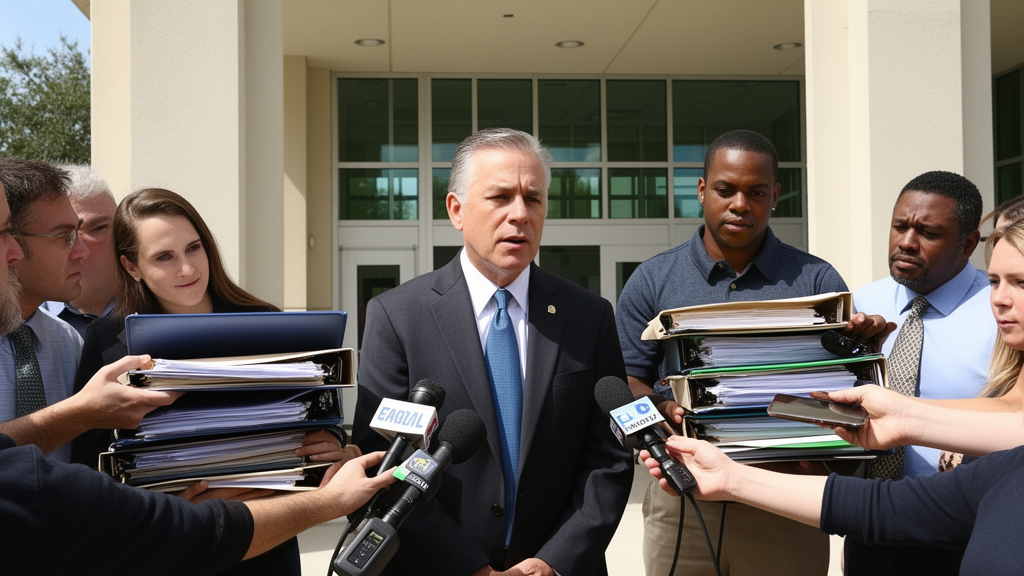
Image Credits: AI Generated
DOI: Not provided
Keywords: Florida education, school boards, education policy, political pressure, school vouchers, curriculum disputes, public schools, qualitative interviews, school governance, education law, Rossier, University
Cite Scienmag News
Courtney Benton. (October 22, 2026). Interview Study Documents Pressure on Florida School Board Members. Scienmag. https://scienmag.com/interview-study-documents-pressure-on-florida-school-board-members/
Courtney Benton. "Interview Study Documents Pressure on Florida School Board Members." Scienmag, 22 October 2026, https://scienmag.com/interview-study-documents-pressure-on-florida-school-board-members/. Accessed 22 October 2026.
Courtney Benton. "Interview Study Documents Pressure on Florida School Board Members." Scienmag. October 22, 2026. https://scienmag.com/interview-study-documents-pressure-on-florida-school-board-members/


