


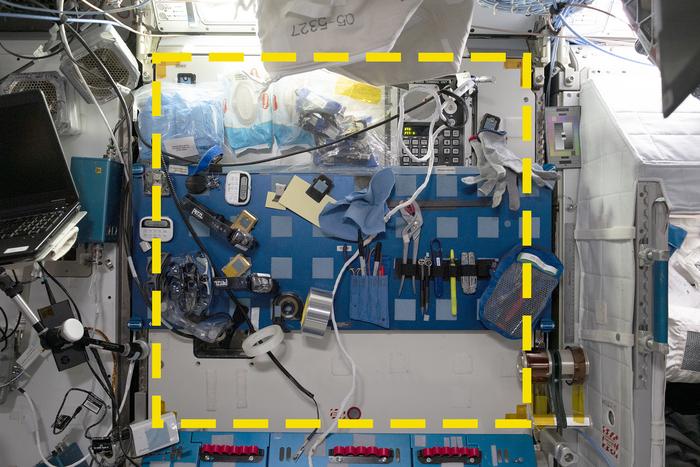
An archaeological strategy adapted for space used daily photos to reveal how astronauts actually use areas aboard the International Space Station – and how this differs from intended uses. Justin Walsh of Chapman University, California, and colleagues present these findings in the open-access journal PLOS ONE on August 7, 2024.

Credit: Walsh et al., 2024, PLOS ONE, CC-BY 4.0 (
An archaeological strategy adapted for space used daily photos to reveal how astronauts actually use areas aboard the International Space Station – and how this differs from intended uses. Justin Walsh of Chapman University, California, and colleagues present these findings in the open-access journal PLOS ONE on August 7, 2024.
More than 270 people from 23 countries have visited the International Space Station (ISS) over more than two decades. Crew member interviews can reveal how people adapt to a novel environment—one featuring isolation, confinement, and microgravity—that is far removed from the context in which humans evolved. However, interviews may be unable to capture insights that could be captured by alternative approaches.
In order to better understand the “microsociety” of the ISS, Walsh and colleagues launched the International Space Station Archaeological Project, which applies an archaeological framework to the ISS and studies the materials used by its crew as artifacts.
For their first direct work on the space station, the team adapted a traditional archaeological strategy known as the shovel test pit, in which small pits are dug at intervals across a site to assess artifact distribution and select areas for more extensive excavation. In this case, the archaeologists asked the ISS crew to document six locations around the station, and instead of digging pits, taking daily photos of each location for 60 days in 2022.
The new article reveals findings from the first two of the six sample areas to be fully documented: one designated for equipment maintenance and another near the latrine and exercise equipment. Further analysis of photos in these areas using a novel open-source image analysis platform developed by the team revealed 5,438 instances of “artifacts” being used for varied purposes, such as writing tools, Post-It notes, and an augmented reality headset.
Cross-referencing the photos with astronaut activity reports, the researchers found that the area near the exercise equipment and latrine, while not designated for any particular purpose, had been used as storage for toiletries, resealable bags, and a rarely used computer. The equipment maintenance area was used primarily for storage, with little or no maintenance actually carried out there.
These findings demonstrate how traditional archaeological techniques can be adapted to study remote or extreme habitats. The findings could also help inform development of future space habitats.
The authors add: “The experiment is the first archaeology ever to happen off of the planet Earth. By applying a very traditional method for sampling a site to a completely new kind of archaeological context, we show how the ISS crew uses different areas of the space station in ways that diverge from designs and mission plans. Architects and planners of future space stations can learn valuable lessons from this work.”
#####
In your coverage please use this URL to provide access to the freely available article in PLOS ONE:
Citation: Walsh JSP, Graham S, Gorman AC, Brousseau C, Abdullah S (2024) Archaeology in space: The Sampling Quadrangle Assemblages Research Experiment (SQuARE) on the International Space Station. Report 1: Squares 03 and 05. PLoS ONE 19(8): e0304229.
Author Countries: USA, Australia
Funding: JW was the recipient of funding from Chapman University’s Office of Research and Sponsored Programs to support the activities of Axiom Space as implementation partner for the research presented in this article. There are no associated grant numbers for this financial support. Axiom Space served in the role of a contractor hired by Chapman University for the purpose of overseeing logistics relating to our research. In-kind support in the form of ISS crew time and access to the space station’s facilities, also awarded to JW from the ISS National Laboratory, resulted from an unsolicited proposal, and therefore there is no opportunity title or number associated with our work. No salary was received by any of the investigators as a result of the grant support. No additional external funding was received for this study.
Journal
PLoS ONE
Method of Research
Observational study
Subject of Research
People
Article Title
Archaeology in space: The Sampling Quadrangle Assemblages Research Experiment (SQuARE) on the International Space Station. Report 1: Squares 03 and 05
Article Publication Date
7-Aug-2024
COI Statement
The authors have declared that no competing interests exist.
Cite Scienmag News
Courtney Benton. (August 7, 2024). International Space Station crew carries out first-ever archeological survey in space. Scienmag. https://scienmag.com/international-space-station-crew-carries-out-first-ever-archeological-survey-in-space/
Courtney Benton. "International Space Station crew carries out first-ever archeological survey in space." Scienmag, 7 August 2024, https://scienmag.com/international-space-station-crew-carries-out-first-ever-archeological-survey-in-space/. Accessed 3 September 2026.
Courtney Benton. "International Space Station crew carries out first-ever archeological survey in space." Scienmag. August 7, 2024. https://scienmag.com/international-space-station-crew-carries-out-first-ever-archeological-survey-in-space/

