


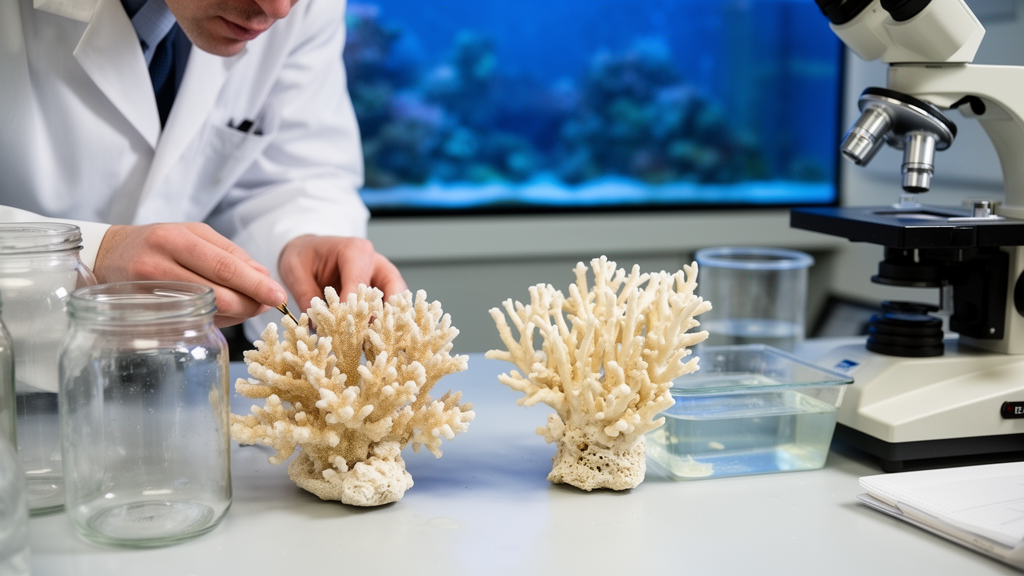
Corals from the eastern North Pacific that had been identified as Desmophyllum pertusum are genetically and morphologically distinct from their Atlantic counterparts, according to an integrative taxonomic study that resurrects the name Desmophyllum californicum. The researchers combined population genomics, nuclear phylogenomics, mitochondrial genomes and skeletal comparisons, finding that the Pacific lineage warrants recognition as a separate species. Their results also support the taxonomic merger of the genera Lophelia and Desmophyllum.
Desmophyllum pertusum, long known as Lophelia pertusa, is a habitat-forming cold-water coral documented in tropical and temperate waters of the Atlantic, Indian and western Pacific oceans. It occurs at depths of 40–2,775 metres, occupies settings including seamounts, submarine canyons and rocky outcrops, and can form bioherms and three-dimensional frameworks that shelter other organisms. Its colonies are morphologically variable, and the species accounts for approximately 30% of published research on colonial scleractinian cold-water corals. Those broad characteristics, combined with similarities among specimens from different ocean basins, had contributed to its treatment as cosmopolitan.
That interpretation placed several nominal species into D. pertusum on the basis of morphology, but genetic analyses indicate that geographic distribution alone may conceal evolutionary boundaries. Previous studies found substantial genetic structure among western North Atlantic populations of D. pertusum and very low divergence between it and the close relative D. dianthus. The new study asked whether corals assigned to D. pertusum on opposite sides of North America belonged to one broadly distributed lineage or represented separate species. Its authors also evaluated whether the distinction between colonial Lophelia and solitary Desmophyllum remained useful at the genus level.
The researchers used contemporary specimens collected over ten years from the North Atlantic and eastern North Pacific, together with 13 historical specimens from the Smithsonian National Museum of Natural History. Recent collections came from the Iceland Basin Slope, Anton Dohrn Seamount, Whittard Canyon, the Lofoten Basin Slope, Georges Bank, Norfolk Canyon, Pamlico Canyon, the Blake Plateau and Escarpment, the east Florida Slope, the Texas–Florida Slope, Whiting Bank and several Pacific sites. Contemporary sampling used the human-occupied submersibles Johnson Sea-Link and Alvin and the remotely operated vehicles SuBastian, Jason and Hercules. Museum material extended the geographic coverage to California, British Columbia, Hawaii, New Jersey and the Galápagos region.
Initial population-genomic comparisons used restriction-site-associated DNA sequencing, or RADSeq. After filtering, the analysis included 101 specimens and 2,496 unlinked single-nucleotide polymorphisms, although the figure captions report 2,495 SNPs for the principal component and STRUCTURE analyses. Principal component analysis identified three broad genetic clusters: one containing the Georges Bank Slope, Blake Plateau and Escarpment, and east Florida Slope; another joining Norfolk Canyon with the Texas–Florida Slope; and a distinct North Pacific group. A separate STRUCTURE analysis also supported three clusters. Pairwise FST values across six regions ranged from 0.01 to 0.27, with the Pacific samples differing from every Atlantic population by 0.23–0.27. In comparison, differentiation among the Georges Bank, Blake Plateau and east Florida groups remained below 0.06.
The team then used low-coverage whole-genome sequencing, known as genome skimming, to recover nuclear ultraconserved elements, exon loci and complete mitochondrial genomes. The final nuclear matrix contained 1,794 loci across 89 targeted specimens and spanned 2,936,258 base pairs. Maximum-likelihood and species-tree analyses produced the same relationships at deep nodes. Both analyses recovered the eastern Pacific specimens formerly identified as D. pertusum as an early-diverging lineage separate from Atlantic D. pertusum. The reconstructed genus also included both colonial and solitary forms, while the two principal colonial lineages and the two solitary lineages were not each monophyletic.
This broader pattern supports treating Lophelia as a synonym of Desmophyllum, a merger previously proposed on mitochondrial, microsatellite and skeletal evidence and subsequently accepted by World Register of Marine Species editors. Some researchers had maintained that more comprehensive molecular evidence was needed. By recovering thousands of nuclear loci and showing a monophyletic Desmophyllum containing both growth forms, the study provides genome-scale support for that synonymy. The result also illustrates why coloniality alone is an unreliable generic character: the recovered relationships do not divide the species into separate colonial and solitary assemblages.
Mitochondrial genomes independently supported the Pacific–Atlantic split. The seven complete genomes recovered in the study were circular, ranged from 16,098 to 16,150 base pairs and contained 34.8%–34.9% GC. Three D. californicum genomes differed from one another by no more than four base pairs, even though samples came from Hawaii and the continental Pacific coast. Pacific genomes differed from Atlantic D. pertusum by as many as 34 base pairs, corresponding to 99.79% sequence identity. Two Atlantic specimens also shared a 51-base-pair deletion in an intron between the nad5 3-prime region and the cob gene that was absent from the other retrieved genomes, reinforcing evidence of genetic discontinuity within western North Atlantic populations.
Skeletal observations supplied a second line of distinction. Desmophyllum californicum forms bushy colonies with closely spaced corallites, frequent intratentacular circumoral budding and short cylindrical coenosteal bridges connecting adjacent branches. As many as eight corallites can bud from the proximal edge of a single corallite, and corallites are usually 4–6 millimetres in greater calicular diameter, although aberrant larger examples occur. Atlantic D. pertusum has more widely spaced corallites, predominantly sympodial budding, a more open colony form and corallites usually 10–15 millimetres wide, sometimes reaching 20 millimetres. The species otherwise share similar septal arrangements, including 28–36 septa in ordinary corallites, so the distinctions are most evident in colony form, budding pattern and corallite size.
The revision carries implications for research and conservation because much of the existing literature and international conservation activity still uses the name Lophelia pertusa. Updating databases, management documents and legislation to Desmophyllum could help maintain continuity with earlier studies. The authors also caution that the sampled Pacific range may not represent the species’ full distribution: populations in the western Pacific or Indian Ocean that remain assigned to D. pertusum may instead belong to D. californicum or other lineages. Their genomic results also identify a solitary lineage previously assigned to D. dianthus that may represent a new or previously described species, but the available samples were insufficient to resolve its taxonomy conclusively. Further sampling, population genomics, ecological data and quantitative morphology are therefore needed to define the remaining lineages and distributions.
Subject of Research: Integrative genomic and morphological analysis of cold-water corals in the Atlantic and eastern North Pacific
Article Title: Integrative Taxonomy Does Not Support a Cosmopolitan Desmophyllum pertusum: Resurrecting D. californicum and Validating the Genus Desmophyllum
Article References: Vaga, C. F., Weinnig, A. M., Cairns, S. D., Taylor, M. L., Everett, M., Herrera, S., Cordes, E. E., Quattrini, A. M., & Morrison, C. L. (2026). Integrative Taxonomy Does Not Support a Cosmopolitan Desmophyllum pertusum : Resurrecting D. californicum and Validating the Genus Desmophyllum. Ecology and Evolution, 16(10), Article e74485. https://doi.org/10.1002/ece3.74485
Image Credits: AI Generated
DOI: 10.1002/ece3.74485
Keywords: cold-water corals, deep-sea coral, Desmophyllum californicum, Desmophyllum pertusum, Lophelia, integrative taxonomy, population genomics, phylogenomics, mitochondrial genomes, marine taxonomy, Integrative, Taxonomy
Cite Scienmag News
Drew Townsend. (October 20, 2026). Integrative Taxonomy Does Not Support a Cosmopolitan Desmophyllum pertusum: Resurrecting D. californicum and Validating the Genus Desmophyllum. Scienmag. https://scienmag.com/integrative-taxonomy-does-not-support-a-cosmopolitan-desmophyllum-pertusum-resurrecting-d-californicum-and-validating-the-genus-desmophyllum/
Drew Townsend. "Integrative Taxonomy Does Not Support a Cosmopolitan Desmophyllum pertusum: Resurrecting D. californicum and Validating the Genus Desmophyllum." Scienmag, 20 October 2026, https://scienmag.com/integrative-taxonomy-does-not-support-a-cosmopolitan-desmophyllum-pertusum-resurrecting-d-californicum-and-validating-the-genus-desmophyllum/. Accessed 20 October 2026.
Drew Townsend. "Integrative Taxonomy Does Not Support a Cosmopolitan Desmophyllum pertusum: Resurrecting D. californicum and Validating the Genus Desmophyllum." Scienmag. October 20, 2026. https://scienmag.com/integrative-taxonomy-does-not-support-a-cosmopolitan-desmophyllum-pertusum-resurrecting-d-californicum-and-validating-the-genus-desmophyllum/


