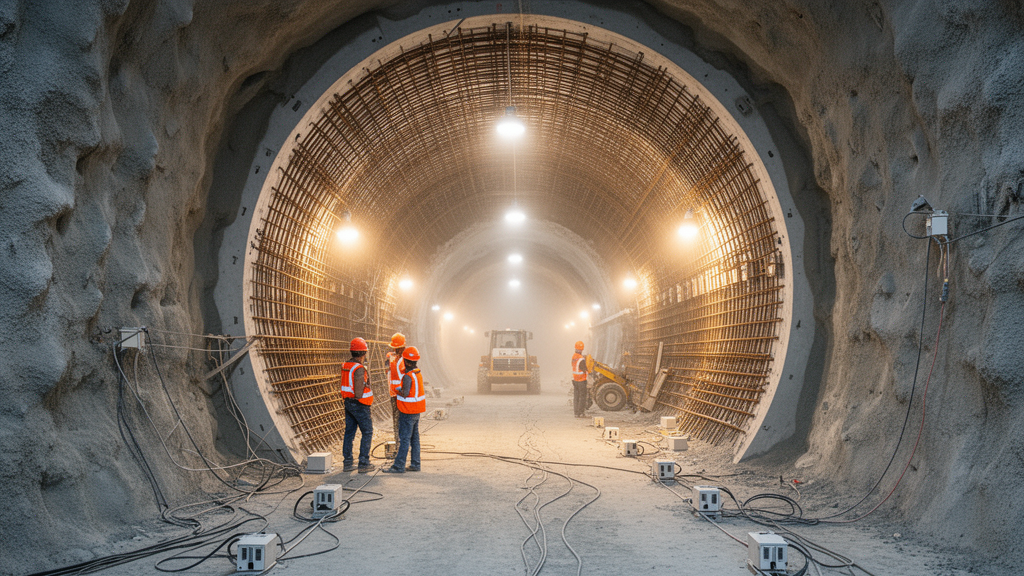
Deep inside a disused section of Austria’s Styrian Erzberg, at an elevation of roughly 1,100 metres, the Technical University of Leoben operates an underground laboratory unlike almost any other in the world. Zentrum am Berg, or ZaB, is a full-scale research infrastructure in which motorway tunnels, railway tunnels, and mining cross-sections exist at true 1:1 scale, allowing engineers to study construction, operation, safety, and energy applications under realistic boundary conditions rather than in scaled-down models. Formally opened on 18 October 2021 after more than a decade of planning and construction, the facility is wholly owned by the university and managed by its Institute of Subsurface Engineering.
The case for full-scale testing rests on a fundamental limitation of laboratory experiments. In smoke and airflow studies of tunnels, the Reynolds number and buoyancy number generally cannot be scaled simultaneously in model systems, which produces deviations in turbulence structure, stratification, backflow zones, mixing rates, and temperature fields. Real geometries also capture features that model tunnels often omit or oversimplify, such as niches, cross-sectional changes, cable ducts, linings, and road surfaces. For fire scenarios, in which heat release, ventilation, and smoke transport are tightly coupled, small-scale setups shift flow regimes and can distort the boundary conditions that matter for evacuation and emergency response planning.
Geotechnical questions demand the same realism. The interaction between a tunnel structure and the surrounding rock mass is governed by discrete features, stress distributions, and nonlinear material behaviour, so convergence, crack formation, the effects of shotcrete and rock anchors, and the influence of local weak zones can only be represented to a limited extent in model geometries under idealised conditions. Hydrogeological processes, including the effects of grouting, drainage, and sealing, can likewise be quantified reliably only when pore-water pressure and deformation are coupled realistically. Even construction logistics, such as the online analysis of material flows at real conveying velocities, benefit from the true-scale environment.
The southern motorway tunnel merges into the western railway tunnel through an underground Y-junction, the tunnel gradient is about 0.7 percent, and the maximum overburden reaches approximately 250 metres. The tunnels were built with the New Austrian Tunnelling Method, in which excavation and support are coordinated so the rock mass is stabilised with minimal support. The primary lining is mainly sprayed concrete with steel elements varied according to ground conditions, the sealing system uses a double plastic membrane with an outer protective fleece, and the inner lining is unreinforced cast-in-place concrete at least 25 centimetres thick. Geologically, the site lies in the Northern Greywacke Zone, with limestone, siderite, and Eisenerz strata of shales and phyllites.
The facility’s instrumentation records not only point measurements but spatially and temporally resolved fields of pressure, temperature, velocity, gas concentrations, heat flux, humidity, and structural-mechanical responses such as strain, convergence, and anchor forces, including fibre-optic sensing. Fixed equipment includes video and thermal imaging cameras, gas analysers, and airflow velocity, dust, and temperature sensors, with abundant power connections for underground machinery such as drilling jumbos. Combining realistic boundary conditions with high-resolution data supports parameter identification, sensitivity analyses, and the validation of numerical models, whether computational fluid dynamics analyses of flow, smoke, and temperature, finite-element analyses in structural and geomechanics, or coupled multiphysics approaches in hydrogeology, yielding robust model bounds and reduced predictive uncertainty.
As a neutral research centre, ZaB is designed for comparative testing of competing solutions under controlled and stable boundary conditions. Identical operating conditions, such as fan performance curves, a uniform measurement and calibration regime with transparently specified sensor positions, and standardised evaluation protocols for filtering and data cleaning are intended to prevent discrepancies from data access, selective presentation, or proprietary evaluation chains. A tight coupling of measurement and simulation underpins the methodology: tests are designed to excite relevant sensitivities by varying fan operation, damper logic, fire load, portal conditions, and installations, and the resulting data, with quantified uncertainties, feed inverse evaluation chains including sensitivity analyses and Bayesian or deterministic calibration, so that simulations are validated for transferability rather than merely fitted.
The facility does have limits, which the operators state explicitly. Experiments in a railway station, a subway station, a power plant cavern, or a very long tunnel system cannot be fully reproduced, because ZaB enables 1:1 research precisely within its existing cross-sections, lengths, and connections. The geology cannot be varied at will: the tunnels use existing systems on the Erzberg supplemented by new construction, so real rock conditions can be investigated but any desired rock type cannot simply be reproduced. Real disasters with uncontrollable damage development cannot be recreated at 1:1 scale, and a public research infrastructure imposes limits on classified projects, unacceptably dangerous experiments, and tests whose effects cannot be sufficiently controlled. Military and security-related work has been carried out, including the NIKE-Swarm Nav project on orientation, robotics, and situational awareness in a conflict scenario, but not every kind of military research is possible there.
Current research at ZaB spans a striking breadth of topics. One project investigates novel source signals for seismic-while-drilling exploration ahead of the tunnel face, combining electromagnetic techniques with seismic refraction and reflection surveying to detect fault zones, lithological changes, and water-bearing structures, with a key task of finding the optimal mounting position for a pilot sensor on the drill rig. Another addresses occupational safety: since the EU classified respirable quartz dust as carcinogenic in 2017 and Austria’s Limit Value Ordinance 2020 lowered permissible workplace concentrations, researchers have combined numerical modelling with extensive testing at ZaB to develop a high-pressure water mist system with new nozzle geometries for tunnel applications. Long-term material studies examine the behaviour of support materials over the at least 100-year design life of tunnels, including continuous basalt fibre reinforcement as a lower-CO2, corrosion-resistant alternative to the 300 to 600 kilograms of steel typically required per prefabricated concrete segment in mechanised tunnelling.
Material reuse and automation feature prominently. Austria generates roughly 46 million tonnes of excavated material from civil engineering and tunnelling each year, and a pilot plant at ZaB with a 100-metre recirculating conveyor loop is testing how sensors and artificial intelligence can characterise the chemical, mineralogical, and geotechnical properties of material moving at 3 metres per second on a conveyor belt, supporting proper recycling. A machine-learning-based diagnostic system for tunnel drainage tubes is being developed alongside optimised rehabilitation methods for pipes damaged by stubborn sinter deposits. Coordinated drone swarms acquire laser scans that generate high-resolution point clouds, from which AI-supported segmentation assigns points to component classes and attaches condition states such as crack indicators, spalling, moisture, and deformation measures, feeding a versioned digital twin across the structure’s lifecycle. Test caverns are also being constructed to validate new lining systems for underground energy storage, including hot-water and compressed-air storage at around 50 bar, addressing temperature gradients, shell tightness, material ageing under cyclic thermal and pressure loads, and safety concepts.
Safety research and training remain central to the facility’s mission. One test tunnel is equipped with exhaust fans for smoke extraction and jet fans for longitudinal flow, enabling longitudinal and semi-transverse ventilation modes that mirror the most common systems in European road tunnels. The fire shield facility trains emergency responders, train crews, and control-room personnel under realistic fire loads that cannot be replicated in operational tunnels, testing self-rescue concepts and advancing smoke detection, suppression technologies, and fire-resistant materials. Research also covers fires involving vehicles with alternative fuels and drive systems, whose behaviour remains insufficiently understood, and the dispersion of neutral, buoyant, and dense gases, combining validated CFD modelling with full-scale trials. Mixed-reality training systems for medical first responders use smart devices that detect and transmit trainees’ biosignals for debriefings and real-time, AI-driven scenario control. ZaB typically hosts 10 to 15 concurrent research projects and serves roughly 1,000 users per year, with four patents filed to date from its findings. The Horizon Europe project iRIS, funded under the HORIZON-INFRA-2025-01-TECH-01 call, plans to establish a pilot at ZaB for real-time analysis of excavation, construction, and demolition materials and to implement harmonised life-cycle sustainability assessments, extending the facility’s role from tunnel safety research toward the environmental performance of research infrastructures across Europe.
Subject of Research: A full-scale underground research infrastructure for tunnel construction, safety, and energy storage research
Article Title: ZaB–Zentrum am Berg: Research for New Underground Solutions
Article References: Galler, R. (2026). ZaB–Zentrum am Berg: Research for New Underground Solutions. EPJ Research Infrastructures, 10(1), Article 34. https://doi.org/10.1007/s41781-026-00188-1
Image Credits: AI Generated
DOI: 10.1007/s41781-026-00188-1
Keywords: tunnel research, underground laboratory, fire safety, ventilation, energy storage, excavated material reuse, digital twins, geotechnics, drone swarms, dust mitigation, Horizon Europe, Erzberg
Cite Scienmag News
Denise Maddox. (October 28, 2026). Inside ZaB: Austria’s Full-Scale Underground Laboratory for Tunnel Research. Scienmag. https://scienmag.com/inside-zab-austrias-full-scale-underground-laboratory-for-tunnel-research/
Denise Maddox. "Inside ZaB: Austria’s Full-Scale Underground Laboratory for Tunnel Research." Scienmag, 28 October 2026, https://scienmag.com/inside-zab-austrias-full-scale-underground-laboratory-for-tunnel-research/. Accessed 29 October 2026.
Denise Maddox. "Inside ZaB: Austria’s Full-Scale Underground Laboratory for Tunnel Research." Scienmag. October 28, 2026. https://scienmag.com/inside-zab-austrias-full-scale-underground-laboratory-for-tunnel-research/