


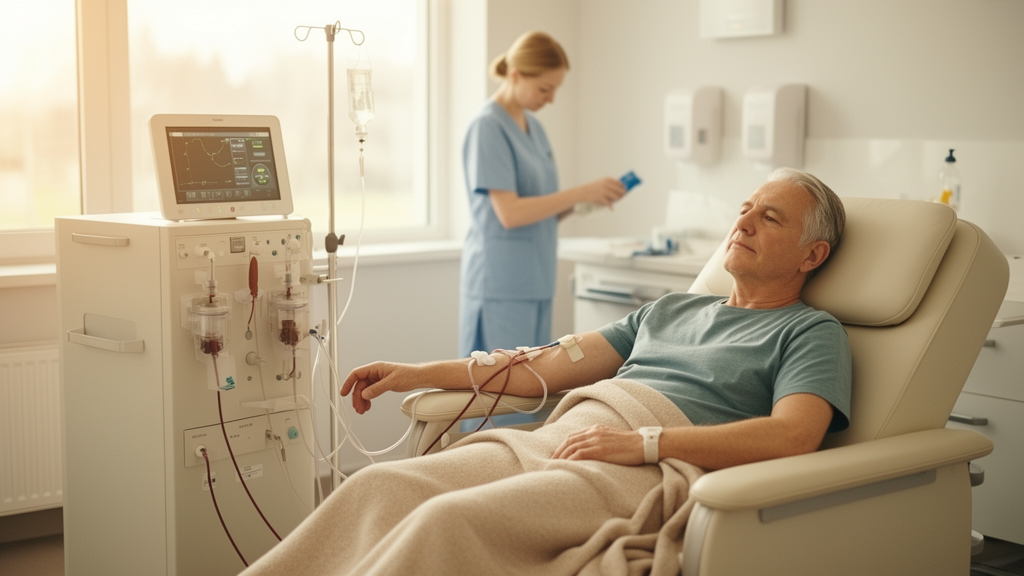
For millions of people with end-stage kidney disease, hemodialysis is not a treatment they undergo once but a rhythm they live inside, typically three sessions a week, each lasting several hours, for the rest of their lives. Medicine has become remarkably good at keeping these patients alive, yet a new qualitative study from China argues that survival is only half the story. Published in BMC Nursing, the research by Yuxin Huang, Mei Sun and colleagues at Central South University’s Xiangya School of Nursing set out to answer a deceptively simple question: what does comfort actually feel like, and what does it mean, to someone whose life is organized around a dialysis machine?
The study matters because comfort is one of the most cited yet least examined concepts in nursing science. Kolcaba’s comfort theory, a widely used framework in the field, treats comfort as a multidimensional state spanning physical ease, psychological peace, social belonging and environmental relief. But the theory’s building blocks were largely derived from Western patient populations, and the researchers suspected that the experience of discomfort and comfort among Chinese patients on maintenance hemodialysis might be shaped by cultural values and beliefs that standard assessment tools never capture. If clinicians cannot see comfort through their patients’ eyes, they cannot deliver the person-centred care that health systems around the world now claim as their goal.
To find out, the team turned to interpretative phenomenological analysis, or IPA, a qualitative method designed to uncover how individuals make sense of their lived experiences. Rather than measuring comfort with rating scales, IPA asks researchers to reconstruct the meaning patients attach to their own suffering and relief. The researchers recruited twenty-one adults receiving maintenance hemodialysis at a national public hospital in China and conducted in-depth, semi-structured interviews with each of them between January and May 2025. Interviews were transcribed and then analysed inductively and iteratively, following the six canonical steps of IPA, with the software NVivo 15 used to organize and code the growing dataset. Reporting followed the Consolidated Criteria for Reporting Qualitative Research, the COREQ checklist that sets transparency standards for interview-based studies, and the project received ethics approval from Xiangya Hospital with written informed consent from every participant.
From those twenty-one narratives, three themes crystallized, and together they sketch an arc from endurance to hope. The first theme, which the authors call putting up with the burdens of disease and hemodialysis, describes discomfort as a layered, self-reinforcing condition. Physical symptoms such as fatigue, pain and the after-effects of dialysis sessions did not sit in isolation; they interacted with and aggravated one another. On top of the physical burden came what the researchers describe as overwhelming psychological crises, a compromised social support system in which relationships frayed under the weight of chronic illness, and a disturbing healthcare environment that patients experienced as a source of stress rather than solace.
That last finding is perhaps the study’s most striking technical result. Across all twenty-one interviews, not a single participant described the healthcare environment as a source of comfort. In comfort theory terms, environmental comfort, the relief that comes from pleasant surroundings, attentive staff and a sense of safety within the care setting, was effectively absent from these patients’ lives. For a hospital-based therapy that patients attend multiple times a week for years, the dialysis unit itself, the very place where treatment happens, registered only as a burden. The authors suggest this points to a systematic gap: the physical and interpersonal environment of dialysis units is rarely designed or evaluated with patient comfort as an explicit outcome.
The second theme, experiencing respite in life with hemodialysis, shifts the picture from suffering to relief. Patients described comfort in concrete, almost tactical terms. Early hemodialysis, meaning earlier initiation of treatment or earlier sessions that brought quicker relief from symptoms, was experienced as comfort because it shortened the window of suffering. Family support emerged as a second pillar, with relatives providing both practical help and emotional anchoring. And in a phrase that captures the social texture of Chinese dialysis wards, patients spoke of fellow patients huddling for warmth, the mutual solidarity that develops among people who share the same chairs, the same schedules and the same fears. Comfort, in other words, was not something patients generated alone; it was co-produced by timely treatment, family and community.
The third theme, seeking a decent life with hemodialysis, reveals what patients are reaching for beyond relief. Their articulated comfort needs fell into four categories: freedom from physical and psychological discomfort, the rebuilding of life meaning, a life-oriented healthcare environment, and access to disease-related information. The desire for information is easy to overlook but technically significant, because it reframes patient education not as an optional courtesy but as a comfort intervention in its own right. Patients who understand their disease and their treatment regimen experience a form of cognitive comfort, a reduction in the anxiety produced by uncertainty. Similarly, the demand for a life-oriented environment suggests that patients want dialysis units that acknowledge them as people with identities, routines and futures, not merely as bodies attached to machines.
Woven through all three themes is the influence of the Chinese sociocultural context, which the authors treat not as background noise but as an active variable. Cultural values around endurance, family obligation and face, the social standing that illness can threaten, may shape how patients interpret their discomfort and what they count as comfort. The phrase putting up with, a direct echo of the Chinese concept of forbearance, implies that many patients experience suffering as something to be borne rather than complained about, which has direct clinical consequences: patients who endure silently may underreport symptoms, delaying interventions. The researchers argue that comfort assessment and care planning must therefore be culturally adapted, not simply translated from instruments developed elsewhere.
The practical implications the authors propose are aimed squarely at nurses, who deliver the overwhelming majority of hands-on dialysis care. Because discomfort in this population is multidimensional, with physical symptoms, psychological crises, social isolation and environmental stressors interacting and aggravating one another, single-target interventions are unlikely to succeed. The study’s findings support comfort-focused nursing assessments that map all four dimensions of Kolcaba’s framework for each patient, systematic screening for psychological distress alongside symptom management, deliberate cultivation of peer support structures that formalize the huddling-for-warmth effect, environmental redesign of dialysis units to make them sources of comfort rather than stress, and structured, accessible patient education that satisfies the documented hunger for disease-related information.
What makes this study resonate beyond nephrology is its methodological honesty and its universal message. By listening rather than measuring, the researchers surfaced needs that standardized comfort questionnaires would likely have missed, including the rebuilding of life meaning and the desire for dignity and some control over daily life. The authors conclude that Chinese maintenance hemodialysis patients experience multidimensional discomfort as a burden of everyday life, find comfort through treatment and the support of others, and aspire to live with dignity, meaning and agency. In a world where aging populations and rising rates of diabetes and hypertension are steadily expanding the dialysis population, that conclusion reads less like a local finding and more like a warning for every health system: keeping patients alive is the floor of care, and the ceiling is a life that still feels worth living.
Subject of Research: Comfort experiences and needs of maintenance hemodialysis patients explored through interpretative phenomenological analysis to inform person-centred nursing care
Article Title: The comfort experiences and needs of maintenance hemodialysis patients: a qualitative study to inform person-centred health services
Article References: Huang, Y., Yan, F., Wang, J., Xiao, J., Wiley, J. A., Zhou, J., Adigawe, T., & Sun, M. (2026). The comfort experiences and needs of maintenance hemodialysis patients: a qualitative study to inform person-centred health services. BMC Nursing. https://doi.org/10.1186/s12912-026-05536-5
Image Credits: AI Generated
DOI: 10.1186/s12912-026-05536-5
Keywords: hemodialysis, comfort, discomfort, qualitative research, interpretative phenomenological analysis, person-centred care, nursing, Kolcaba's comfort theory, kidney disease, patient experience, China, quality of life
Cite Scienmag News
Jerry Hayes. (October 17, 2026). Inside the Dialysis Chair: What Kidney Patients Say Comfort Really Means. Scienmag. https://scienmag.com/inside-the-dialysis-chair-what-kidney-patients-say-comfort-really-means/
Jerry Hayes. "Inside the Dialysis Chair: What Kidney Patients Say Comfort Really Means." Scienmag, 17 October 2026, https://scienmag.com/inside-the-dialysis-chair-what-kidney-patients-say-comfort-really-means/. Accessed 17 October 2026.
Jerry Hayes. "Inside the Dialysis Chair: What Kidney Patients Say Comfort Really Means." Scienmag. October 17, 2026. https://scienmag.com/inside-the-dialysis-chair-what-kidney-patients-say-comfort-really-means/


