


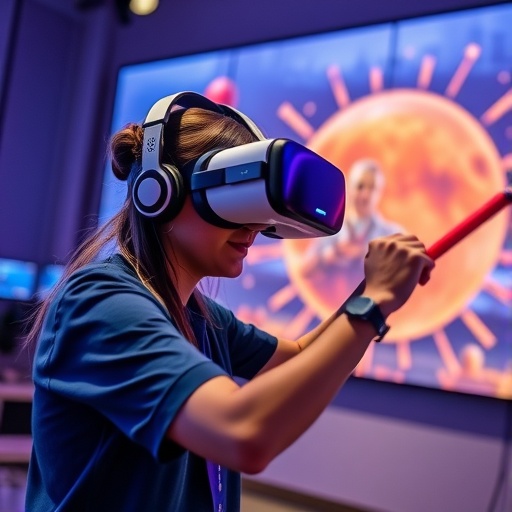
In a groundbreaking advancement for immersive technology research, San José State University’s School of Information has partnered with New Media Learning to embark on a pioneering study funded by the Virtual Experience Research Accelerator (VERA). VERA, a National Science Foundation-supported initiative led by the University of Central Florida, is reshaping how extensive human-subjects research is conducted in virtual and augmented reality environments. This collaboration aims to revolutionize the understanding of how immersive technologies can enhance learning, engagement, and information acquisition across diverse educational and cultural contexts.
The extensive project is set to deploy a Unity-based immersive information behavior testbed integrated with VERA’s cutting-edge platform, enabling participants from public libraries, universities, and key community sites nationwide to engage remotely in virtual reality (VR) studies. This infrastructure represents a leap forward in scale and sophistication for XR research, allowing for comprehensive data capture on participant interactions within virtual environments and bridging the gap between controlled experimentation and real-world applicability.
Researchers will employ an array of data collection techniques, monitoring detailed behavioral and interaction metrics such as attention patterns, object manipulations, navigation pathways, spatial movement, click rates, overall engagement levels, and time-on-task measurements. These quantitative insights will be augmented by qualitative survey responses and participant feedback, providing a multidimensional perspective on how immersive experiences influence cognitive and informational behaviors.
Central to the study’s thematic focus is the utilization of the United Nations Sustainable Development Goals (SDGs) to guide content and learning objectives within the immersive environments. This framework not only aligns educational content with globally pressing challenges but also examines how virtual reality can effectively communicate complex social, environmental, and economic issues in ways traditional media often cannot, thus fostering deeper public awareness and engagement.
Looking beyond the pilot phase, the research vision extends into broader applications including digital literacy enhancement, workforce development initiatives, cultural heritage preservation, health communication strategies, and the deployment of AI-assisted immersive learning scenarios. These prospective extensions underscore the versatility of XR technology as a transformative medium for knowledge dissemination and community empowerment.
A key feature distinguishing this project is its integration into academic training, providing San José State University’s undergraduate and graduate students with hands-on research experience alongside faculty and technology partners. This living laboratory approach ensures that emerging information professionals are equipped with practical expertise at the nexus of information science, immersive technology, and user experience research, priming them for future careers in rapidly evolving tech landscapes.
This collaboration also exemplifies the expanding role of libraries and educational institutions as hubs for technological innovation and community engagement. By embedding immersive research within these accessible public environments, the project illustrates how emerging tools like VR can be leveraged not only for education but also as catalysts for addressing societal challenges and fostering lifelong learning across demographics.
The partnership benefits from New Media Learning’s extensive experience deploying over 200 VR systems across public libraries in California and Nevada, where thousands of learners have been exposed to immersive educational experiences. This operational expertise ensures that technical deployment strategies and participant support structures are well established, contributing to the project’s scalability and inclusivity.
VERA itself represents a monumental effort to create a human-machine system that facilitates XR experimentation on a previously unattainable scale, prioritizing speed, precision, and rigor. Supported by multiple National Science Foundation grants, VERA fosters a collaborative research ecosystem where diverse investigators can conduct large-sample longitudinal studies in virtual and augmented reality, driving forward the scientific understanding of immersive environments.
Leadership endorsements underscore the significance of this initiative. Anthony S. Chow, a prominent figure at San José State University, emphasizes the transformative potential of NSF’s investment in VERA to unlock insights into how immersive technologies can influence learning outcomes, engagement patterns, and informational behaviors. Similarly, Gregory Welch from the University of Central Florida highlights the project’s role in setting new standards for XR research and the importance of interdisciplinary collaboration in advancing collective knowledge.
As this immersive research endeavor progresses, it promises to deliver findings that will not only advance academic knowledge but also provide practical frameworks for libraries, museums, educators, and community organizations to harness virtual reality for societal benefit. This initiative’s commitment to workforce development, coupled with its innovative research infrastructure, poises it to be a blueprint for future studies at the intersection of technology and information science.
Ultimately, the project’s ambition transcends academic inquiry; it seeks to democratize immersive learning experiences, making them widely accessible and addressing critical educational disparities. By leveraging immersive technologies within public access points and integrating student training, this collaboration sets a precedent for how virtual and augmented reality can be systematically researched, developed, and deployed to tackle multifaceted societal challenges in the 21st century.
News Publication Date: (Not Provided)
Web References: https://vera-xr.io/
References: (Not Provided)
Cite Scienmag News
Courtney Benton. (June 24, 2026). Innovative VR Initiative Aims to Enhance Immersive Learning Experiences. Scienmag. https://scienmag.com/innovative-vr-initiative-aims-to-enhance-immersive-learning-experiences/
Courtney Benton. "Innovative VR Initiative Aims to Enhance Immersive Learning Experiences." Scienmag, 24 June 2026, https://scienmag.com/innovative-vr-initiative-aims-to-enhance-immersive-learning-experiences/. Accessed 4 September 2026.
Courtney Benton. "Innovative VR Initiative Aims to Enhance Immersive Learning Experiences." Scienmag. June 24, 2026. https://scienmag.com/innovative-vr-initiative-aims-to-enhance-immersive-learning-experiences/


