


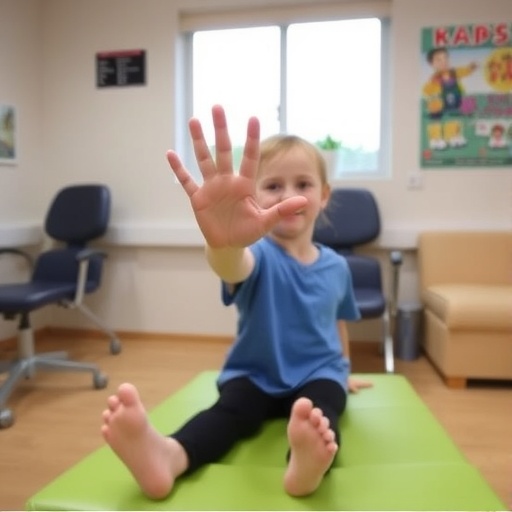
In a groundbreaking stride toward pediatric neurorehabilitation, researchers have unveiled a pioneering protocol that harnesses the power of nonlinear mechanical stimulation combined with engaging game-based exercises to restore upper extremity function in children afflicted with spastic hemiparetic cerebral palsy (CP). This innovative approach, rooted in sophisticated chaotic mathematical modeling, marks a significant advancement in addressing the intricate challenges faced by unilateral cerebral palsy (UCP) rehabilitation. The study, recently published in BioMedical Engineering OnLine, elucidates the integration of tactile stimulation and interactive training designed to optimize neuroplasticity and motor recovery in young patients.
Upper extremity rehabilitation in children with hemiparetic CP is notoriously complex due to the diverse neurological impairments that limit precise motor control. Traditional therapies often struggle to induce meaningful, lasting changes in motor function. Acknowledging these limitations, the research team conceptualized a hybrid protocol intertwining nonlinear dynamic principles with modern therapeutic gaming. The cutting-edge mechanical stimulation targets cutaneous mechanoreceptors on the back of the affected hand, provoking neural responses through patterns derived from a chaotic mathematical framework — a strategy inspired by the brain’s inherent nonlinear self-organizing properties.
The chaotic model implemented in this study serves as a sophisticated generator of mechanical stimuli, creating unpredictable yet structured patterns that challenge and engage the somatosensory system. By avoiding monotonous stimulation, which the nervous system quickly habituates to, the chaotic sequences maintain heightened neural responsiveness. This innovative stimulus design aims to capitalize on the brain’s adaptability, encouraging the formation of new neural connections necessary for motor skill recovery. The combination with game-based exercises further enhances this effect by promoting patient motivation and active participation.
To evaluate the effectiveness of the combined intervention, the researchers conducted a pilot study involving four pediatric participants diagnosed with unilateral CP. This pilot design allowed for a detailed exploratory assessment, focusing on both clinical outcomes and neuromuscular dynamics. By integrating clinical motor function tests with advanced electromyography (EMG) analyses, the study uniquely bridges functional improvements with underlying physiological changes, providing a comprehensive understanding of rehabilitation impacts.
Findings from the study revealed encouraging clinical improvements, particularly in wrist flexion and extension motions. These gains, observed following the combined mechanical and game-based training, underscore the potential for meaningful recovery of movement in a population often resistant to conventional therapies. Importantly, these improvements suggest the intervention’s capacity not only to enhance muscle strength but to refine motor control and coordination, critical components of functional hand use.
The exploration of EMG signals offered provocative insights into the neuromuscular adaptations initiated by the protocol. Employing nonlinear signal processing techniques, the research team detected alterations in muscle activation patterns and temporal coordination. Such changes are indicative of the nervous system’s reorganization towards establishing a novel motor program. This phenomenon, reflective of neuroplasticity, is foundational for long-term rehabilitation success, signifying that the brain and muscular system can relearn and adapt through the applied stimulation.
Moreover, the dual modality intervention addresses a pivotal factor in rehabilitation effectiveness: patient engagement. The inclusion of game-based exercises transforms therapy sessions into interactive experiences that sustain attention and motivation. This engagement is crucial in pediatric populations, where motivation heavily influences therapy adherence and outcomes. By aligning mechanical stimulation with enjoyable game mechanics, the protocol simultaneously tackles neurological and psychological facets of recovery.
The theoretical underpinnings of this study draw heavily from nonlinear dynamics and chaos theory, disciplines traditionally applied in physics and mathematics but now finding novel applications in biomedical engineering. The chaotic stimulation paradigm exemplifies how complex systems theory can inspire innovative medical interventions, suggesting that controlled complexity within stimuli may be pivotal in optimizing neural rehabilitation.
Importantly, this research also highlights the methodological synergy between clinical assessment and signal processing. By applying advanced computational analyses to EMG data, the authors transcend traditional clinical observation, unveiling subtleties in muscle function and neural coordination that are otherwise imperceptible. This integrative assessment model may set a precedent for future rehabilitation research, emphasizing the value of interdisciplinary approaches.
Despite the promising outcomes, the study acknowledges its pilot nature and the limited sample size. However, the initial findings pave a fertile path for subsequent research trials involving larger cohorts and longer follow-up periods. Further investigations will be critical in validating the reproducibility of results and refining stimulation protocols to maximize therapeutic gains.
This study’s convergence of chaotic nonlinear stimulation with game-based therapeutic exercise embodies a broader trend in rehabilitation medicine—leveraging complexity and interactivity to harness neuroplastic mechanisms. As neural recovery increasingly comes to the forefront of clinical practice, interdisciplinary innovations like this herald a new era of personalized, effective therapies designed to improve quality of life for children affected by cerebral palsy.
In conclusion, the integration of mathematically modeled mechanical stimulation with interactive gamified exercises opens new horizons in pediatric neurorehabilitation. Through detailed clinical and neuromuscular analyses, the research under review substantiates the feasibility of this approach in fostering significant motor improvements in children living with unilateral spastic CP. The study represents a compelling example of how advanced engineering concepts and human-centered design can synergize to transform therapeutic interventions, potentially reshaping standards of care in the years to come.
Cite Scienmag News
Ophelia Keating. (October 9, 2025). Innovative Therapy Boosts Upper Limb Rehab in Children. Scienmag. https://scienmag.com/innovative-therapy-boosts-upper-limb-rehab-in-children/
Ophelia Keating. "Innovative Therapy Boosts Upper Limb Rehab in Children." Scienmag, 9 October 2025, https://scienmag.com/innovative-therapy-boosts-upper-limb-rehab-in-children/. Accessed 3 September 2026.
Ophelia Keating. "Innovative Therapy Boosts Upper Limb Rehab in Children." Scienmag. October 9, 2025. https://scienmag.com/innovative-therapy-boosts-upper-limb-rehab-in-children/


