


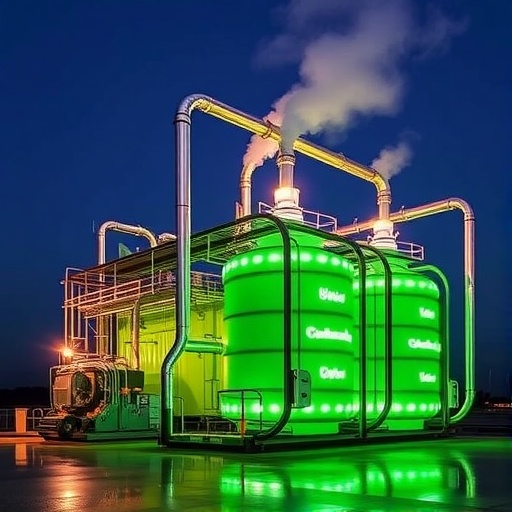
In a groundbreaking advancement that could redefine the future of renewable energy storage, an international research team led by Bruce Logan, Director of Penn State’s Institute of Energy and the Environment, has unveiled a novel microbial electrosynthesis reactor designed to efficiently convert carbon dioxide and renewable electricity into methane. Methane, the principal component of natural gas, emerges here not from fossil fuel extraction but from an innovative bioelectrochemical system that leverages microbes and electrochemistry, marking a significant step toward sustainable, scalable energy solutions.
The reactor’s promise lies in its ability to surmount the persistent challenges that have historically confined microbial electrosynthesis systems to small-scale laboratory conditions, which often suffer from low energy efficiency and limited production rates. By ingeniously redesigning the reactor as an upscaled “zero-gap” cell, where electrodes are separated solely by a membrane, the new system dramatically reduces internal electrical resistance, thus enhancing electron transfer efficiency. This reconfiguration enables the reactor to amplify its surface electrode area by approximately an order of magnitude, greatly expanding the volume and throughput without compromising operational performance.
At the core of this reactor’s function is a synergy between renewable power sources and biological catalysts. Renewable electricity derived from solar or wind energy is first employed to electrolyze water, generating hydrogen gas and oxygen. This hydrogen acts as a critical intermediate, readily consumed by specialized archaea known as methanogens. These microbes utilize hydrogen to effectively reduce carbon dioxide into methane through biochemical pathways, thus transforming a greenhouse gas into a high-energy, storable, and transportable fuel compatible with existing natural gas infrastructure.
The design innovations extend beyond electrode configuration, featuring multiple flow ports that ensure even distribution of fluids and gases within the reactor. This uniformity in flow safeguards microbial communities from localized stress and fosters consistent reaction kinetics throughout the system. Moreover, by maintaining optimal environmental conditions, such as a temperature of approximately 30 degrees Celsius, the reactor achieves robust methane production rates reaching nearly 7 liters per liter of reactor volume daily—a remarkable metric demonstrating the system’s practical viability.
Crucially, this reactor achieves coulombic efficiencies exceeding 95%, indicating that the overwhelming majority of electrical input converts directly to methane rather than dissipating into side reactions or undesired byproducts. The overall energy efficiency approaches 45%, placing it among the highest performance metrics reported for microbial electrosynthesis devices under standardized testing protocols. This efficiency is not trivial; it reflects a finely tuned interdependence between electrical engineering and microbial electroactivity.
Unlike prior technologies attempting direct electron transfer to microbes, which are hampered by sluggish reaction rates and low throughput, the device’s methodically engineered hydrogen-mediated pathway enhances current densities and accelerates methane synthesis. The process first generates molecular hydrogen electrochemically, which is then immediately consumed by methanogens localized in proximity, reducing diffusion limitations and increasing reaction speed. This coupling effectively integrates a water electrolyzer and a biological methanation system into a seamless unit.
From an energy management perspective, such technology holds transformative potential in addressing one of the renewable energy sector’s most intractable problems: long-duration, large-scale energy storage. Conventional approaches, such as pumped hydroelectric storage, suffer from geographical and scale constraints. By chemically storing excess renewable electricity in the form of methane, operators can leverage existing gas pipelines and storage facilities to buffer seasonal variations in energy demand and supply, thus enhancing grid resilience and sustainability.
Looking forward, the study’s authors envision widespread deployment of methane generation plants adjacent to solar or wind farms. These integrated systems could bypass the electricity grid, directly converting intermittent renewable power into pipeline-ready methane. This localized conversion mitigates grid congestion and transmission losses, while enabling carbon capture and utilization by recycling industrial or atmospheric carbon dioxide as reactant feedstock—thus simultaneously contributing to climate mitigation efforts.
Nonetheless, the path toward commercial adoption is nuanced. Economic feasibility depends heavily on access to low-cost renewable electricity and ongoing advancements in catalytic materials that can further improve reaction rates and durability. Crucially, system design must also prioritize stringent control of methane emissions to prevent leakage, which could negate the environmental benefits due to methane’s high global warming potential. Therefore, engineering solutions aimed at leak-proof reactor and pipeline interfaces will be critical.
This innovative bioelectrochemical conversion process signals a promising intersection of environmental engineering, microbiology, and energy technology. It challenges conventional paradigms by demonstrating that carbon dioxide need not be a waste pollutant but can serve as a valuable substrate for renewable energy storage. Such advancements not only offer pathways toward decarbonized fuel production but also contribute to circular carbon economies where fossil-derived methane is supplanted by sustainably produced alternatives.
In sum, Penn State’s zero-gap microbial electrosynthesis reactor stands as a beacon of interdisciplinary innovation. By scaling efficiency without compromising performance, it encapsulates the promise of converting renewable electricity and greenhouse gases into clean, storable fuels. As the global community intensifies efforts to transition toward net-zero emissions, technologies that effectively integrate biology and electrochemistry at scale will be essential in bridging energy supply fluctuations and meeting long-term sustainability goals.
Keywords
Renewable energy, microbial electrosynthesis, methane production, zero-gap cell, hydrogen mediation, water electrolysis, energy storage, carbon dioxide conversion, bioelectrochemical reactor, sustainable fuels, methanogens, scalable renewable technologies
Cite Scienmag News
Faith Mcneil. (May 12, 2026). Innovative Reactor Converts Carbon Dioxide into Renewable Methane. Scienmag. https://scienmag.com/innovative-reactor-converts-carbon-dioxide-into-renewable-methane/
Faith Mcneil. "Innovative Reactor Converts Carbon Dioxide into Renewable Methane." Scienmag, 12 May 2026, https://scienmag.com/innovative-reactor-converts-carbon-dioxide-into-renewable-methane/. Accessed 4 September 2026.
Faith Mcneil. "Innovative Reactor Converts Carbon Dioxide into Renewable Methane." Scienmag. May 12, 2026. https://scienmag.com/innovative-reactor-converts-carbon-dioxide-into-renewable-methane/


