


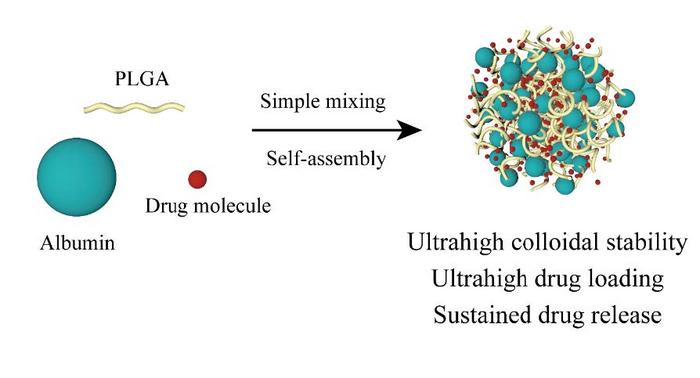
In a groundbreaking advancement that promises to reshape the landscape of targeted drug delivery, scientists at Xi’an Jiaotong-Liverpool University (XJTLU) in collaboration with Nanjing University have engineered a novel nanoparticle system that significantly enhances the efficiency and safety of administering chemotherapy and potentially other therapeutic agents. Their research, recently published in ACS Applied Materials & Interfaces, unveils a sophisticated coassembly of a medical-grade polymer, PLGA (poly(lactic-co-glycolic acid)), with the naturally abundant blood protein albumin, culminating in an innovative drug carrier marked by unprecedented stability and drug-loading capacity.
For decades, PLGA has been a stalwart in the fabrication of biodegradable nanoparticles. Its capacity to degrade into biocompatible byproducts enables a controlled and sustained release of drugs, which is critically advantageous in diseases necessitating prolonged medication, such as cancer. However, conventional PLGA-based nanoparticles suffer from significant challenges, foremost among them a tendency to aggregate—or clump—over time, reducing their therapeutic efficacy and complicating clinical use. Moreover, their drug encapsulation efficiency often remains suboptimal, limiting the dosage that can be safely and effectively delivered to the patient.
The team’s pioneering approach involves coassembling PLGA with albumin, a protein that naturally circulates in the bloodstream and possesses inherent drug-binding and transport capabilities. Albumin’s clinical relevance is well-established; it serves as a carrier molecule in several FDA-approved cancer therapeutics. By integrating albumin into the nanoparticle architecture, the researchers created "supraparticles" with a level of colloidal stability and drug-loading efficiency that surpasses current benchmarks. Specifically, these hybrid particles demonstrated a remarkable ability to encapsulate up to 40% by weight of doxorubicin, a widely used chemotherapeutic agent, which significantly outperforms existing commercial formulations like Doxil, which encapsulate approximately 11%.
Mechanistically, the coassembly leverages the intrinsic properties of both polymer and protein components. PLGA provides a biodegradable scaffold conducive to sustained release, while albumin imparts natural targeting and biocompatibility. During synthesis, these components self-organize through non-covalent interactions into robust supraparticle complexes, resisting degradation and aggregation far beyond what either material could achieve independently. This advances drug delivery kinetics by maintaining particle integrity over extended periods, a crucial consideration for therapies requiring precise dosing regimens.
The researchers explored two distinct methods for drug loading: incorporation of doxorubicin during particle formation allowed the drug to be encapsulated within the polymer-protein matrix, while a secondary technique involved infusing already formed nanoparticles with the drug by exploiting concentration gradients and solvent interactions. Combining both methods synergized the overall loading capacity and drug distribution within the particles, optimizing payload and release profiles.
Extensive preclinical evaluations underscored the therapeutic promise of these supraparticles. In vitro studies utilizing cancer cell lines demonstrated efficient uptake and cytotoxic effects aligned with potent anticancer activity. Complementary in vivo studies in animal models corroborated these findings, showing that the nanoparticles preferentially target malignant tissues, reducing off-target toxicity that often limits chemotherapeutic dosage in clinical settings. Notably, the new delivery system minimized damage to healthy tissues, a significant stride towards mitigating debilitating side effects commonly associated with chemotherapy.
Another pivotal finding of this research was the extraordinary colloidal stability exhibited by the supraparticles. Traditionally, the shelf-life of nanoparticle drug carriers is curtailed by aggregation and premature drug leakage. However, the albumin-PLGA supraparticles remained physically and chemically stable for over six months under laboratory storage conditions. This durability suggests the potential for scalable manufacturing and distribution, addressing key hurdles in translating nanomedicine from bench to bedside.
The innovation extends beyond simple drug encapsulation; it introduces the concept of exploiting biopolymers’ natural functions within synthetic drug delivery platforms. Albumin’s role is not limited to passive stability enhancement but may confer active targeting capabilities via endogenous transport pathways such as albumin receptor-mediated endocytosis. This dual-functionality could revolutionize precision medicine by enhancing drug accumulation in diseased tissue while sparing healthy cells.
From a pharmaceutical manufacturing standpoint, preliminary scale-up studies indicate that these protein-polymer supraparticles can be produced reproducibly without compromising particle uniformity or functionality. This is paramount for commercial viability, as consistency in nanoparticle size, drug loading, and release kinetics are critical quality attributes required by regulatory bodies.
Looking forward, the research team envisions broadening the spectrum of therapeutics compatible with their system. The modular nature of the coassembly process could facilitate loading of diverse drugs beyond doxorubicin, including biologics, nucleic acids, or combination therapies. Such versatility holds immense potential for managing a variety of chronic conditions, including neurodegenerative diseases, infectious diseases, and other malignancies.
Moreover, the platform’s ultrahigh colloidal stability could enable more flexible dosing schedules, patient-friendly administration routes, and the development of novel formulations such as injectable gels or inhalable aerosols. These adaptations could significantly improve patient compliance and clinical outcomes.
This research underscores a vital paradigm shift in nanomedicine, where hybrid materials synthesized via bioinspired assembly unlock new frontiers in therapeutic delivery. By bridging material science with molecular biology, Dr. Gang Ruan and his team have charted a path toward safer, more effective treatments that harness the body’s natural biological machinery in concert with engineered polymers.
As cancer treatments evolve to prioritize efficacy alongside quality of life, drug delivery innovations like these supraparticles will be pivotal in overcoming current pharmacological limitations. The promising results obtained set the stage for future clinical trials, which will be instrumental in validating safety, pharmacokinetics, and therapeutic benefit in humans.
In conclusion, this development marks a significant milestone in the design of nanocarriers that reconcile the need for high drug loading, extended stability, and biocompatibility. The synergy between PLGA and albumin opens a novel avenue for creating ultrastable drug delivery systems, setting a new benchmark in cancer nanotherapeutics and beyond.
News Publication Date: 20-Jun-2025
Web References:
https://doi.org/10.1021/acsami.5c07710
Cite Scienmag News
Nathaniel Bowman. (June 20, 2025). Innovative Nanoparticles Enable Safer, More Efficient Drug Delivery. Scienmag. https://scienmag.com/innovative-nanoparticles-enable-safer-more-efficient-drug-delivery/
Nathaniel Bowman. "Innovative Nanoparticles Enable Safer, More Efficient Drug Delivery." Scienmag, 20 June 2025, https://scienmag.com/innovative-nanoparticles-enable-safer-more-efficient-drug-delivery/. Accessed 3 September 2026.
Nathaniel Bowman. "Innovative Nanoparticles Enable Safer, More Efficient Drug Delivery." Scienmag. June 20, 2025. https://scienmag.com/innovative-nanoparticles-enable-safer-more-efficient-drug-delivery/


