

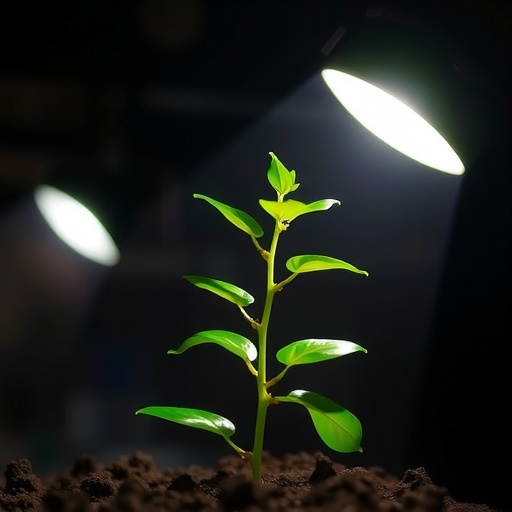
In a groundbreaking development that sheds new light on how plants regulate their growth, researchers at Osaka Metropolitan University have uncovered a previously unknown mechanism involving the adhesion between different tissue layers in young pea stems. This discovery, emerging from meticulous experimental observations and innovative measurement techniques, reveals that exposure to white light significantly enhances the adhesive strength between the epidermal layer and the underlying inner tissues. This enhanced adhesion is intricately linked to the accumulation of a specific phenolic acid known as p-coumaric acid, a compound renowned for its role in fortifying plant cell walls.
The team, led by Professor Kouichi Soga of the Graduate School of Science, employed a novel approach to quantify the adhesion between the epidermis—the outermost protective layer of the stem—and the internal tissue layers of pea epicotyls. By comparing plants cultivated under continuous white light to those grown in complete darkness, they discovered a marked increase in adhesive forces in the light-exposed group. This finding challenges existing paradigms by demonstrating that light not only influences biochemical pathways but also mechanically stabilizes the structural integrity of plant tissues at a microscopic level.
Upon closer examination using fluorescence microscopy, the researchers observed a distinctive fluorescence pattern in the cells of light-exposed stems. This pattern was consistent with the substantial accumulation of p-coumaric acid bound to the cell walls. P-coumaric acid is a well-documented phenolic compound integral to the synthesis of lignin and other polyphenolics that reinforce the rigidity and resilience of plant cell walls. Its accumulation enhances the strength of adhesion between tissue layers by cross-linking cell wall components, thereby creating a more cohesive and robust structural matrix.
Graduate student Yuma Shimizu, the first author of the study, elaborated on the significance of this biochemical change. The enhanced accumulation of cell wall-bound p-coumaric acid serves as the molecular basis for the strengthened adhesion observed. This biochemical reinforcement restricts the spatial expansion of inner tissues, effectively imposing a biomechanical constraint that regulates overall stem growth. In essence, light acts not only as an energy source for photosynthesis but also engages in sophisticated regulatory mechanisms that modulate the physical properties of plant tissues.
This discovery fundamentally advances our understanding of plant biomechanics by revealing how environmental cues translate into mechanical changes at the cellular level. The increased adhesion between the epidermal and inner tissues functions as a growth brake, preventing excessive or uncontrolled elongation of the stem. Such control is crucial for maintaining structural stability, optimizing resource allocation, and potentially enhancing resistance to environmental stressors like wind or herbivory.
Professor Soga highlighted the novelty of this finding, noting that while light’s role in plant growth regulation has been extensively studied, the mechanical aspect involving tissue adhesion had not been previously documented. The ability to measure and quantify adhesion in situ opens new avenues for exploring how plants integrate external signals with internal structural adaptations, thus enriching the field of plant developmental biology and biophysics.
Future work proposed by the research team aims to investigate whether this adhesion-mediated modulation of growth is a universal mechanism across diverse plant species and tissues. By applying their unique measurement technique to various environmental conditions and genetic backgrounds, they hope to elucidate how widespread and fundamental this mechanism is in plant adaptation and survival.
From an applied perspective, these insights hold considerable promise for agriculture and horticulture. By modulating adhesion between epidermal and inner tissues, it may become possible to breed crops with enhanced mechanical robustness and improved tolerance to environmental stressors such as drought, mechanical damage, or pathogen attack. Such advancements could translate into better yield stability and resilience under fluctuating climate conditions.
Additionally, understanding the biochemical pathways that control cell wall composition and adhesion offers potential targets for genetic engineering or chemical treatment to fine-tune plant growth and morphology. The accumulation of p-coumaric acid and its regulation could be leveraged to develop crops that maintain optimal growth rates while resisting environmental challenges.
The research was recently published in the esteemed journal Physiologia Plantarum, providing a comprehensive account of the methodology, findings, and implications. This work not only enriches basic plant science but also underscores the intricate interplay between environmental factors and plant structural biology.
In summary, the discovery that white light enhances adhesion between epidermal and inner tissues in pea epicotyls through the accumulation of p-coumaric acid represents a significant leap forward in plant science. It reveals a novel biomechanical control point for growth regulation, emphasizing the sophisticated strategies plants employ to adapt to their environment. These findings open exciting possibilities for advancing agricultural practices and plant biotechnology in the years to come.
Subject of Research: Not applicable
Article Title: White light enhances adhesive strength between epidermal and inner tissues of pea epicotyls via accumulation of cell wall-bound p-coumaric acid
News Publication Date: 25-Jan-2026
References:
DOI: 10.1111/ppl.70755
Image Credits: Osaka Metropolitan University
Keywords: Plant growth regulation, p-coumaric acid, cell wall adhesion, epidermal tissue, pea epicotyls, plant biomechanics, fluorescence microscopy, phenolic compounds, white light effect, plant structural biology


