


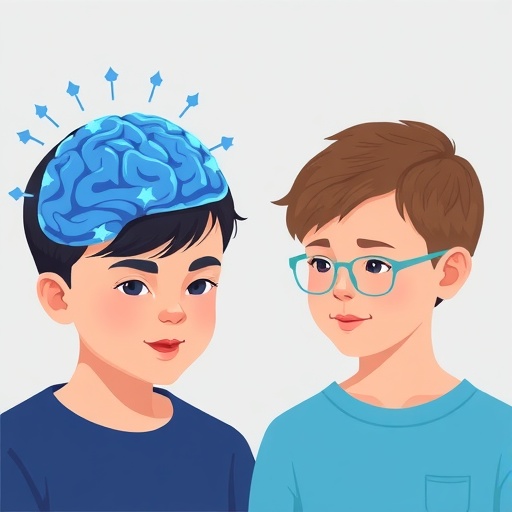
A groundbreaking advancement in non-invasive brain stimulation has emerged from a multicentre randomized controlled trial conducted in China, offering new hope for children diagnosed with autism spectrum disorder (ASD). This innovative technique, known as accelerated continuous theta burst stimulation (a-cTBS), has demonstrated significant improvements in social communication abilities at a one-month follow-up, coupled with a favorable safety profile. The study, published by The BMJ on April 29, 2026, pioneers a potentially transformative therapeutic approach for autism, especially considering the challenges faced by traditional interventions in young children and those with intellectual disabilities.
Accelerated continuous theta burst stimulation capitalizes on a specialized pattern of brain stimulation that modulates neural circuits implicated in social cognition and language. Unlike traditional repetitive transcranial magnetic stimulation (rTMS), a-cTBS administers brief bursts of high-frequency stimulation in a compressed timeframe, reducing session length without compromising efficacy. This is particularly advantageous in pediatric populations, who often struggle with lengthy and repetitive clinical protocols. By targeting the left primary motor cortex—an area integrally involved in motor functions, language production, and social interaction—researchers aimed to harness neuroplasticity mechanisms that could enhance behavioral outcomes in ASD.
The trial enrolled 200 children aged between four and ten years, including both boys and girls, with nearly half exhibiting comorbid intellectual disability. Participants were randomized to receive either the active a-cTBS treatment or a sham control over five consecutive days, with an intensive schedule of 10 sessions each day. Such an accelerated design sought to determine not only immediate post-intervention changes but also the durability of effects at a one-month follow-up, a critical period for assessing lasting neurobehavioral improvements.
To objectively quantify changes in social communication abilities, the investigators employed the Social Responsiveness Scale, Second Edition (SRS-2), a widely recognized tool sensitive to social impairment severity in autism. Additionally, three standardized language assessment tools provided a multidimensional understanding of verbal abilities post-intervention. After completion of the full treatment course by 193 participants, results indicated statistically significant reductions in social communication deficits in the a-cTBS group compared to sham controls. These improvements sustained from the immediate post-intervention phase through the one-month follow-up, highlighting the method’s potential for enduring therapeutic impact.
Further analysis revealed concurrent enhancements in language functions within the treatment group, reinforcing the targeted stimulation’s neurophysiological relevance. Effect sizes calculated via Cohen’s d ranged from 0.12 to 0.47, indicating small to moderate but clinically meaningful improvements. These findings suggest that a-cTBS may facilitate modulation of neural networks that underpin both social exchange and linguistic capacities, domains notoriously impaired in autism.
Regarding safety, the intervention exhibited a tolerable profile with adverse events primarily characterized by restlessness and scalp discomfort. These symptoms were more frequent in the active treatment group than in controls (54.5% versus 29.3%), yet all reported side effects were mild to moderate and resolved without medical intervention. This reassuring safety data emphasizes the feasibility of implementing a-cTBS even in younger children and those with intellectual challenges.
The study authors acknowledged certain methodological considerations, including possible expectancy bias given the nature of the intervention and reliance on the SRS-2, which may be subject to subjective reporting limitations. Additionally, the trial’s relatively short follow-up period leaves open questions about long-term efficacy and durability of benefits. The demographic skew toward male participants also suggests future research should further explore gender-related differences in treatment response.
Nevertheless, the inclusion of younger children and those with intellectual disabilities underscores the broad applicability of this accelerated protocol across diverse clinical profiles. Sensitivity analyses bolstered confidence in the robustness of findings, positioning a-cTBS as an accessible neurotherapeutic tool capable of bridging gaps in current autism care paradigms globally. The study represents a significant stride toward equitably disseminating advanced neuroscience interventions to populations historically underserved.
In a complementary editorial from Hong Kong, experts echoed cautious optimism while underscoring the importance of integrating a-cTBS with established psychosocial and educational supports. Rather than supplanting behavioral interventions, a-cTBS may serve as a critical component of comprehensive, multimodal treatment strategies for socially impaired children with autism, pending further replication and thoughtful clinical integration. This holistic perspective highlights the future potential for combining cutting-edge neurotechnology with traditional therapies to optimize developmental trajectories.
The patent held by several authors related to this repetitive transcranial magnetic stimulation system signals ongoing innovation and commercialization potential, which may expedite wider clinical adoption. Supported by prestigious funding bodies such as the National Natural Science Foundation of China and the China Brain Initiative Grant, this research aligns with international priorities to deepen understanding and improve management of neurodevelopmental disorders.
As the global incidence of autism spectrum disorder continues to rise, demand surges for scalable, effective, and child-friendly treatment modalities. Accelerated continuous theta burst stimulation stands at the forefront of technological solutions poised to meet these needs. Its capacity to produce rapid, sustained improvements in core social and communication deficits with minimal risk heralds a new frontier in autism therapeutics.
The implications of this research extend beyond clinical application, inviting neuroscientists, clinicians, and policy makers to reimagine intervention frameworks that harness neuroplasticity cost-effectively and inclusively. Future studies with extended follow-up, larger female cohorts, and mechanistic neuroimaging correlates could further elucidate the biological underpinnings driving these promising outcomes. For families and practitioners, the advent of a-cTBS represents both hope and a call for collaborative advancement in autism care.
News Publication Date: 29-Apr-2026
Web References:
http://dx.doi.org/10.1136/bmj-2025-086295
Cite Scienmag News
Cassandra Pierce. (April 30, 2026). Innovative Brain Stimulation Method Enhances Short-Term Social Skills in Children with Autism. Scienmag. https://scienmag.com/innovative-brain-stimulation-method-enhances-short-term-social-skills-in-children-with-autism/
Cassandra Pierce. "Innovative Brain Stimulation Method Enhances Short-Term Social Skills in Children with Autism." Scienmag, 30 April 2026, https://scienmag.com/innovative-brain-stimulation-method-enhances-short-term-social-skills-in-children-with-autism/. Accessed 4 September 2026.
Cassandra Pierce. "Innovative Brain Stimulation Method Enhances Short-Term Social Skills in Children with Autism." Scienmag. April 30, 2026. https://scienmag.com/innovative-brain-stimulation-method-enhances-short-term-social-skills-in-children-with-autism/


