


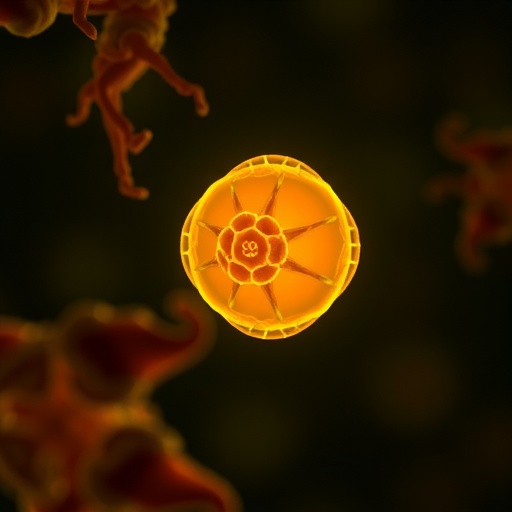
A groundbreaking study published in Nature unveils a novel mechanism governing the growth dynamics of pronuclei within mammalian zygotes, shedding light on the intricate cytoplasmic interactions that dictate early embryonic development. The research pivots around the fascinating observation that maternal and paternal pronuclei, although spatially distinct, engage in a competitive interplay mediated by the shared cytoplasm to regulate their respective volumes.
Historically, the independent growth of maternal and paternal pronuclei following fertilization was assumed to be relatively autonomous. However, this new research contradicts this assumption by demonstrating that the pronuclear volume is not an isolated phenomenon but rather a consequence of a finely tuned competition for limiting cytoplasmic components. Intriguingly, experiments manipulating zygotic volume through halving and doubling reveal that the ratio between maternal and paternal pronuclear volumes remains consistent, hinting at a systemic regulatory mechanism imposed by the shared cytoplasmic environment.
Crucially, the study draws parallels between haploid parthenotes—zygotes containing solely maternal genetic material—and conventional biparental zygotes with both maternal and paternal pronuclei. The volume measurements of pronuclei in these haploid models closely approximate the combined volume of maternal and paternal pronuclei within normal zygotes, reinforcing the hypothesis that volumetric constraints stem from a shared pool of cytoplasmic components rather than independent growth capacities.
Delving deeper, the researchers identify that the rate of nuclear import plays a pivotal role in this volume regulation. Utilizing live imaging techniques alongside immunostaining, they observed that paternal pronuclei accumulate nuclear pore complex (NPC) components faster than maternal pronuclei during their growth phases. Specifically, paternal pronuclei displayed accelerated enrichment of key nuclear pore proteins such as NUP35, NUP93, and NUP98, compared to their maternal counterparts, suggesting a mechanistic asymmetry in nuclear pore biogenesis or function.
Mass spectrometry-based quantification, employing isotope-labelled cell-free products, further corroborated these findings by demonstrating that the abundance ratios of nuclear pore components heavily favor paternal pronuclei relative to maternal ones. These ratios exceeded the mere surface area differences observed between the two pronuclei, suggesting that paternal pronuclei possess a disproportionately higher nuclear pore production or retention capacity beyond simple scaling with surface area.
Building on these observations, the authors formulated a robust theoretical model encapsulating the dynamics of pronuclear growth rooted in competitive acquisition of components from a finite cytoplasmic reservoir. The model assumes that pronuclear volume increment depends on the import of materials via nuclear pores, with the paternal pronucleus possessing an elevated rate of nuclear pore synthesis. This elevated rate drives distinct growth kinetics, where paternal pronuclei initially grow faster, outpacing maternal pronuclei during early developmental stages.
The theoretical framework predicts nuanced growth patterns in various experimental scenarios. For instance, in haploid parthenote zygotes, which contain only maternal genomes, the model forecasts an initially slower growth phase due to reduced competition, but a subsequent accelerated phase leading to overall larger pronuclear volume compared to paternal pronuclei in biparental zygotes. Live imaging data from these haploid systems strikingly mirrored these predictions, confirming the essential role of cytoplasmic competition in pronuclear size control.
Moreover, the model extends its predictive power to altered zygotes with artificially increased or decreased cytoplasmic volumes, accurately describing the kinetic variations in pronuclear growth observed experimentally. These results highlight a critical cytoplasmic capacity threshold that directly governs the allocation of nuclear packaging components, thereby controlling pronuclear size and possibly influencing subsequent embryonic developmental trajectories.
The implications of these findings are profound, as the regulation of pronuclear size has long been an enigmatic aspect of zygotic biology with potential downstream effects on genomic stability and embryonic viability. By illustrating a cytoplasm-mediated competitive mechanism, this study opens new avenues into understanding how early embryonic structural organization is orchestrated at the molecular level, potentially impacting assisted reproductive technologies and developmental biology.
Furthermore, this research emphasizes the asymmetric role of parental genomes during early development, as paternal pronuclei prioritize nuclear pore component acquisition, possibly reflecting evolutionary adaptations favoring paternal genome integration efficiency. This differential nuclear pore biogenesis might have broader implications for epigenetic reprogramming and chromatin remodeling during the initial zygotic stages.
Beyond basic developmental biology, the insights gleaned from this study could inform cancer biology and nuclear architecture research, given the universality of nuclear pore complexes and their critical roles in nucleocytoplasmic transport. Understanding how nuclear size is competitively regulated by cytoplasmic factors might unravel new molecular targets for diseases characterized by nuclear morphology abnormalities.
In conclusion, this pioneering work delineates an elegant cytoplasmic competition mechanism underlying pronuclear volume regulation in zygotes, bridging gaps between cellular biophysics and embryology. It underscores the importance of nuclear pore complex dynamics in early development and establishes a framework for future explorations into how cellular components and spatial limitations orchestrate life’s earliest moments.
Cite Scienmag News
Denise Maddox. (April 30, 2026). Parental Pronuclei Compete in Zygote Cytoplasm. Scienmag. https://scienmag.com/parental-pronuclei-compete-in-zygote-cytoplasm/
Denise Maddox. "Parental Pronuclei Compete in Zygote Cytoplasm." Scienmag, 30 April 2026, https://scienmag.com/parental-pronuclei-compete-in-zygote-cytoplasm/. Accessed 3 September 2026.
Denise Maddox. "Parental Pronuclei Compete in Zygote Cytoplasm." Scienmag. April 30, 2026. https://scienmag.com/parental-pronuclei-compete-in-zygote-cytoplasm/


