


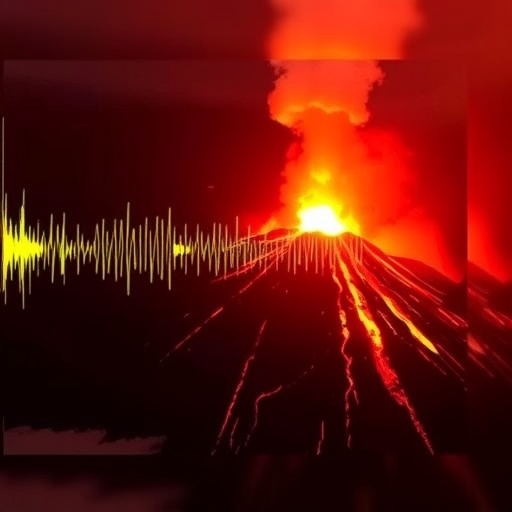
Recent advancements in volcanology have led to the exploration of innovative techniques that enhance monitoring and understanding of volcanic activity. A groundbreaking study conducted by Barrière, Oth, and Assink et al. presents the remarkable potential of infrasound to unveil intricate eruptive processes at the Nyiragongo volcano. With the capacity to detect subtle atmospheric sounds generated by volcanic events, infrasound monitoring offers a revolutionary tool for scientists seeking to improve hazard assessments and mitigate risks during periods of unrest.
Infrasound, the low-frequency sound waves that can travel long distances through the atmosphere, has been traditionally utilized in various fields, including meteorology and seismology. However, its application in volcanology has only recently garnered attention. The research conducted at Nyiragongo volcano demonstrates how infrasound can provide invaluable insights into the dynamics of volcanic eruptions. By capturing acoustic signals generated by gas emissions, explosions, and lava movements, scientists are able to construct detailed models of eruptive behavior.
The Nyiragongo volcano, located in the Democratic Republic of the Congo, is infamous for its highly active lava lake and frequent eruptions. Due to its proximity to urban areas, understanding its behavior is critical for the safety of local populations. The research team employed a network of infrasound sensors strategically positioned around the volcano, enabling them to detect even the faintest sound waves emanating from volcanic activity. This setup allowed researchers to monitor the volcano continuously, capturing data that would otherwise remain unnoticed by conventional monitoring techniques.
One of the remarkable findings from this study is the correlation between infrasound data and the physical phenomena observed during eruptions. For instance, the researchers identified specific acoustic signatures associated with particular volcanic events, such as gas bursts and lava fountaining. By analyzing these signatures, scientists can gain a deeper understanding of the underlying processes driving eruptive activity, paving the way for more accurate forecasting and risk assessment.
The implications of these findings extend beyond mere academic interest. Enhanced monitoring capabilities during unrest periods can significantly impact disaster preparedness efforts in local communities threatened by potential eruptions. With infrasound technology, authorities can be better equipped to issue timely warnings and allocate resources effectively, ultimately saving lives in the event of an eruption. As urbanization continues to encroach upon volcanic regions, understanding these dynamics becomes an essential component of risk management strategies.
Moreover, the study highlights the importance of interdisciplinary collaboration in addressing complex scientific challenges. By integrating expertise from fields such as acoustics, geology, and remote sensing, the research team was able to develop a comprehensive approach to volcanic monitoring. This collaborative spirit fosters innovation and encourages the application of diverse methodologies to tackle pressing issues in the realm of earth sciences.
Another critical aspect of this research is its potential to enhance our fundamental understanding of volcanic systems. The data collected through infrasound monitoring can help unravel the complex physical processes occurring within volcanoes. By examining how gas dynamics influence eruption behavior, scientists can refine existing models of volcanic activity, contributing to a more nuanced understanding of the factors that lead to eruptions.
The findings presented in this study not only bolster the current body of knowledge surrounding Nyiragongo volcano but also set a precedent for future research endeavors. The successful application of infrasound monitoring opens new avenues for investigating other volcanoes worldwide, particularly those in remote or difficult-to-access regions. This broad applicability of the technology signifies a turning point in how scientists can approach the study of volcanic phenomena.
In summary, the research conducted by Barrière, Oth, and Assink et al. sheds light on the transformative potential of infrasound in volcanic monitoring. The detailed insights gained from this technology not only improve our understanding of eruptive processes but also enhance the capabilities of monitoring systems during periods of unrest. As scientists continue to tap into the power of infrasound, the future of volcanic hazard assessment looks promising, potentially reducing risks for communities living near active volcanoes.
As the scientific community embraces new technologies, it is essential to consider the ethical implications of data collection and the responsibility that comes with disseminating findings. Ensuring accurate and responsible communication of risk assessments is paramount in fostering public trust and preventing misinformation. By prioritizing education and outreach efforts, scientists can empower local communities with knowledge about volcanic activity and preparedness measures.
In conclusion, the intersection of technology and volcanology holds immense promise for future research and monitoring efforts. As the Nyiragongo volcano and its infrasound data continue to yield insights, the opportunity for innovation and deeper understanding of global volcanic systems expands. This study exemplifies the importance of leveraging technology to navigate the challenges posed by natural hazards, emphasizing the critical role of science in protecting lives and advancing knowledge.
Barrière, J., Oth, A., Assink, J. et al. Infrasound reveals detailed eruptive processes at Nyiragongo volcano and enhances monitoring capabilities during unrest periods.
Commun Earth Environ 6, 978 (2025). https://doi.org/10.1038/s43247-025-02937-3
Cite Scienmag News
Violet Maxwell. (November 27, 2025). Infrasound Enhances Monitoring of Nyiragongo Volcano Eruptions. Scienmag. https://scienmag.com/infrasound-enhances-monitoring-of-nyiragongo-volcano-eruptions/
Violet Maxwell. "Infrasound Enhances Monitoring of Nyiragongo Volcano Eruptions." Scienmag, 27 November 2025, https://scienmag.com/infrasound-enhances-monitoring-of-nyiragongo-volcano-eruptions/. Accessed 4 September 2026.
Violet Maxwell. "Infrasound Enhances Monitoring of Nyiragongo Volcano Eruptions." Scienmag. November 27, 2025. https://scienmag.com/infrasound-enhances-monitoring-of-nyiragongo-volcano-eruptions/


