


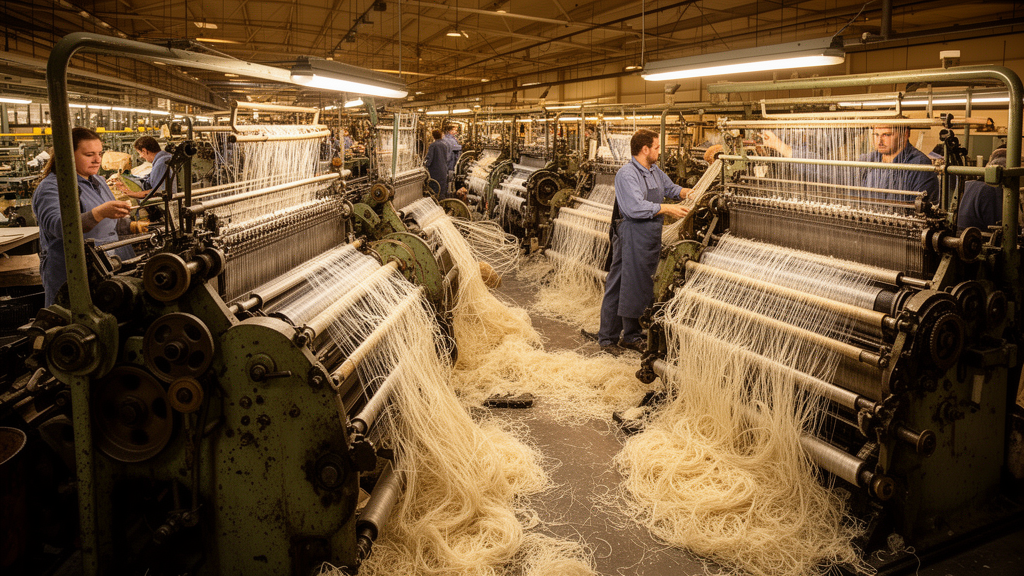
A panel analysis of 647 Indian textile firms found that technical efficiency remained persistently low across 2011–12, 2016–17 and 2020–21, with wide differences among industrial sub-sectors and little evidence of sustained improvement. The study, published in Discover Global Society, combined bootstrap data envelopment analysis with Tobit regression to examine how efficiently firms converted inputs into sales and which firm characteristics were associated with those efficiency scores. The results indicate that managerial practices, underused labour and capital, and limited technology adoption were more prominent sources of inefficiency than operating scale alone.
The researchers built a balanced firm-level panel from the CMIE Prowess database. Companies with incomplete financial information were removed, leaving 647 textile businesses observed in all three selected years. The sample covered 11 National Industrial Classification sub-sectors and included market leaders as well as companies described as struggling in the market. The three observation years were spaced across a decade to capture changes in the sector’s efficiency. The design does not represent every year in that interval, and the absence of informal producers means the findings apply to the formal firms included in the database rather than to the entire Indian textile industry. Regional effects were also not assessed because regional data were unavailable.
Technical efficiency was estimated with input-oriented Charnes, Cooper and Rhodes DEA under constant returns to scale and Banker, Charnes and Cooper DEA under variable returns to scale. The constant-returns model produced overall technical-efficiency scores, while the variable-returns model separated pure technical efficiency from scale efficiency. In this framework, a score of one denotes a firm on the estimated efficient frontier. A firm with a pure technical-efficiency score of one but an overall score below one was classified as locally efficient, indicating that its apparent shortfall was associated with scale rather than management of the input-output mix. DEA estimates a piecewise production frontier from observed input-output data without imposing a specific functional form on the technology.
All three years of observations were placed against one global frontier rather than separate annual frontiers. This common-reference approach was intended to make changes over time comparable, because conventional year-by-year DEA estimates can combine changes in a firm’s performance with shifts in the technology frontier itself. The analysis used three inputs: raw materials, labour and gross fixed assets converted into a capital-stock measure. Monetary values were deflated using relevant wholesale-price indices for net sales and raw materials and a national capital-stock deflator. Net sales served as the output variable. The sample of 647 firms was large relative to the number of inputs and outputs, reducing, though not eliminating, the possibility that the estimated frontier would be distorted by a small number of observations.
The bootstrap procedure produced both original and bias-corrected DEA estimates. According to the study’s test, the calculated bias measure was below one in each selected year for overall and pure technical efficiency, so the authors ruled out the bias-corrected estimates and interpreted the original CCR and BCC results. The descriptive results showed mean pure technical-efficiency scores of only 0.115 to 0.129 across the three periods, a very large distance from the frontier. Mean scale-efficiency scores were much higher, around 0.75 in the earlier observations and 0.723 in 2020–21. The smaller change in scale efficiency, contrasted with the persistently very low pure technical efficiency, points toward shortcomings in how firms used resources rather than a simple mismatch in production scale. The study’s interpretation is that weak managerial practices, inadequate input utilization and limited technology adoption were central contributors to the observed inefficiency, although the analysis did not directly measure each management practice or technology adoption.
Distributions by enterprise size showed no convincing upward shift over the decade. Large, medium, micro and small firms were all heavily concentrated in the lowest technical-efficiency range, and few firms approached a perfect-efficiency score. The authors suggested that large organizations may face bureaucratic complexity, regulatory burdens or difficulty in using their capacities fully, whereas smaller enterprises may be constrained by limited access to capital and technology. These interpretations remain plausible explanations rather than effects demonstrated by the statistical design, which measured associations among firms rather than experimentally assigning constraints or management practices. The analysis also found technical and scale inefficiencies across all enterprise sizes, indicating that size alone did not guarantee efficient performance.
Sub-sector results were similarly uneven. Manufacture of made-up textile articles other than apparel, wearing apparel other than fur apparel, and knitted and crocheted apparel performed better than many categories. Around 12% to 13% of firms manufacturing carpets and rugs registered scores above 0.9 in the earlier analysis, although that group’s efficiency range declined in 2020–21. Cordage, rope, twine and netting, knitted and crocheted fabrics, man-made fibres and other textiles were among the weaker or stagnant categories. The authors associated many 2020–21 declines with the effects of COVID-19, but the panel includes only one observation from that period and therefore cannot separate pandemic effects from other concurrent changes in demand, operations or the wider economy. The results also indicated that efficiency was not uniformly distributed within sub-sectors, with substantial variation among firms in the same classification.
DEA slack analysis identified resources that could theoretically be reduced without changing output. Excess labour slack appeared in about 39% of firms, with the tendency toward labour abundance increasing alongside actual workforce size. Capital-stock slack was more widespread, appearing in approximately 68% of firms and indicating substantial underuse of physical capacity in much of the sample. Most inefficiency was described as radial, meaning inputs could be reduced proportionately to reach the frontier, although a distinct subset showed a non-optimal input mix. These are model-based slack measurements rather than direct observations of unemployed machinery or idle workers, and their interpretation depends on the estimated production frontier and the quality of the reported inputs. The results therefore identify potential input-reduction opportunities within the model rather than directly documenting how much capacity could be removed in practice.
In the second stage, Tobit regression modeled the bounded efficiency scores, with zero and one representing the limits, while ordinary least squares served as a robustness check. Relative to the reference category of preparation and spinning of textile fibres, seven industrial classifications had significantly higher efficiency estimates: weaving of textiles, knitted and crocheted fabrics, carpets and rugs, other textiles, wearing apparel, knitted and crocheted apparel, and man-made fibres. Carpets and rugs had the largest positive industry effect. Firm size and the capital-to-labour ratio were also positively and significantly associated with efficiency, whereas firm age, ownership type and year effects were statistically insignificant. Coefficient signs, magnitudes and significance were broadly consistent between Tobit and OLS, and all variance inflation factors were below five. The analysis also used the common-frontier DEA estimates to examine how input-oriented efficiency related to slack in labour and capital, rather than treating slack as a direct measure of unobserved managerial quality.
Overall, the analysis points to industry characteristics, firm size and capital intensity as the clearest correlates of technical efficiency, rather than organizational maturity or public-versus-private status. The authors interpret the results as support for better management, workforce training, digital manufacturing, process automation and more productive use of installed capital. They also call for improved quality control, stronger marketing, support for small and medium-sized enterprises, domestic production of man-made fibres, research into high-value textile products, and streamlined regulation. These are policy implications derived from the observed efficiency gaps, not measured outcomes from a policy trial. The study’s main limitations are its exclusion of the large informal textile sector, lack of regional variables, dependence on three annual snapshots and reliance on secondary company data. The researchers note that future work should examine performance after the COVID-19 pandemic and the effects of major policy changes, including simplified GST filing, reduced textile-industry rates and the production-linked incentive scheme launched in 2017. Until such evidence is available, the results describe persistent measured gaps in the formal firms studied rather than demonstrating how a particular policy or managerial change will affect the industry.
Subject of Research: Firm-level technical efficiency and its determinants in India’s textile industry, 2011–12 to 2020–21.
Article Title: Efficiency and its determinants in India’s textile firms using two stage bootstrap DEA and tobit model
Article References: Pawar, S., & Sunny, D. (2026). Efficiency and its determinants in India’s textile firms using two stage bootstrap DEA and tobit model. Discover Global Society, 4(1), Article 280. https://doi.org/10.1007/s44282-026-00616-y
Image Credits: AI Generated
DOI: 10.1007/s44282-026-00616-y
Keywords: Indian textiles, technical efficiency, data envelopment analysis, bootstrap DEA, Tobit regression, capital intensity, labour slack, firm productivity, industrial classification, input utilization, Efficiency, determinants
Cite Scienmag News
Courtney Benton. (October 20, 2026). Indian textile firms show persistent technical inefficiency across a decade. Scienmag. https://scienmag.com/indian-textile-firms-show-persistent-technical-inefficiency-across-a-decade/
Courtney Benton. "Indian textile firms show persistent technical inefficiency across a decade." Scienmag, 20 October 2026, https://scienmag.com/indian-textile-firms-show-persistent-technical-inefficiency-across-a-decade/. Accessed 20 October 2026.
Courtney Benton. "Indian textile firms show persistent technical inefficiency across a decade." Scienmag. October 20, 2026. https://scienmag.com/indian-textile-firms-show-persistent-technical-inefficiency-across-a-decade/


