


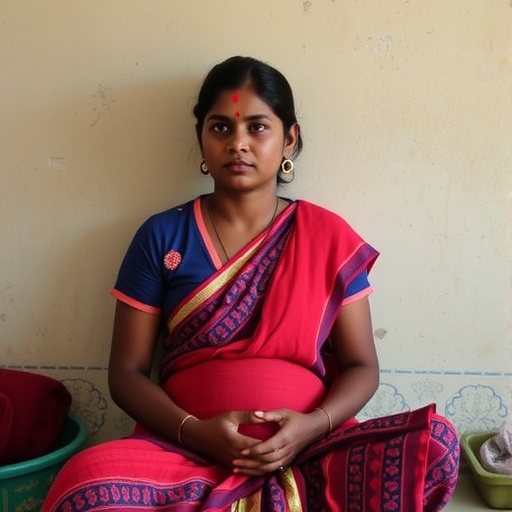
In recent decades, a subtle yet significant shift has been observed in the physiological development of Indian adolescents: the onset of menarche, or the first menstrual period, is occurring at an increasingly earlier age compared to data from a quarter-century ago. This trend, documented in a comprehensive new study published in PLOS Global Public Health, unveils a complex interplay of environmental and demographic factors influencing biological maturation in a population undergoing rapid social transformation. The findings challenge simplistic narratives and point toward multifactorial causes, including improved educational attainment and possibly even the subtle, pervasive impacts of climate change.
Menarche, a critical milestone in female pubertal development, has long been regarded as a sensitive bioindicator reflective not only of genetic predispositions but also environmental exposures, nutritional status, and socioeconomic variables. Tracking its timing provides insights into broader health patterns and can forecast future reproductive health trajectories and risks for non-communicable diseases. The recent research conducted by scholars from Bangladesh leverages longitudinal demographic and environmental data to analyze shifts in age at menarche across diverse Indian cohorts, representing a landmark effort in public health physiology.
One of the pivotal findings of the study is that improvements in education levels correlate strongly with earlier menarche. Enhanced female education often accompanies better nutrition, increased health awareness, and timely access to healthcare resources, all factors known to influence physiological maturity. This intersection of socio-educational progression and biological development underscores the intricate synergy between social determinants and human biology, reinforcing the necessity for integrated approaches in adolescent health research.
Beyond education, the study contemplates environmental changes — particularly burgeoning evidence that climate variability, including temperature fluctuations and altered precipitation patterns, may exert subtle pressures on endocrine function and growth rates. Although the mechanisms remain speculative, the hypothesis posits that environmental stressors might modulate hypothalamic-pituitary-gonadal axis activity, which regulates pubertal timing. Given the accelerating pace of global climate change, this avenue of inquiry allows public health experts to anticipate the potential secondary effects on adolescent development worldwide.
Additionally, demographic transitions within India — such as urbanization, shifting economic structures, and changing family dynamics — are likely contributing to the observed trend. Urban living, for example, often entails different patterns of physical activity, diet, and exposure to environmental pollutants compared to rural settings, thereby influencing growth and maturation. The data suggest that these demographic shifts create diverse developmental environments, necessitating nuanced policies tailored to heterogeneous adolescent groups.
The methodological rigor of the study — encompassing repeated cross-sectional analyses over 25 years and controlling for confounders such as socioeconomic status and regional diversity — lends credence to its conclusions. This longitudinal approach surpasses previous research limited by snapshot observations, allowing the authors to capture temporal trends and generate predictive models for future menarcheal timing. Such data are invaluable for healthcare planning, educational programming, and anticipating public health challenges related to adolescent reproductive health.
One cannot overlook the broader implications of earlier menarche. Biologically, earlier puberty is associated with increased risks for conditions including breast cancer, cardiovascular diseases, and metabolic syndrome later in life. Psychosocially, younger girls experiencing menarche may face challenges related to mental health, education continuity, and exposure to early sexual activity or exploitation. Therefore, recognizing and understanding shifts in menarcheal age equips stakeholders with the foresight needed to implement protective measures spanning healthcare, social services, and community education.
Critically, this study also highlights the absence of substantial external funding, emphasizing the commitment of researchers working to fill vital knowledge gaps with limited resources. The transparency regarding conflicts of interest assures the scientific community and public that findings emerge from impartial, evidence-based inquiry, reinforcing the credibility of the work in a field sometimes complicated by extrinsic influences.
The integration of physiological metrics with environmental and demographic data sets a benchmark for future interdisciplinary research. As nations worldwide grapple with demographic changes and environmental challenges, such integrated investigations provide frameworks to anticipate shifts in human development patterns, shaped by the interwoven forces of nature and society. This study paves the way for comparably rigorous research in other low- and middle-income contexts, where data scarcity routinely limits health interventions.
Furthermore, while the research concentrates on India, its implications reverberate globally. As adolescent health is fundamental to achieving sustainable development goals, understanding the drivers of biological maturation informs international strategies in education, gender equity, and health promotion. Recognizing that menarche timing is not static but dynamically influenced by modifiable external factors opens venues for intervention, surveillance, and support structures.
In sum, the study documented in PLOS Global Public Health portrays a nuanced portrait of adolescent development evolving in sync with social progress and environmental shifts. It calls for heightened awareness and proactive engagement from policymakers, healthcare providers, educators, and communities to address and adapt to these physiological changes. The quest to understand menarche timing transcends biology, encompassing the holistic well-being of future generations navigating an increasingly complex world.
Cite Scienmag News
Russell Cooper. (September 17, 2025). Indian Adolescents Begin Menstruation at Younger Ages Compared to 25 Years Ago. Scienmag. https://scienmag.com/indian-adolescents-begin-menstruation-at-younger-ages-compared-to-25-years-ago/
Russell Cooper. "Indian Adolescents Begin Menstruation at Younger Ages Compared to 25 Years Ago." Scienmag, 17 September 2025, https://scienmag.com/indian-adolescents-begin-menstruation-at-younger-ages-compared-to-25-years-ago/. Accessed 3 September 2026.
Russell Cooper. "Indian Adolescents Begin Menstruation at Younger Ages Compared to 25 Years Ago." Scienmag. September 17, 2025. https://scienmag.com/indian-adolescents-begin-menstruation-at-younger-ages-compared-to-25-years-ago/


